The short answer
Weigh yourself first thing in the morning, after using the toilet and before you eat or drink, in the same clothes (or none), on the same scale.
Cleveland Clinic recommends the morning because the previous day’s food and drink have had time to digest. NHS England gives the same advice: weigh at a consistent time, preferably in the morning.
The time of day matters less than doing it the same way each time, so one reading can be compared with the next.
A consistent weigh-in, step by step
| What | How |
|---|---|
| Time | First thing in the morning, at about the same time each day you weigh. |
| Bathroom | After using the toilet. |
| Food and drink | Before breakfast and before drinking anything. |
| Clothing | As little as possible, or the same items every time. No shoes. |
| Scale | The same scale, on a hard, level floor. Not on carpet. |
| Posture | Both feet on the scale, weight even, standing still until the number settles. |
These steps come from Cleveland Clinic and NHS England guidance.
Setting up the scale
Where the scale sits matters more than people expect. Cleveland Clinic advises placing it flat on a hard floor, and warns that a tilted scale or one on carpet can give an inaccurate reading. Find a spot on tile or wood, leave the scale there, and use the same scale each time, so every reading is measured the same way.
Which scale you use matters too. University Hospitals notes that digital bathroom scales are typically more precise and consistent than older mechanical ones (University Hospitals, 2026). Nick Fuller of the University of Sydney suggests replacing the batteries regularly and checking the scale against something of known weight, such as a 10 kg weight plate (The Conversation, 2024). If your scale also shows body fat, treat that figure as a rough estimate. University Hospitals says smart scale body composition readings should be viewed only as approximate.
Morning vs evening: a worked example
Here is one sample day. The same person steps on the same scale at 07:10 and again at 21:30.
The evening reading is 0.9 kg higher, about 2.0 lb. In this example, nothing about the person’s body fat changed between breakfast and bedtime. Cleveland Clinic puts the average daily fluctuation at about 5 to 6 pounds, or 2 to 3 pounds in either direction, and this day sits inside that.
The trouble starts when readings are mixed. Compare this evening’s 79.3 kg with last week’s morning reading, and you could think you gained 0.9 kg in a week. Weigh at the same time and that false gain disappears.
The worst times to weigh yourself
A reading at these times is not wrong, but it is hard to compare with your usual morning number.
| When | Why it misleads |
|---|---|
| In the evening | The day’s food and drink are still in your system. Cleveland Clinic recommends the morning because the previous day has had time to digest. |
| After a big meal or a few drinks | Everything you eat or drink adds a little weight while it passes through, and Cleveland Clinic lists salty or carbohydrate-heavy meals and alcohol among the things that make you hold water. |
| After a hard or new workout | Cleveland Clinic notes that exercise, strength training in particular, can cause short-term weight gain, so a higher reading in the days after is unlikely to be fat. |
| Around the first day of a period | In a year-long study of 62 women, self-reported fluid retention peaked on the first day of flow and was lowest in the middle of the first half of the cycle. |
Other things shift the number overnight too, even with a perfect routine: travel and changes in routine, constipation, and starting a new exercise plan. These are rarely a change in body fat. The weight fluctuation guide covers how big these swings get, the water weight guide explains the salt, carbohydrate, and period effects, and weight gain after exercise covers a new exercise plan.
What if you can’t weigh in the morning?
Shift work, early starts, or a scale in someone else’s bathroom can make mornings impossible. That is fine. Cleveland Clinic’s main rule is consistency: if you weigh daily, weigh at the same time each day, so readings are comparable.
- Pick one time you can keep. Before dinner, or before bed, every day you weigh.
- Keep the other conditions the same. Same scale, same clothes, after the toilet, and not straight after a meal or a workout.
- Compare like with like. An evening routine runs higher than a morning one. Compare your evening readings with each other, and do not mix in the odd morning reading.
- Change your time on purpose, not by accident. If you move from evenings to mornings, expect a step down in the numbers that is not real loss.
Which day of the week to weigh
If you weigh once a week, pick one day and keep it. Weekends tend to look different from weekdays: in a European study that used smart scales, weight rose slightly over weekends and came back down during the week (Turicchi and colleagues, 2020).
Cleveland Clinic’s dietitian suggests Friday as a good weekly weigh-in, because it reflects a full week of routine, while others prefer a midweek day such as Wednesday. Monday tends to read highest if your weekends are very different from your weekdays.
How often to weigh
That depends on you. Health guidance ranges from daily to monthly, and consistency matters more than frequency. The how often to weigh yourself guide covers the research and the possible downsides.
Whichever rhythm you choose, read the direction over weeks. If the weekly number stops moving for a month, the weight loss plateau guide and why am I not losing weight? help you check what is going on. To see how far you have come, try the weight loss percentage calculator.
Logging at the same time each morning
- Set a reminder for your weigh-in time. One optional daily reminder, which skips any day you have already logged.
- Keep your routine number as the day’s value. If you sometimes weigh again later, the daily value set to First keeps your morning reading. If your routine weigh-in is before bed, Latest keeps that one instead. See first, latest, or average.
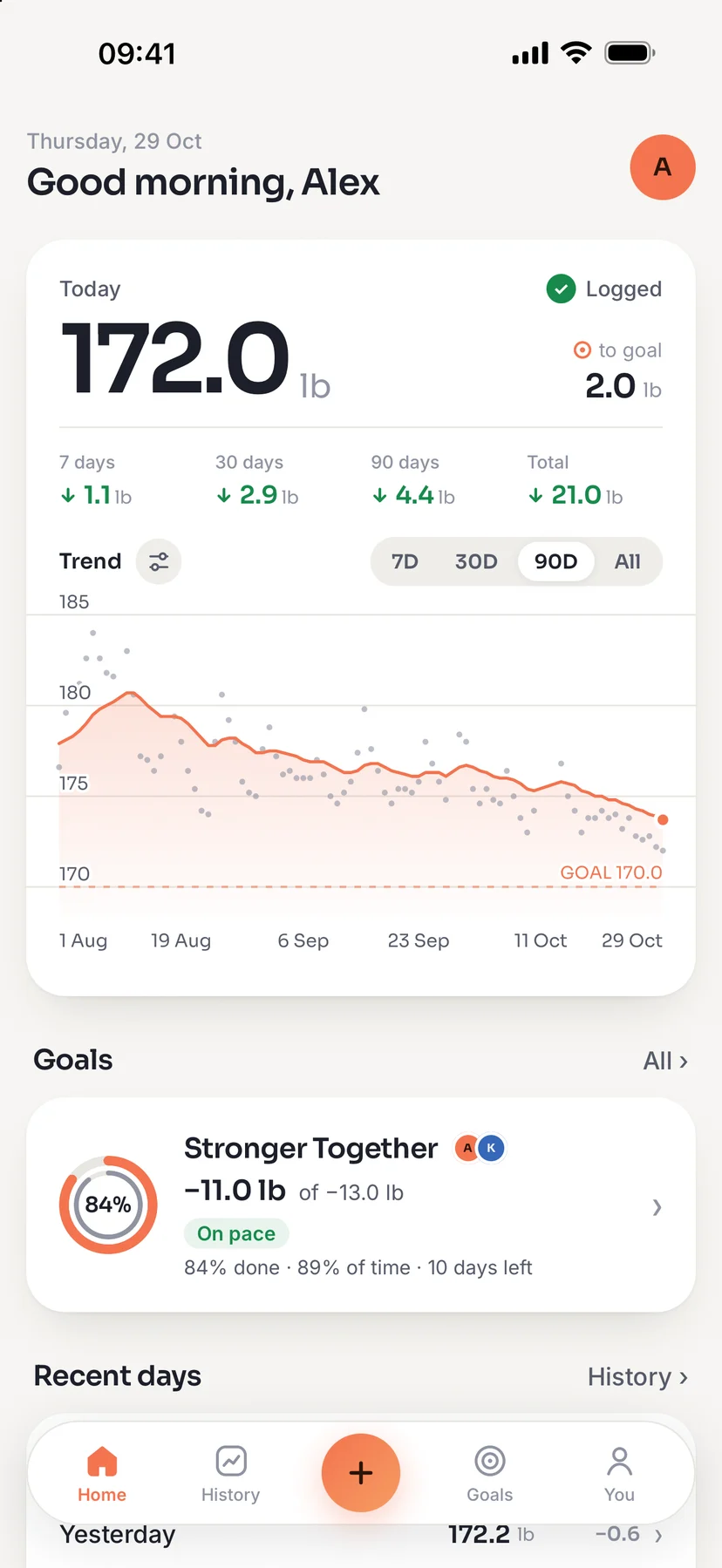
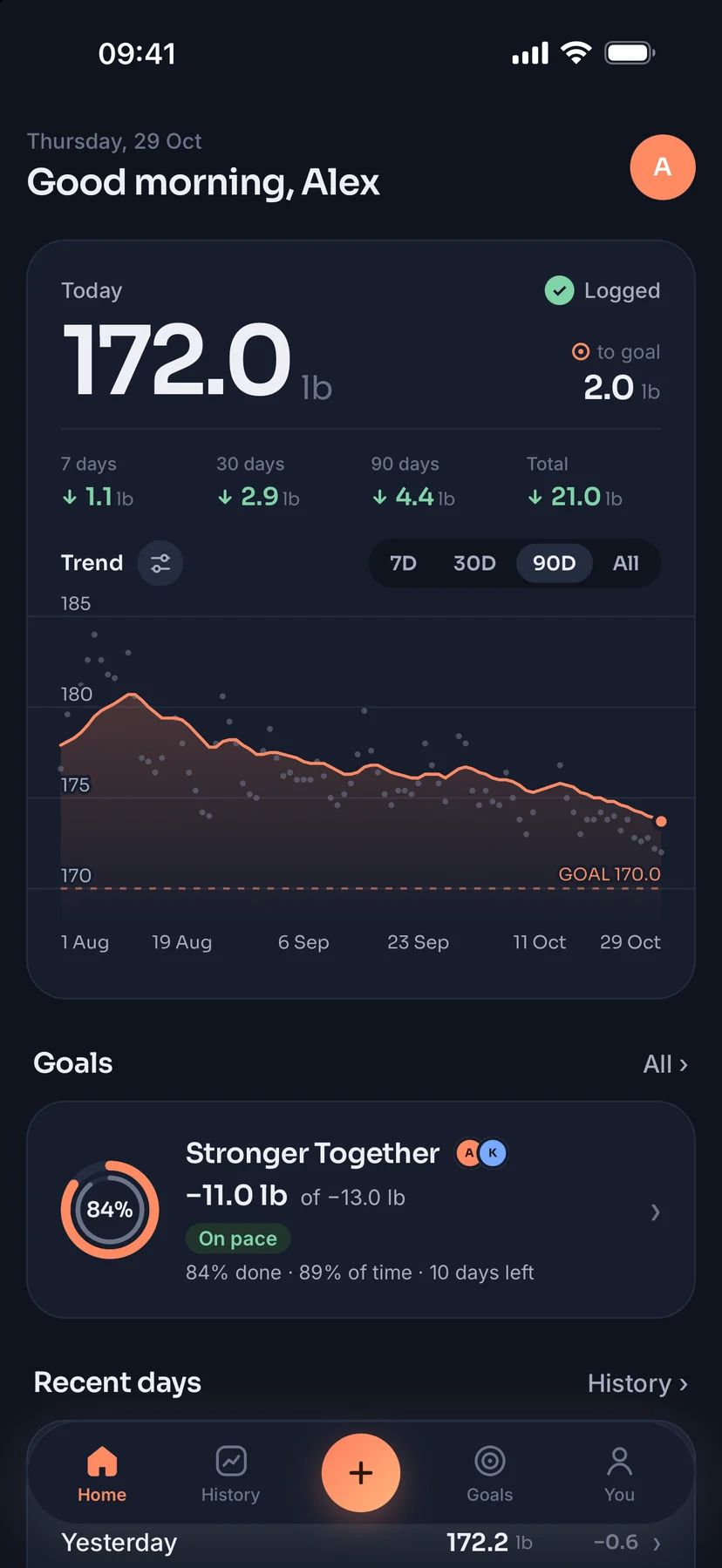
- Read the trend, not the morning. Your trend chart shows the direction over weeks.
- Use the scale you already have. If your smart scale saves weights to Apple Health, Weight Tracker can import them. The import is read-only, so nothing is written back to Health.
Questions
Is it better to weigh yourself in the morning or at night?
The morning, after using the toilet and before eating or drinking. By then the previous day’s food and drink have been digested, so the reading is easier to compare from one day to the next.
Why do I weigh more at night than in the morning?
Food and drink from the day are still in your system. In our sample day, the evening reading is 0.9 kg (about 2.0 lb) above the morning one, which is within the normal daily swing.
Should I weigh myself on my period?
You can. Many people report feeling the most fluid retention on the first day of flow, and a study that weighed women found weight slightly higher during their periods, so compare weekly averages or the same point in each cycle rather than single days.
Should I weigh myself before or after a workout?
Before, as part of your usual morning weigh-in. Straight after a session you weigh less from the fluid lost in sweat, so that reading is hard to compare with the others.
What if I can’t weigh myself in the morning?
Pick a time you can keep and weigh at that time every day, under the same conditions. Compare those readings with each other, not with morning readings.
What is the best day of the week to weigh yourself?
Any day you can keep. Cleveland Clinic’s dietitian suggests Friday, after a week of routine, and some people prefer Wednesday. Monday can run high if your weekends are different from your weekdays.
Should I weigh myself before or after going to the toilet?
After. Cleveland Clinic and NHS Tayside both include it in the morning routine, and it keeps one more thing the same each day.
Should I weigh myself naked?
If you can, or in the same light clothes every time. Cleveland Clinic advises wearing as little as possible, or at least the same items each time.
Sources
Show all 8 sourcesHide sources
- Cleveland Clinic. The best time to weigh yourself (and how often you should step on the scale). 12 June 2023.
- Cleveland Clinic. 7 possible reasons why your weight fluctuates. 26 July 2024.
- NHS England. How to record your weight. 1 December 2023.
- NHS Tayside. Weighing yourself. No date given.
- University Hospitals. How often should you weigh yourself? October 2026.
- Fuller N. How often should you really weigh yourself? The Conversation, 1 July 2024.
- White CP, Hitchcock CL, Vigna YM, Prior JC. Fluid retention over the menstrual cycle: 1-year data from the Prospective Ovulation Cohort. Obstet Gynecol Int 2011;2011:138451. PMC3154522.
- Turicchi J, et al. Weekly, seasonal and holiday body weight fluctuation patterns among individuals engaged in a European multi-centre behavioural weight loss maintenance intervention. PLoS One 2020;15(4):e0232152. doi:10.1371/journal.pone.0232152.
This guide is general information, not medical advice.