Weight Tracker for iPhone
Keep an eye on your weight trend.
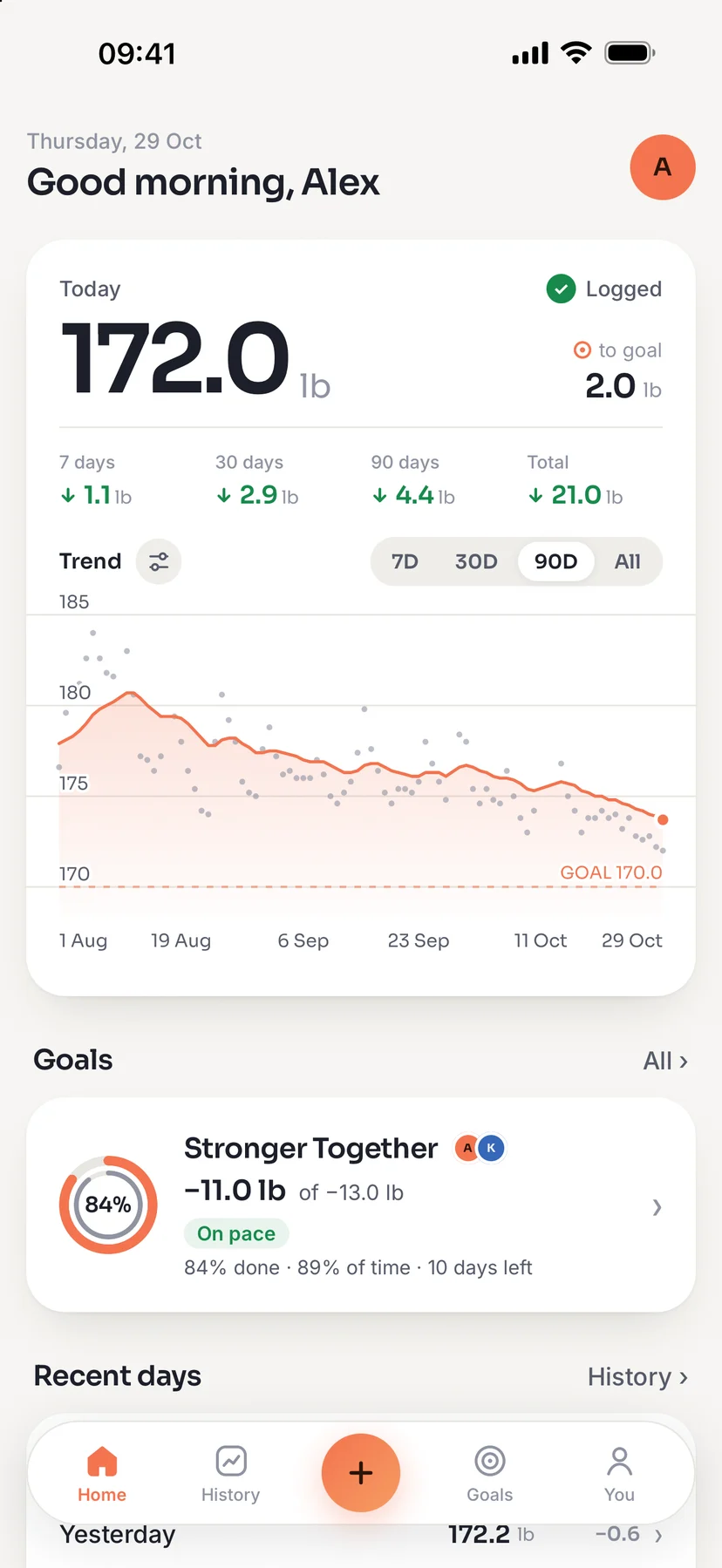
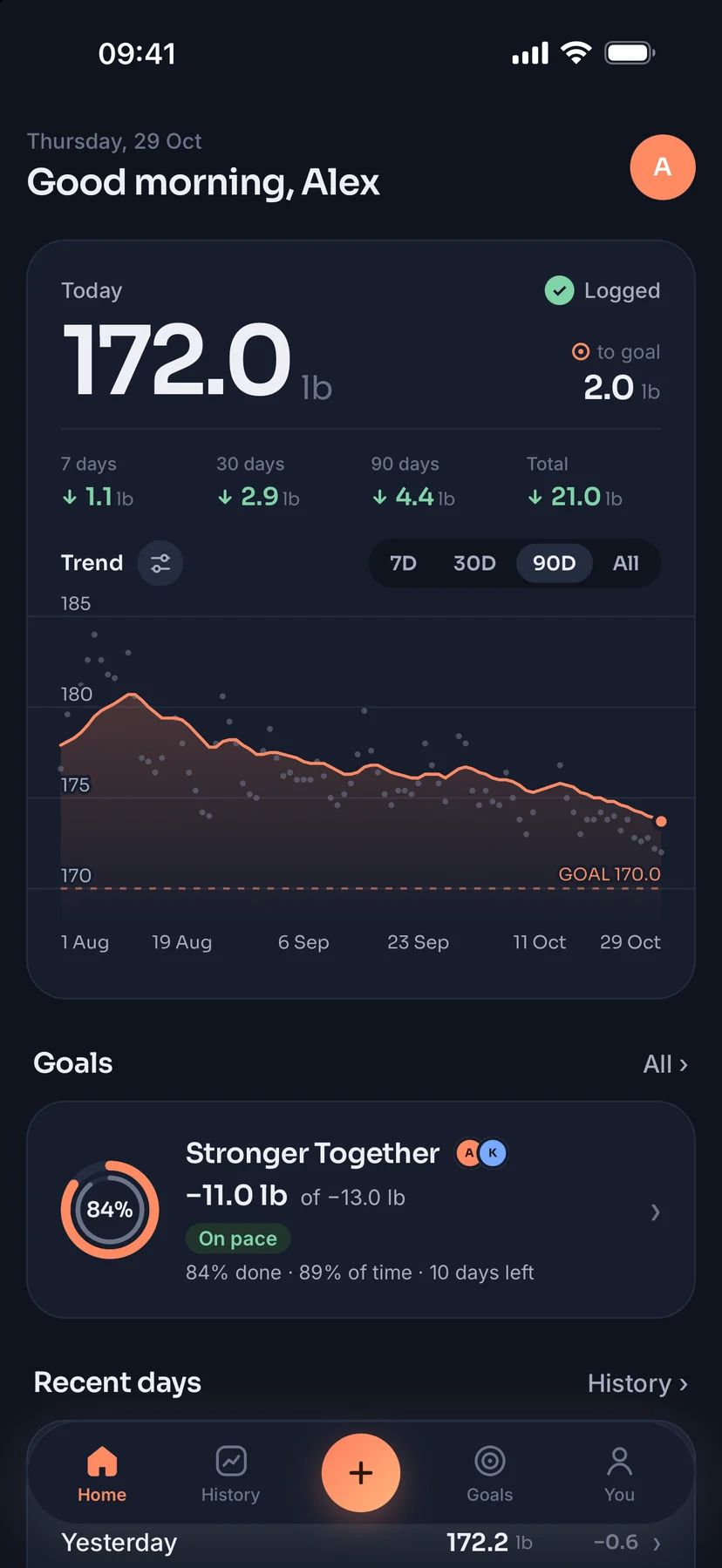
Weight Tracker logs your weight, not your waist. Measure here every few weeks, and let the app show your weight trend in between.
A quick check of weight around the middle. Measure your waist, enter your height, and see where you sit and the waist size at half your height.
Printed from https://weightracker.app/tools/waist-to-height-ratio-calculator/. For general information, not medical advice.
Before you start
0.4 to 0.49ratio
No increased health risks from weight around the middle.
At 175 cm, a waist of 70 to 87.4 cm
0.5 to 0.59ratio
Increased health risks, such as type 2 diabetes and heart disease.
At 175 cm, a waist of 87.5 to 104.9 cm
0.6 or moreratio
Further increased health risks. A doctor can talk through what would help.
At 175 cm, a waist of 105 cm or more
| Height | Healthy | Increased from | High from |
|---|---|---|---|
| 5 ft 0 in | 24 to 29.9 | 30 | 36 |
| 5 ft 2 in | 24.8 to 30.9 | 31 | 37.2 |
| 5 ft 4 in | 25.6 to 31.9 | 32 | 38.4 |
| 5 ft 6 in | 26.4 to 32.9 | 33 | 39.6 |
| 5 ft 8 in | 27.2 to 33.9 | 34 | 40.8 |
| 5 ft 10 in | 28 to 34.9 | 35 | 42 |
| 6 ft 0 in | 28.8 to 35.9 | 36 | 43.2 |
| 6 ft 2 in | 29.6 to 36.9 | 37 | 44.4 |
| 6 ft 4 in | 30.4 to 37.9 | 38 | 45.6 |
| Height | Healthy | Increased from | High from |
|---|---|---|---|
| 150 cm | 60 to 74.9 | 75 | 90 |
| 155 cm | 62 to 77.4 | 77.5 | 93 |
| 160 cm | 64 to 79.9 | 80 | 96 |
| 165 cm | 66 to 82.4 | 82.5 | 99 |
| 170 cm | 68 to 84.9 | 85 | 102 |
| 175 cm | 70 to 87.4 | 87.5 | 105 |
| 180 cm | 72 to 89.9 | 90 | 108 |
| 185 cm | 74 to 92.4 | 92.5 | 111 |
| 190 cm | 76 to 94.9 | 95 | 114 |
Healthy is a ratio of 0.4 to 0.49, increased risk starts at 0.5, and high risk at 0.6. Put in your own height above for exact sizes.
NICE uses these classes for adults with a BMI under 35, of both sexes and all ethnicities, including people with a lot of muscle. It recommends them alongside BMI. For the weight side, see the healthy weight for your height.
These classes are for adults. The NHS says its version is not suitable for adults with a BMI over 35, during pregnancy, with a diagnosed or suspected eating disorder, or with a condition that affects height (NHS).
How it works
Use the same unit for both. A ratio under 0.5 means your waist is less than half your height.
Your ratio
Waist over height. In inches, 32 divided by 69 gives the same 0.46.
Half your height
A waist below it gives a ratio under 0.5.
Waist-to-hip ratio
Waist over hips. At the WHO cut-off for women, below the one for men.
A second ratio
Waist-to-hip ratio compares your waist with your hips instead of your height. A WHO expert consultation lists 0.90 or more in men, or 0.85 or more in women, as a substantially increased risk of metabolic complications.
Measure your hips around the widest part of your bottom with the tape level, and your waist the same way as for the waist-to-height ratio. Use the same unit for both. The calculator above works it out when you add your hips.
Unlike the waist-to-height ratio, the WHO cut-offs differ by sex, so choose the one that applies to you.
Worked example
The same measurements can sit on different sides of the line for men and women.
The bigger picture
Your waist shows where weight sits. BMI compares your weight with your height, and your weight trend shows which way things are moving.
BMI compares your weight with your height. NICE recommends using it alongside your waist-to-height ratio for adults with a BMI under 35.
The scale shows day-to-day changes that a tape measure cannot. A trend over a few weeks says more than any single reading.
If you decide to lose some weight, the planner shows when you could reach a goal at a gradual, steady pace.
Good to know
For general information, not medical advice. A doctor can help you choose goals that are right for you.
NICE classes 0.4 to 0.49 as healthy, 0.5 to 0.59 as increased health risks, and 0.6 or more as further increased risks. NICE asks professionals to explain it as keeping your waist to less than half your height.
NICE classes a ratio of 0.4 to 0.49 as healthy, so a waist under half your height (and at least 0.4 of it). At 5 ft 4 in (64 in) that means a waist under 32 in, and at 5 ft 10 in (70 in) under 35 in. In centimetres, at 165 cm it is under 82.5 cm, and at 180 cm under 90 cm.
Find the bottom of your ribs and the top of your hips. Measure around your middle halfway between them, which is usually just above the belly button, after breathing out normally.
Yes. NICE says the same classes apply to both sexes and all ethnicities, including adults with a lot of muscle.
NICE recommends using both: waist-to-height ratio alongside BMI for people with a BMI under 35, because it shows weight around the middle that BMI can miss.
Older guidance uses fixed sizes. The cut-offs often attributed to the WHO, listed in its expert consultation report, are a waist over 94 cm (about 37 in) in men or 80 cm (about 31.5 in) in women as increased risk, and over 102 cm (about 40 in) or 88 cm (about 34.5 in) as substantially increased; the report notes these were developed mainly in European populations. NICE now uses the waist-to-height ratio, which it says offers a truer estimate of fat around the middle.
A WHO expert consultation lists a waist-to-hip ratio of 0.90 or more in men, or 0.85 or more in women, as a substantially increased risk of metabolic complications. Measure your hips around the widest part of your bottom with the tape level, and enter both in the same unit.
Yes. The calculator runs in your browser and does not send your numbers to us. A share link keeps them after the # in the address, a part browsers do not send to the website.
Weight Tracker for iPhone
Weight Tracker logs your weight, not your waist. Measure here every few weeks, and let the app show your weight trend in between.