Weight Tracker for iPhone
Skip the sums. Keep the trend.
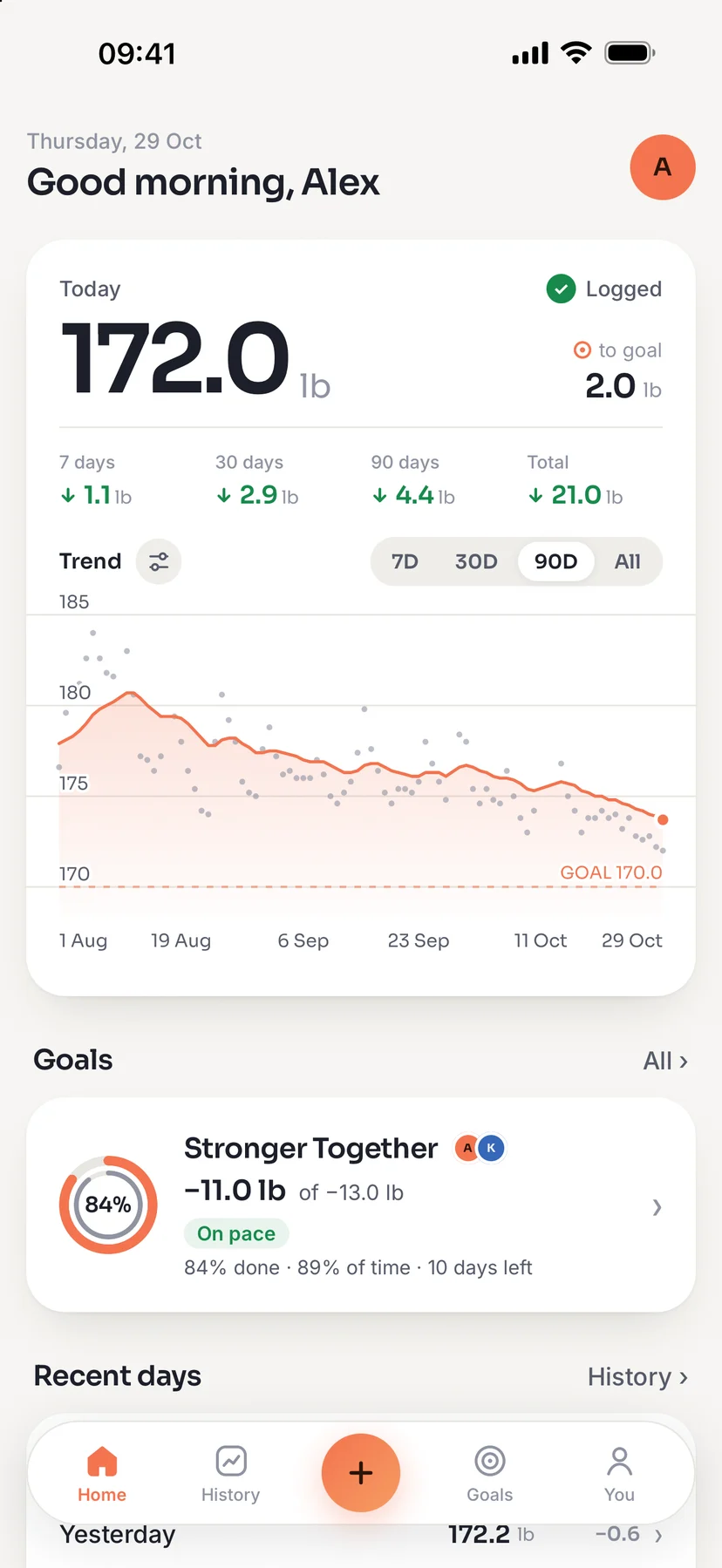
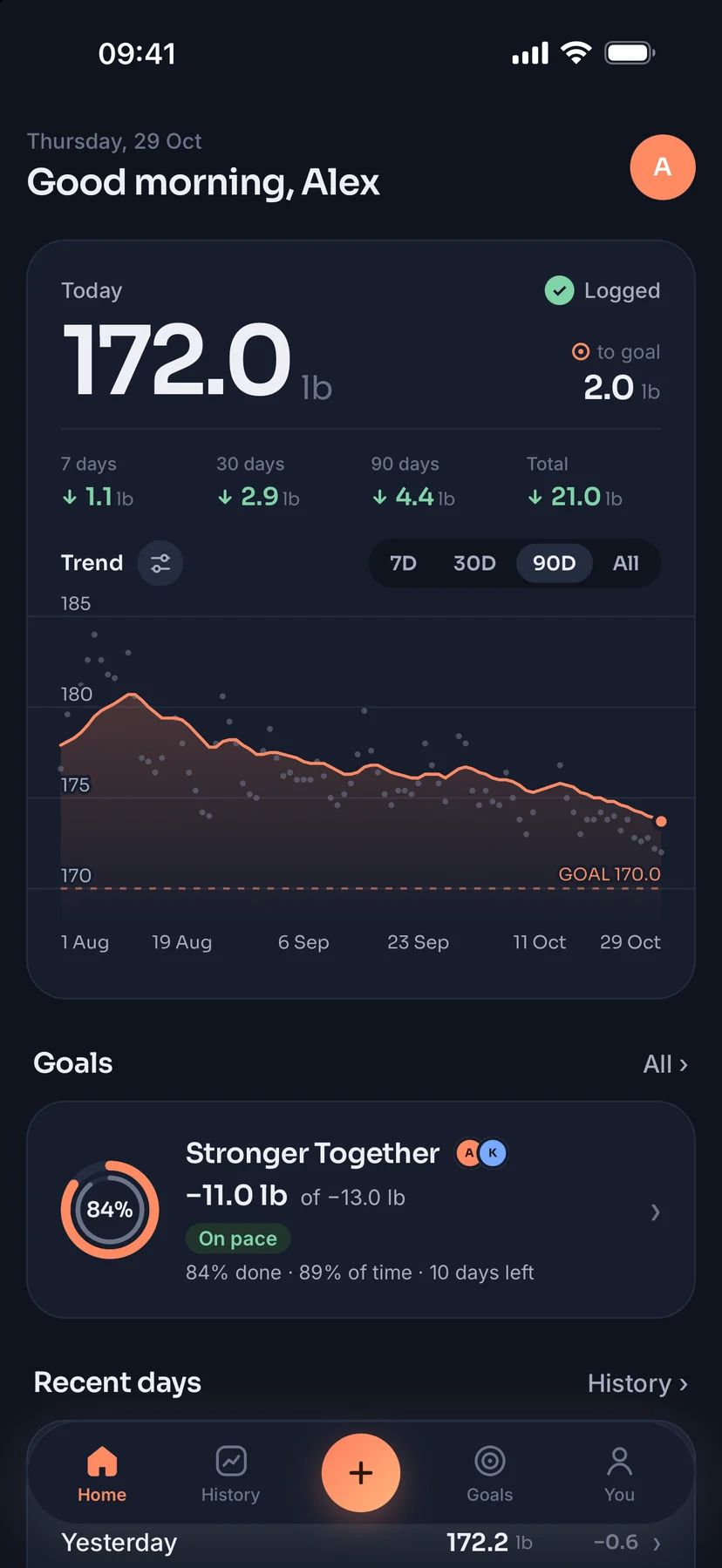
Weight Tracker does the averaging and draws the chart as you log, and it never runs out of rows. Free, with no calorie counting.
Print it, weigh in each morning, and write the number down. Once a week, average your weigh-ins, so one salty dinner or heavy morning does not throw you.
Free, with no sign-up and no email address.
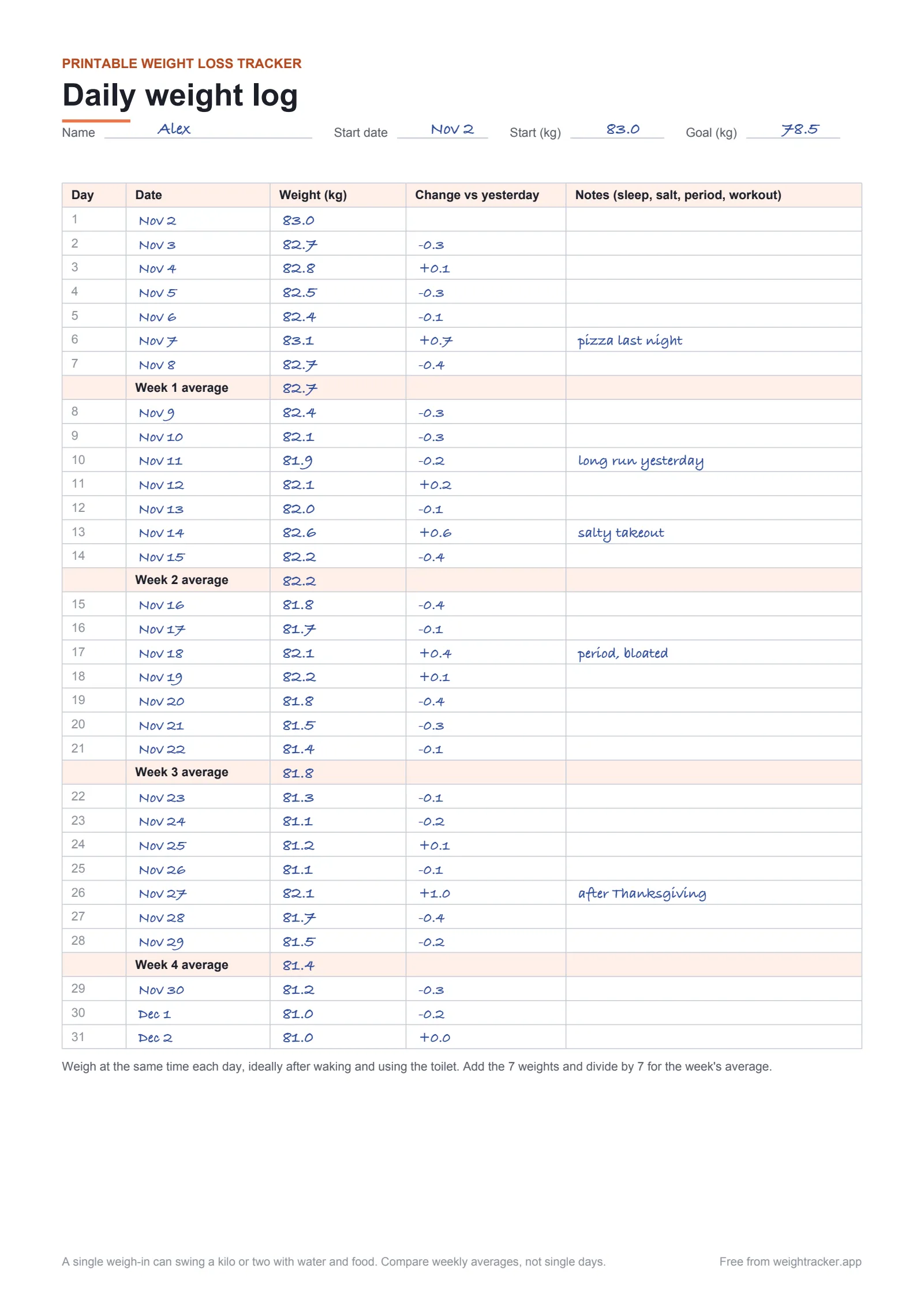
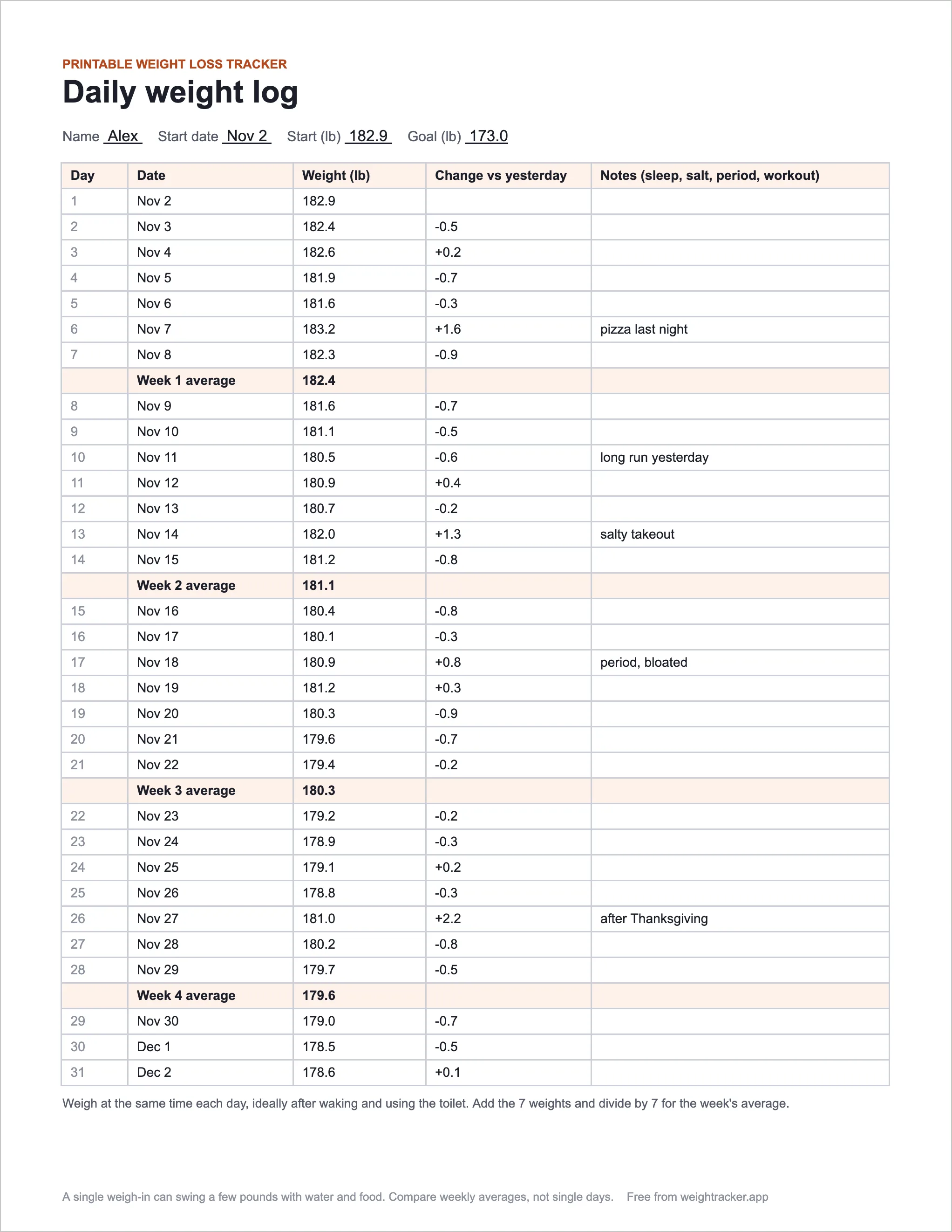
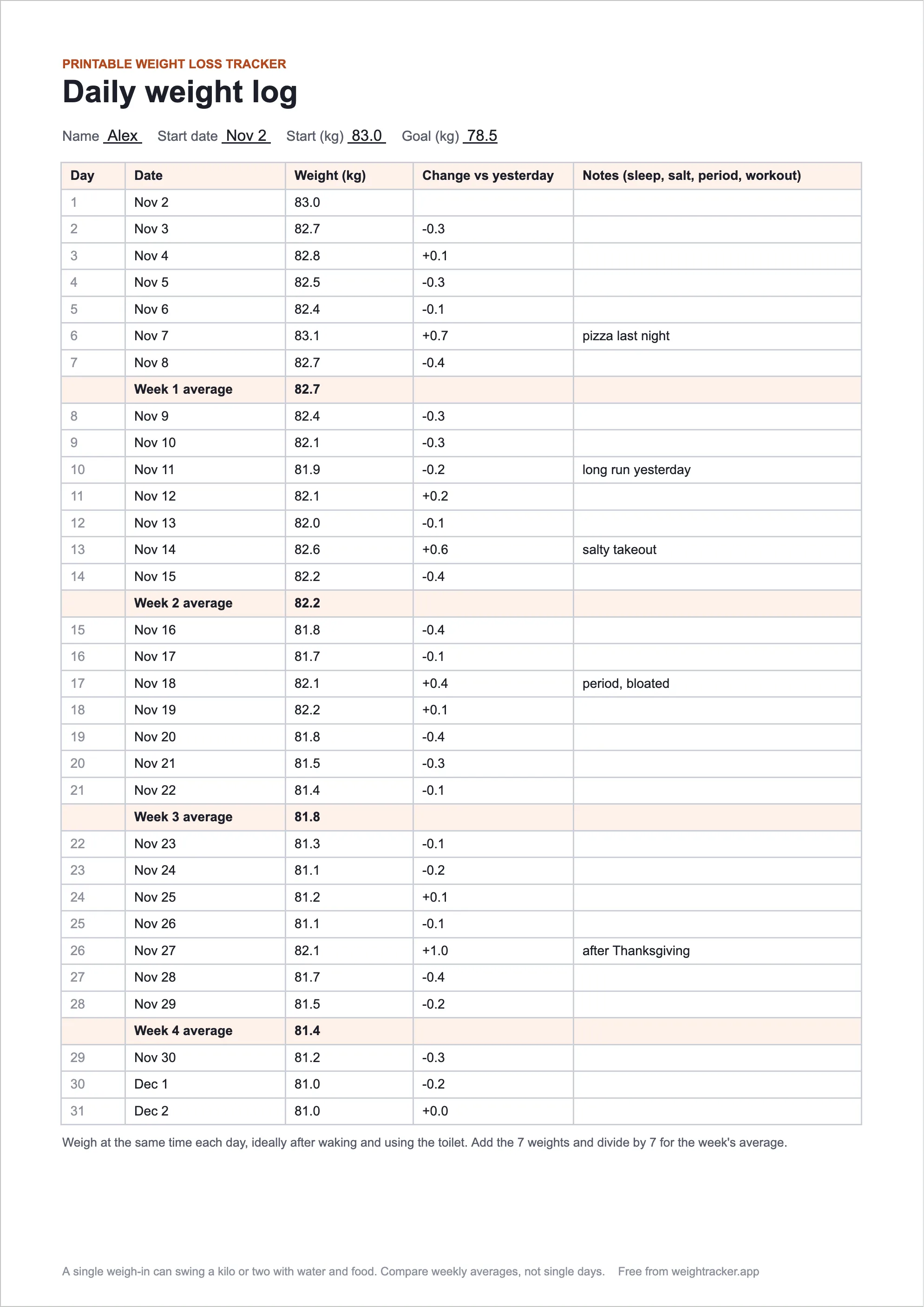
What is in the tracker
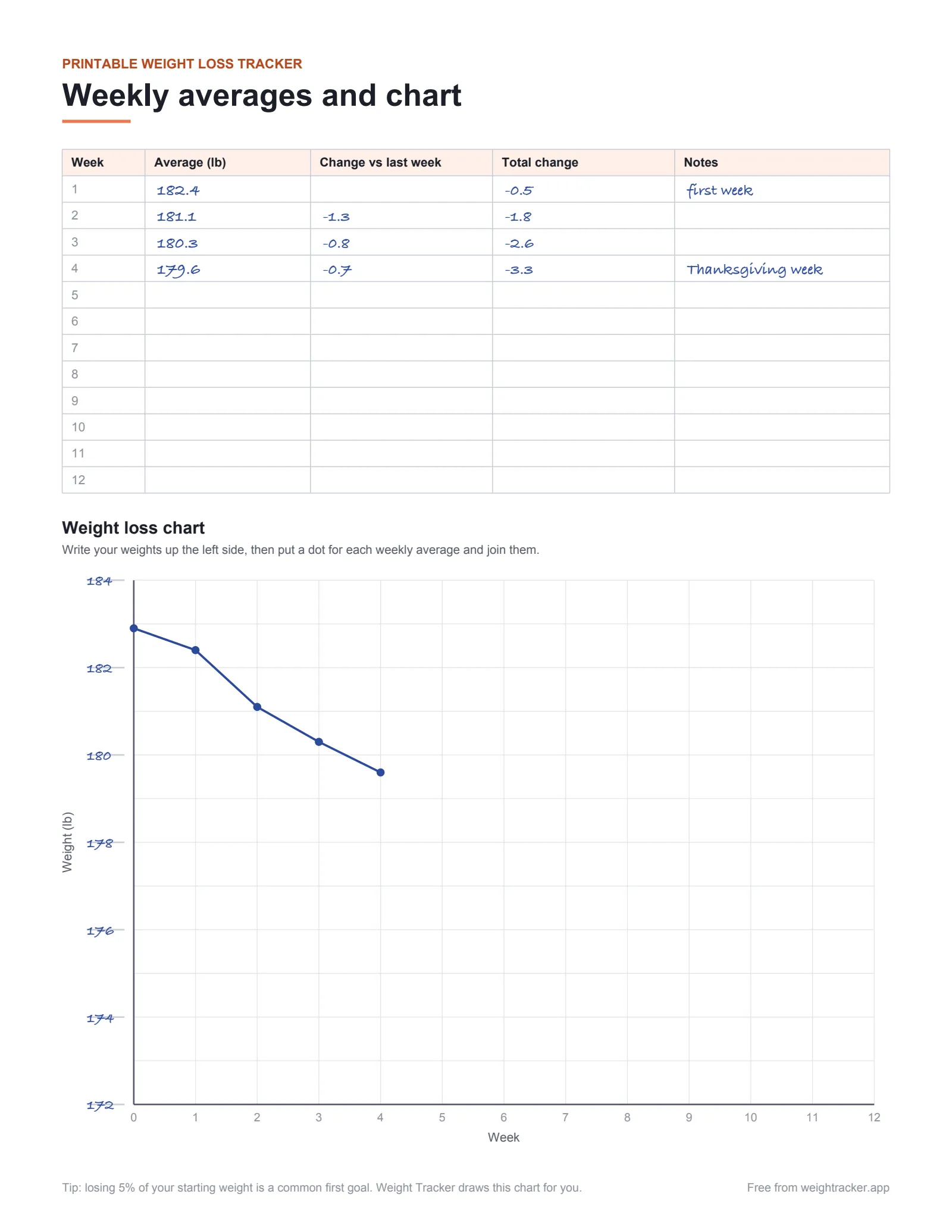
How to use it
Pin page 1 near the scale and keep a pen with it. Page 2 is for Sunday evening.
Worked example
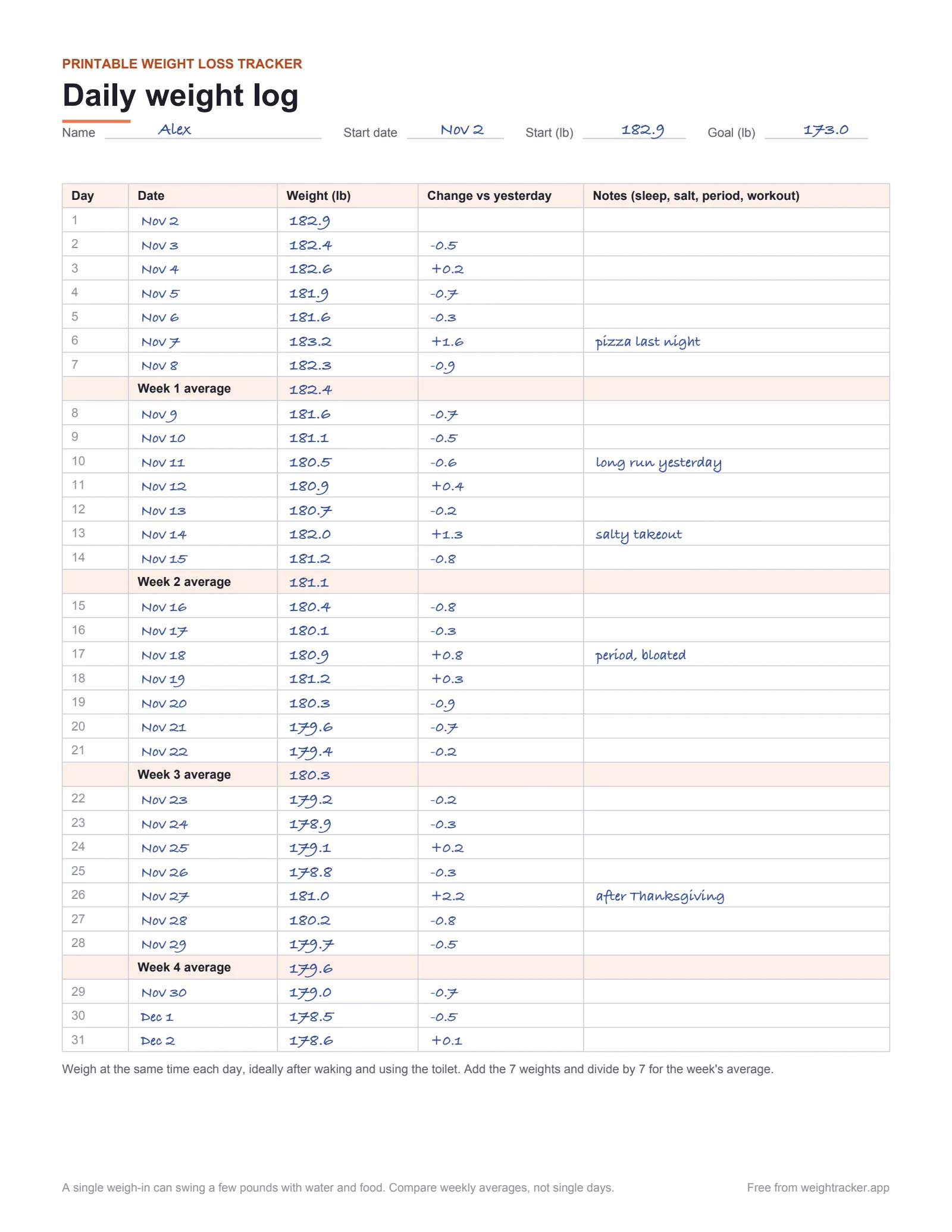
Day to day, this week jumps by as much as 1.6 lb: Saturday, the morning after pizza. The average is the number to keep.
Add the seven weights: 182.9 + 182.4 + 182.6 + 181.9 + 181.6 + 183.2 + 182.3 = 1276.9. Divide by 7 for a weekly average of 182.4 lb.
If next week averages 181.1 lb, the change is -1.3 lb. That is the number for page 2.
Missed a day? Average the weigh-ins you have. Six readings work just as well. Why the days bounce so much is in the guide to daily weight fluctuation, and how many weigh-ins you need is in how often to weigh yourself.
| Day | Weight | Change vs yesterday |
|---|---|---|
| Mon | 182.9 | – |
| Tue | 182.4 | -0.5 |
| Wed | 182.6 | +0.2 |
| Thu | 181.9 | -0.7 |
| Fri | 181.6 | -0.3 |
| Satafter pizza | 183.2 | +1.6 |
| Sun | 182.3 | -0.9 |
| Week 1 average | 182.4 |
Page 2, step by step
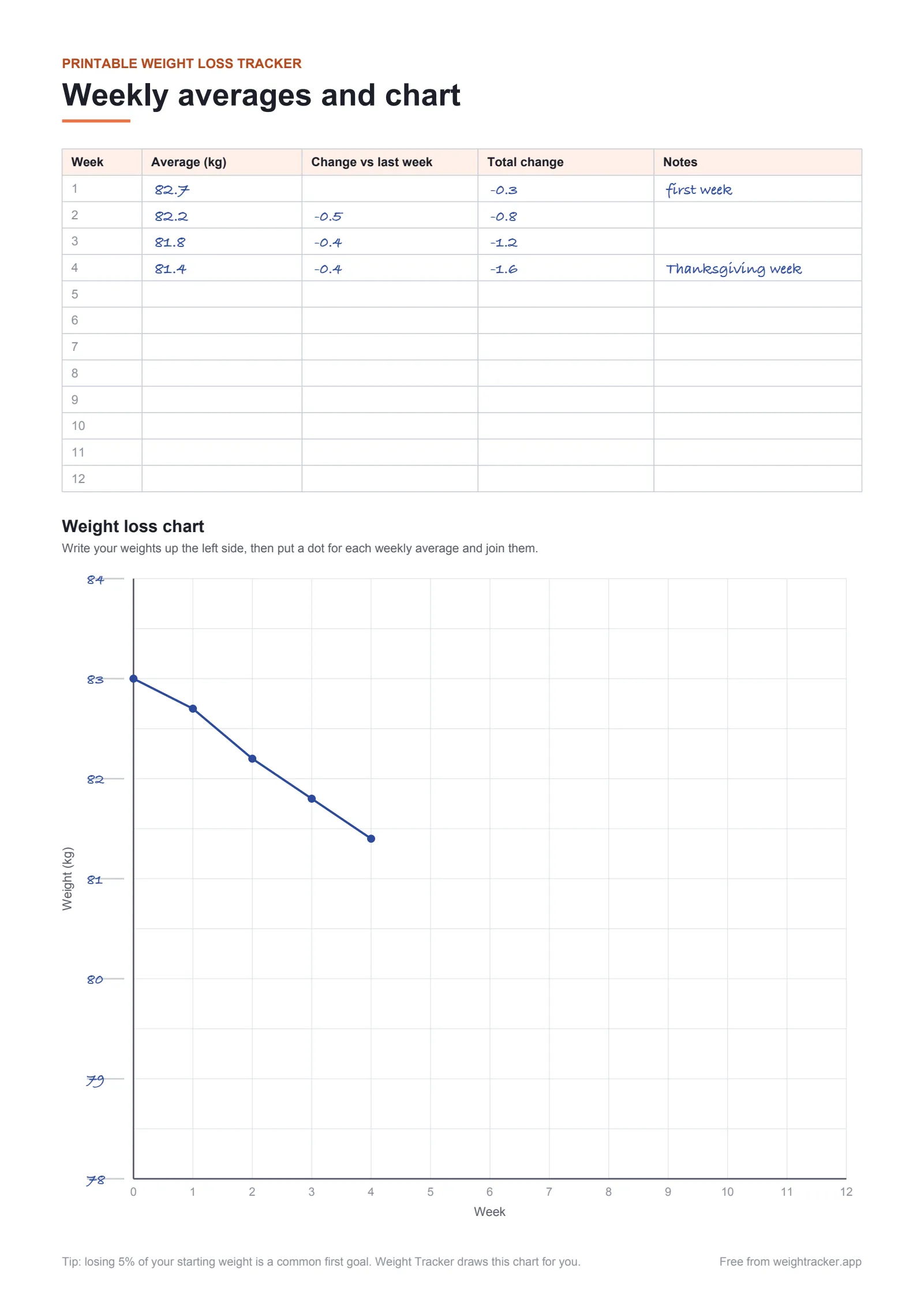
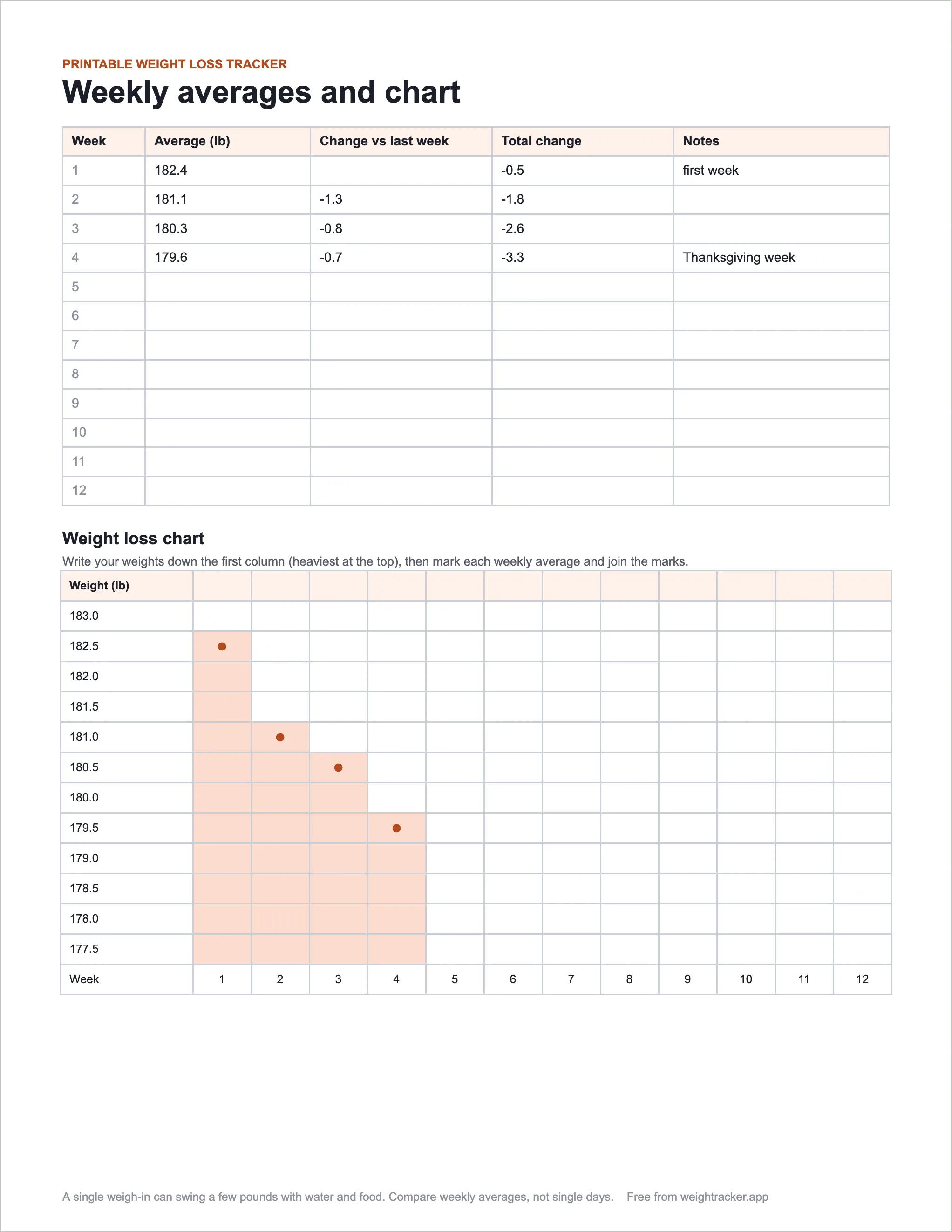
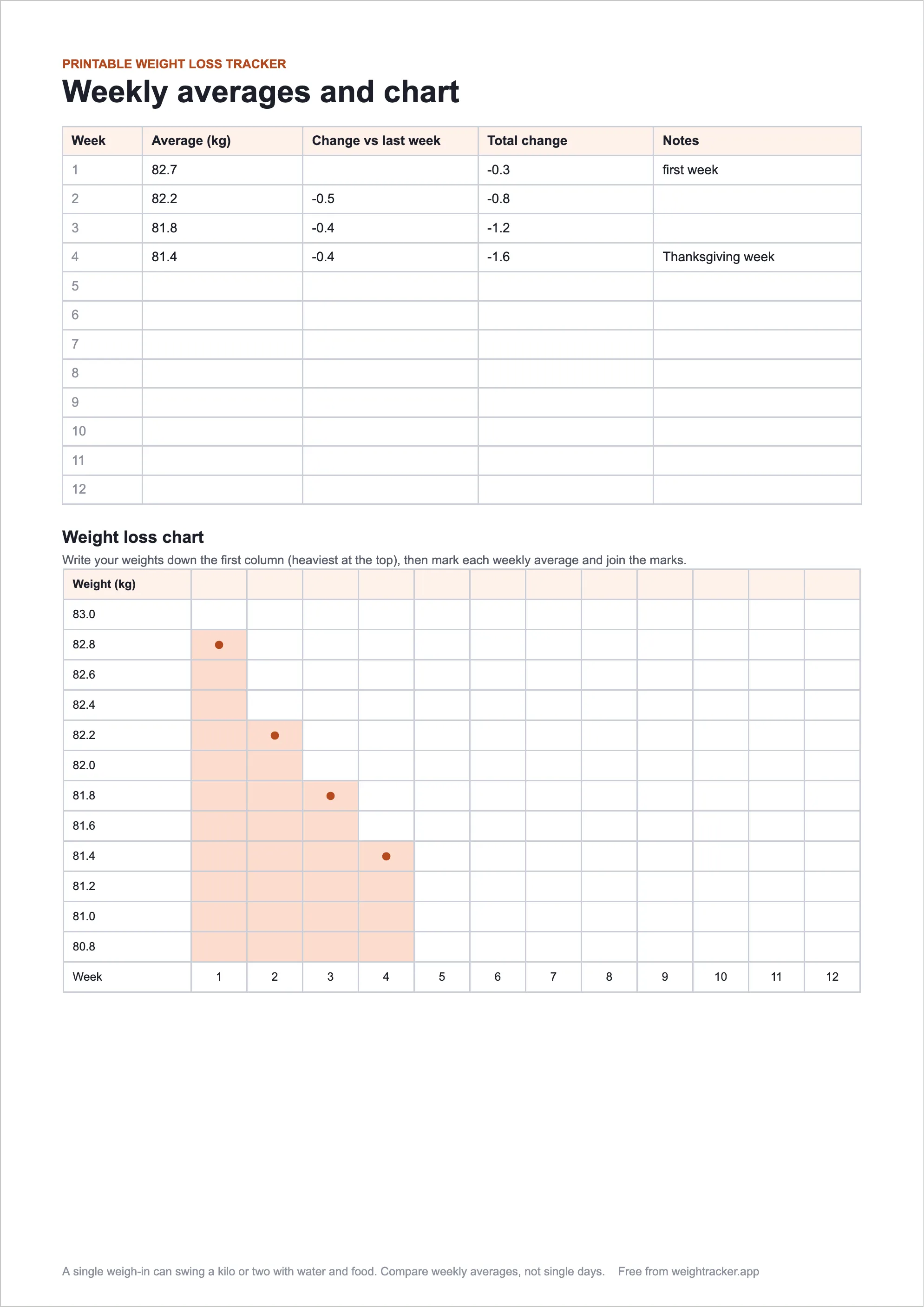
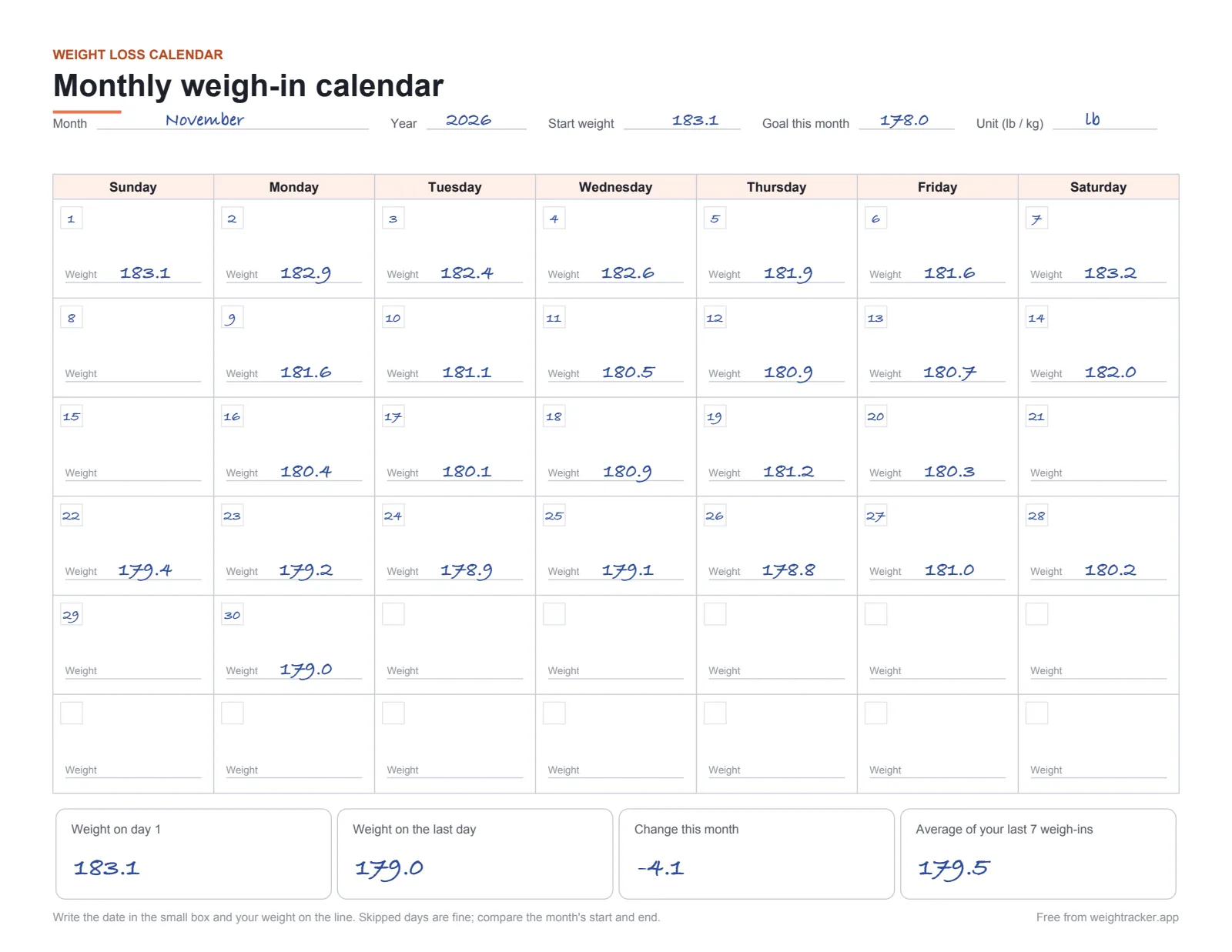
The chart is blank so it fits any weight. Setting up the side takes a minute, once every 12 weeks. The example uses the month from the pictures above.
Reading page 2
“Change vs last week” is the number to watch. In the example month it reads -1.3, -0.8, -0.7 lb: a steady month, even though week 3 had period water weight and week 4 had Thanksgiving.
| Change vs last week | What it usually means | What to do |
|---|---|---|
| −1 to −2 lb−0.5 to −1 kg | The gradual pace the CDC describes; the NHS gives 0.5 to 1 kg a week. | Keep going. The CDC says people who lose at this pace are more likely to keep it off. |
| Down, but less than 1 lbunder 0.5 kg | Still moving. A period, a salty weekend, or a hard workout can hide part of a week’s loss. | Judge three or four weeks together before changing anything. |
| More than −2 lbover 1 kg | Common in the first week or two, when water comes off as well. | Do not expect it every week. See how much you can lose in a month. |
| Up for one week | Usually water: a holiday, travel, a hard training week, or your period. | Write the reason in Notes and look at the next week. |
| Flat for 3 to 4 weeks | More likely a real stall than day-to-day noise. | The weight loss plateau guide goes through what helps. |
The Notes column
Two or three words are enough. Cleveland Clinic lists water retention, recent meals, exercise, hormones, stress, and some medicines among the usual reasons weight moves from day to day, so those are the things worth noting. Weeks later, the notes explain the bumps on your chart.
Food
Takeout, a restaurant, a party. Write it on the morning after, when the scale shows it, as the example does with “pizza last night”.
Training
A long run, a first week of weights, a sore day. The guide to weight gain after exercise explains why the scale can rise.
Cycle
Note the days before and during it. Over a few months the pattern repeats, and a heavier week stops being a surprise. More in period weight gain.
Sleep and stress
Worth a word when it is out of the ordinary, so you can see whether your heavier mornings line up with it.
Routine
Weighed later than usual, in clothes, on a different scale, or while travelling. These readings are real but not comparable with the rest.
Health
Write down the start date. Cleveland Clinic advises talking to a healthcare provider about sudden or large changes that have no clear explanation.
Printing and keeping it going
The routine
| When | What to do |
|---|---|
| Every morning10 seconds | Weigh, write the number, add a note if the day was different. |
| Day 75 minutes | Add up the week, divide by the number of weigh-ins, write it in the shaded row, then copy it to page 2 and plot it. |
| Every 4 weeks | Start a new page 1. Compare the last week’s average with the first. |
| Every 12 weeks | Start a new page 2. Work out the change as a share of your start with the percentage calculator; NIDDK gives 5% in six months as an example first goal. |
Paper or app
Paper works well
Writing a number down every morning is a habit in itself, and a sheet on the fridge is hard to ignore.
Paper gets harder
Every week means another average by hand, and comparing this month with three months ago means digging out old sheets. How to track your weight covers both routines.
Weight Tracker
Log in a few seconds and the app draws the trend over 7, 30, or 90 days. Goals with your own dates, alone or with friends. See the weight history
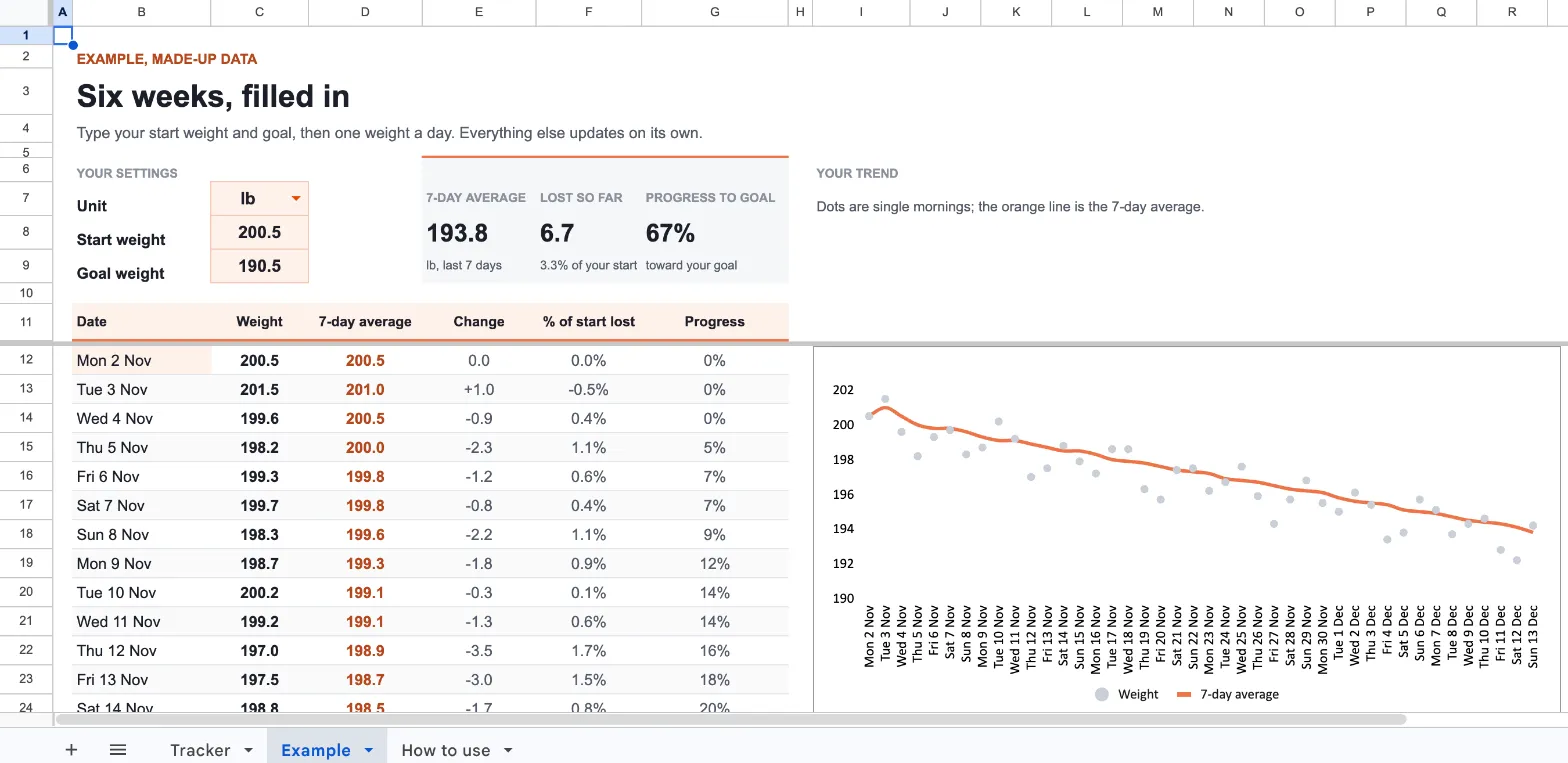 Google Sheets · Excel
 Google Sheets · PDF · Word · Excel
Work out a percentage, a goal date, or a healthy range without the arithmetic.
Good to know
For general information, not medical advice. A doctor can help you choose goals that are right for you.
Write your start weight, rounded up, on the top line of page 2 and count down one pound (or half a kilo) a line. Put your start weight at week 0, then add one dot for each weekly average and join the dots with a ruler. The line’s direction over several weeks is your trend.
Open the PDF and print it at 100% or with “Fit to page”. The pounds version is US Letter and the kilograms version is A4, but either prints cleanly on the other paper size with “Fit to page”. Print page 1 once a month and page 2 once every 12 weeks.
Yes. Download the Word version, or make your own Google Docs copy, and type into the table. The PDF is for pen and paper. If you want the averages and the chart worked out for you, use the free weight loss tracker spreadsheet instead.
Daily and weekly both work. Reviews of studies link regular self-weighing with more weight loss, and daily weigh-ins give the weekly average more to work with. If daily numbers stress you, weigh once a week on the same morning and use one row a week.
Mostly water. Cleveland Clinic puts a normal daily swing at about 5 to 6 pounds (2 to 3 kg), driven by salt, carbohydrates, food still being digested, hormones, and exercise. That is why the tracker has you compare weekly averages.
One you choose with your own context in mind. The US National Institute of Diabetes and Digestive and Kidney Diseases gives losing 5% of your body weight over six months as an example of a good first goal. The weight loss percentage calculator shows what 5% is for you.
Yes. Give each person their own copy and compare percentage lost rather than pounds, so people who start at different weights compete fairly. The guide to running a fair weight loss challenge has rules that work.
Yes. There is no sign-up and no email address. Print as many copies as you like for yourself, your family, or a group, and share the link with anyone.
Weight Tracker for iPhone
Weight Tracker does the averaging and draws the chart as you log, and it never runs out of rows. Free, with no calorie counting.