
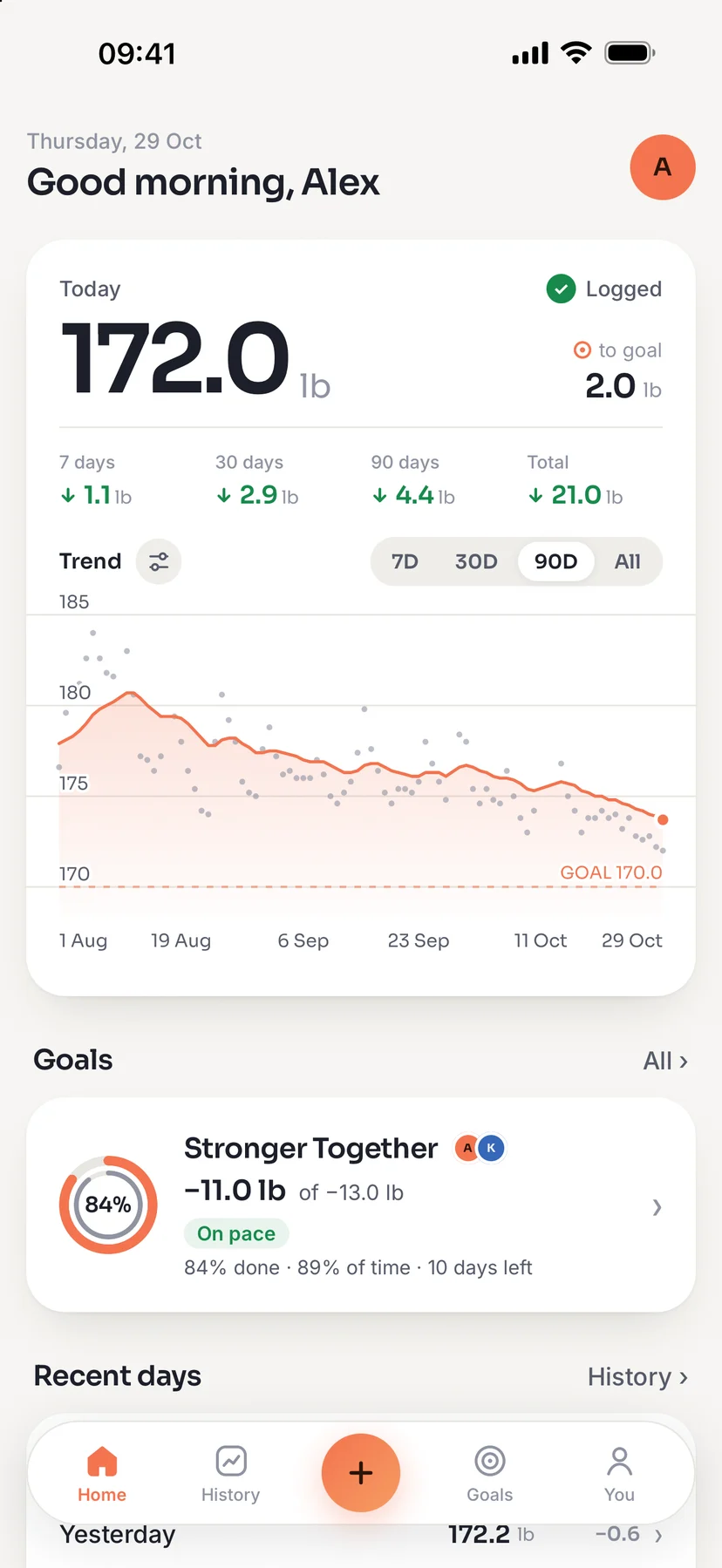
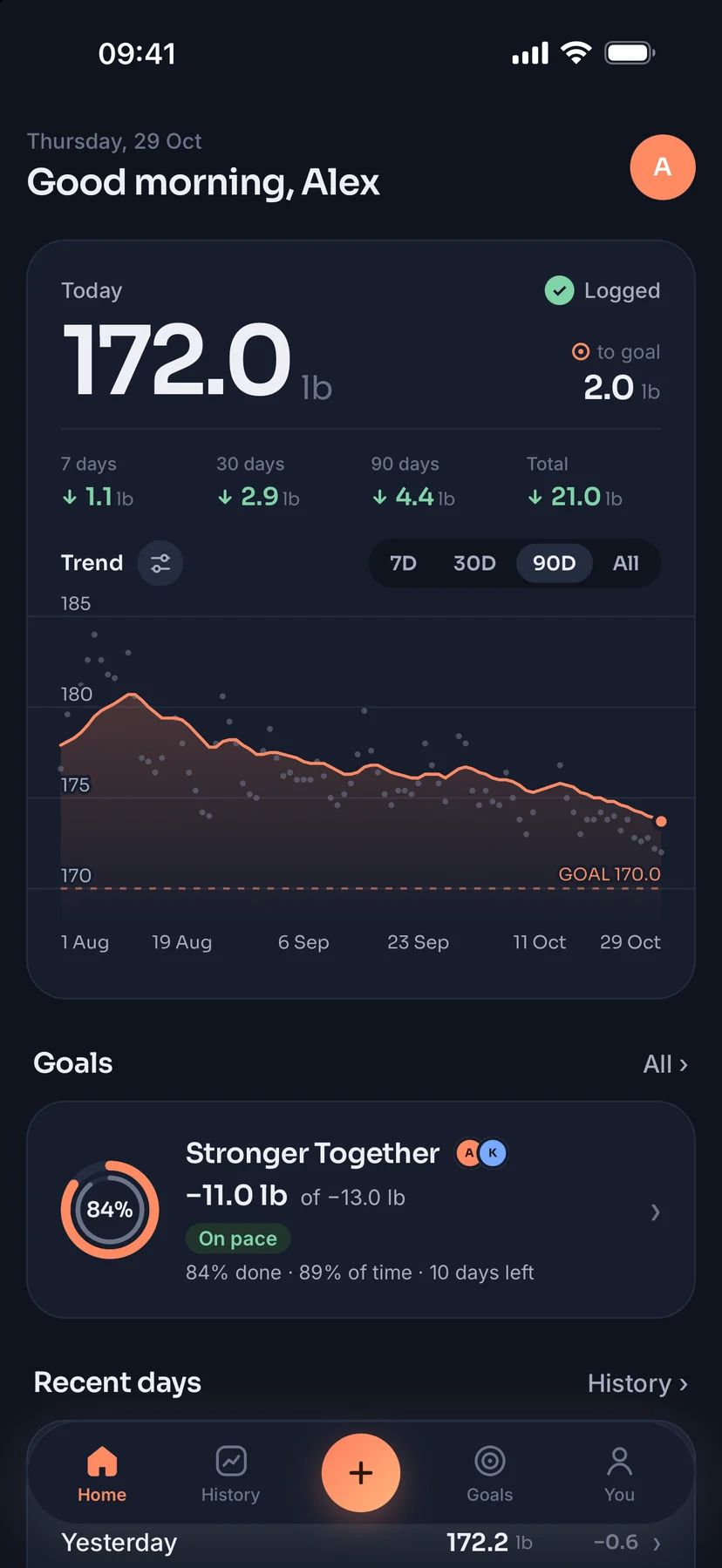
Weight goals for iPhone
Make it a percentage goal.
Set a percentage to lose with your own dates, and follow your progress and pace toward it. Add up to three friends without sharing a weight.
See what share of your starting weight you have lost and how far along your goal you are. Add your start date for your weekly pace and when it gets you there.
Printed from https://weightracker.app/tools/weight-loss-percentage-calculator/. For general information, not medical advice.
Why a percentage
Losing 5 kg means something different at 60 kg than at 120 kg. A percentage puts every starting weight on the same scale, which is why the NIDDK frames a good first goal as 5% of your weight over six months. The NHS says losing 5 to 10% of your body weight can improve your health, so the 5% and 10% rows in your results are worth noticing.
Starting at 60 kg (132 lb)
3kg
That is 5%, or about 6.6 lb.
Starting at 90 kg (198 lb)
4.5kg
That is 5%, or about 9.9 lb.
Starting at 120 kg (265 lb)
6kg
That is 5%, or about 13.2 lb.
| Start | 5% lost | 10% lost | 15% lost | 20% lost |
|---|---|---|---|---|
| 150 lb | 142.5 | 135 | 127.5 | 120 |
| 175 lb | 166.3 | 157.5 | 148.8 | 140 |
| 200 lb | 190 | 180 | 170 | 160 |
| 225 lb | 213.8 | 202.5 | 191.3 | 180 |
| 250 lb | 237.5 | 225 | 212.5 | 200 |
| 300 lb | 285 | 270 | 255 | 240 |
| Start | 5% lost | 10% lost | 15% lost | 20% lost |
|---|---|---|---|---|
| 60 kg | 57 | 54 | 51 | 48 |
| 70 kg | 66.5 | 63 | 59.5 | 56 |
| 80 kg | 76 | 72 | 68 | 64 |
| 90 kg | 85.5 | 81 | 76.5 | 72 |
| 100 kg | 95 | 90 | 85 | 80 |
| 120 kg | 114 | 108 | 102 | 96 |
The weight you would be at after losing each percentage. Put in your own starting weight above for exact numbers.
How it works
Most of these sums divide by your starting weight. The units cancel out, so the percentage is the same in pounds or kilograms.
Weight lost
Weight lost over starting weight, from 90 kg down to 84.5 kg. In pounds, 12 lb from 200 lb is 6%.
Toward your goal
Lost so far over the total to lose, on the way from 200 to 180 lb. This is the number in the ring.
Weight at a percentage
The weight 10% below your start. Use 0.95 for 5% and 0.85 for 15%.
Percent gained
Weight gained over starting weight, from 150 to 154 lb. It is the same sum when the scale goes up.
Comparing people
Someone who starts heavier can often lose more pounds in the same weeks, so ranking by pounds tends to favour them. Dividing by each person’s own starting weight puts everyone on the same scale.
That is why many weight loss challenges and office competitions rank by percentage. Our guide to running a fair weight loss challenge covers the rest, and Shared Goals show each member’s progress toward their own target.
Same four weeks
| Friend | Lost | Percent |
|---|---|---|
| Alex, from 260 lb | 15 lb | 5.8% |
| Sam, from 150 lb | 9 lb | 6% |
Alex lost more pounds, but Sam lost a bigger share of their starting weight.
Day to day
Your weight moves from day to day with water, food, and salt. Cleveland Clinic puts the average daily window at about 5 to 6 lb, or 2 to 3 lb either way. At a 200 lb start, a 2 lb swing is a full percentage point, so one morning can look like a week of progress or a step back.
Weigh-ins taken the same way each time, and a trend over a few weeks, give a steadier picture than any single morning. See the best time to weigh yourself and how much weight fluctuates in a day.
At a 200 lb start
Compare weekly averages rather than single days. The Weight Tracker iPhone app draws a trend line behind your daily weigh-ins.
Good to know
For general information, not medical advice. A doctor can help you choose goals that are right for you.
Subtract your current weight from your starting weight, divide the result by your starting weight, and multiply by 100. Losing 5.5 kg from a starting weight of 90 kg is 5.5 ÷ 90 × 100 = 6.1%.
No. The units cancel out, so the percentage is the same in kilograms or pounds. Only the amount lost is shown in the unit you choose.
The US National Institute of Diabetes and Digestive and Kidney Diseases gives losing 5% of your body weight over six months as an example of a good first goal. Talk to a healthcare professional about the right goal for you.
Multiply your starting weight by 0.1. At 200 lb that is 20 lb, so a 10% loss takes you to 180 lb. At 90 kg it is 9 kg, down to 81 kg. The calculator shows 5%, 10%, 15%, and 20% for your own starting weight.
The CDC describes about 1 to 2 pounds a week as gradual and steady. For someone starting at 200 lb that is 0.5% to 1% of their body weight a week, and for someone at 150 lb it is about 0.7% to 1.3%. Add your start date and the calculator shows your own average pace.
Divide the weight you have lost so far by the total you want to lose, then multiply by 100. Losing 13 lb on the way from 200 to 180 lb is 13 ÷ 20 × 100 = 65% of the way. That is the number in the ring.
A percentage compares people with very different starting weights fairly. Losing 15 lb from 260 lb is 5.8%, while 9 lb from 150 lb is 6%, so the person who lost fewer pounds is slightly ahead. Shared Goals in Weight Tracker also avoid comparing pounds, but show each member’s progress toward their own target instead.
The calculator shows the change as a percentage gained instead. Day-to-day swings are normal, so compare over several weeks rather than one morning.
Add the date of your starting weight and the calculator works out your average loss per week since then. It then continues that pace in a straight line to your goal. Real progress is rarely that even, so treat it as a rough guide. Weight loss tends to slow as you go, so this date is likely on the early side. The weight loss planner eases the pace for a later, more realistic date.
Yes. The calculator runs in your browser and does not send your numbers to us. A share link keeps them after the # in the address, a part browsers do not send to the website.
Weight goals for iPhone
Set a percentage to lose with your own dates, and follow your progress and pace toward it. Add up to three friends without sharing a weight.