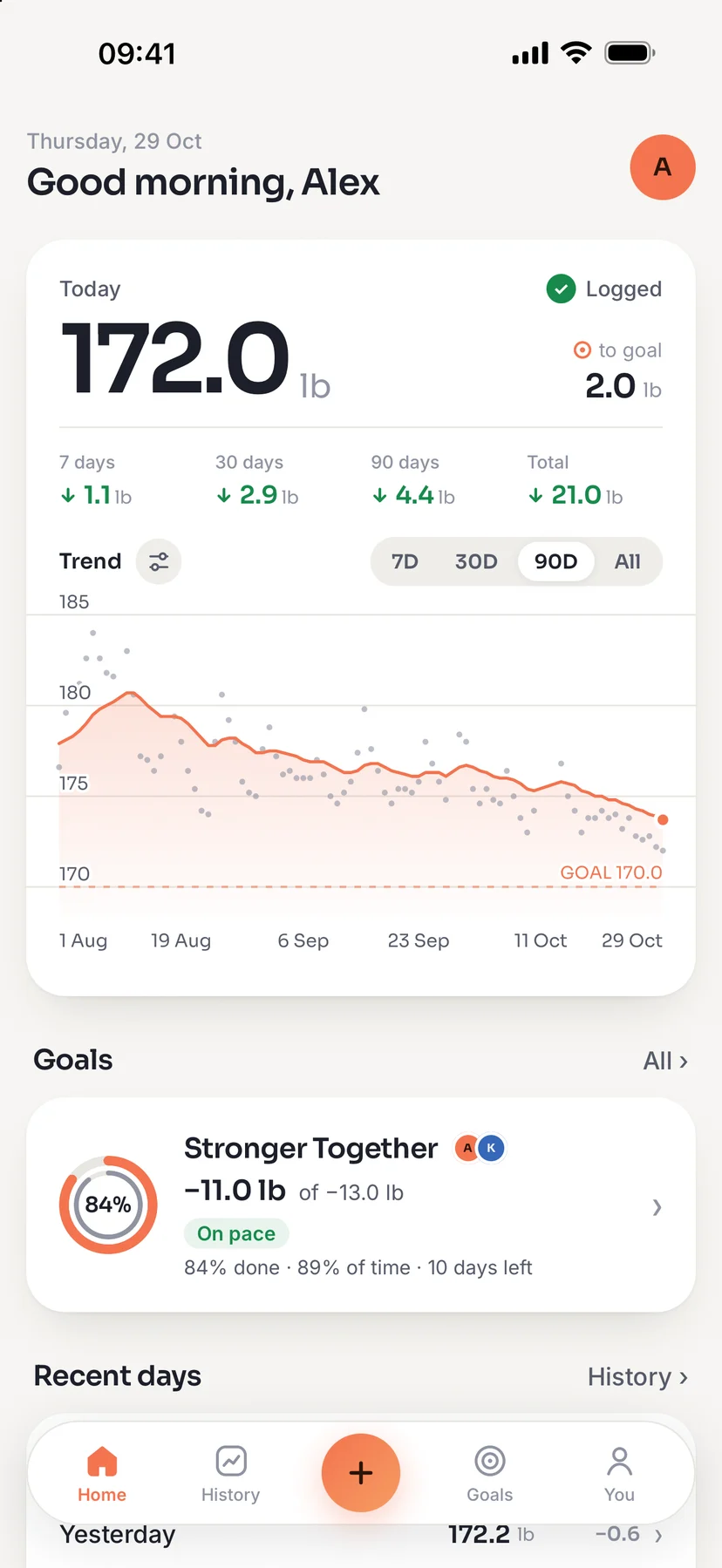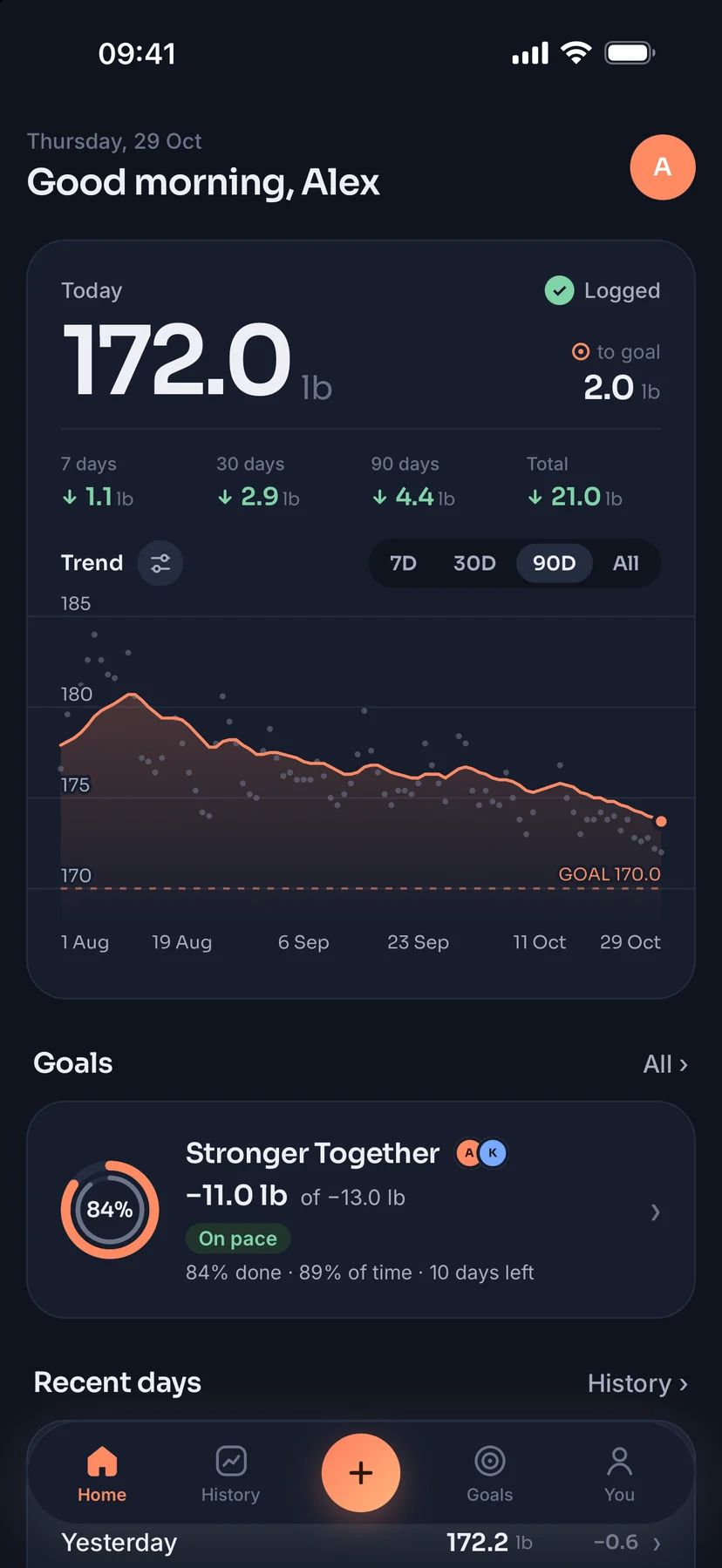

If your group is two to four people, Weight Tracker’s Shared Goals handle most of these rules. Each person sets their own target, everyone shares the dates, and members see each other’s progress toward their own target, their pace, and which days they logged. Weights, weight changes and targets stay private.
Rule 1: score by percentage
Rank people by the percentage of their own starting weight they have lost. Losing 5 kg is a bigger change at 70 kg than at 120 kg, so a kilos-lost leaderboard favors whoever starts heaviest.
The person who lost fewer pounds is slightly ahead. The units cancel out, so it works the same in kilograms or pounds, and people in the same challenge can use different units.
Free toolWeight loss percentage calculatorEnter a starting and current weight to get each person’s percentage, in kilograms or pounds.Open the toolRule 2: agree on how everyone weighs in
- Same conditions. Morning, after the toilet, before eating or drinking, in similar clothes, as Cleveland Clinic describes.
- Same scale where possible. Different scales can disagree.
- A fixed check-in day. Everyone weighing on the same day is what keeps it fair. In a European smart-scale study, weight tended to rise over weekends and read lowest on Friday on average (Turicchi and colleagues, 2020), so a Friday check-in tends to catch the week at its low point.
- A clear start and end. Record everyone’s starting weight on the same day.
The best time to weigh yourself guide explains why these details matter. Each person can keep their own log on the free printable weight loss tracker, or in the weight loss tracker spreadsheet, whose “% of start lost” column is the number to share.
Rule 3: share progress, not weights
Many people are happy to share how they are doing but not what they weigh. Post percentages and progress, and let one person keep the raw numbers privately, or use an app that shares only progress.
Rule 4: reward a pace people can keep
The CDC says people who lose about 1 to 2 pounds a week are more likely to keep the weight off. A challenge that rewards the biggest drop in a week can push people the other way. Some ways to avoid that:
- Score over several weeks rather than one.
- Reward consistency with points or prizes, such as for the most check-ins.
- Make joining optional, and never single anyone out.
Talk to a healthcare professional before joining if you have a health condition, are pregnant, or have a history of disordered eating.
Length and scoring
Agree on three things before anyone steps on a scale: how long the challenge runs, how points are scored, and how a tie is broken.
| Length | Suits | Keep in mind |
|---|---|---|
| 4 weeks | A first try, or a group that wants something short. | Normal day-to-day swings weigh more heavily over a short period. Lean more on check-ins than on the final number. |
| 8 weeks | A common middle length for friend and office groups. | Long enough for a weekly average to show a direction. |
| 12 weeks | A group that wants a full season, such as one per quarter. | Plan a mid-point check-in so people who fall behind have a reason to stay. |
A simple scoring system that rewards both results and steady effort:
- Percentage points. One point for each percent of starting weight lost, to one decimal place.
- Consistency points. 0.5 points for each weekly check-in, up to 4 over 8 weeks.
- Tie-breaker. If two scores match, the person with more check-ins goes ahead.
Here is how that looks for four sample people after 8 weeks:
| Rank | Person | Lost | Check-ins | Score |
|---|---|---|---|---|
| 1 | Sam | 6.0% | 8 of 8 | 10.0 |
| 2 | Jordan | 4.8% | 8 of 8 | Tie 8.8 |
| 3 | Alex | 5.8% | 6 of 8 | Tie 8.8 |
| 4 | Riley | 3.7% | 7 of 8 | 7.2 |
Sam lost the largest share of starting weight and comes first. Jordan and Alex tie on 8.8, and Jordan goes ahead on check-ins, even though Alex lost a larger percentage. Change the numbers to suit your group, but write them down before the start.
Do teams and challenges help?
There is some evidence that the people around you matter. Leahey and colleagues looked at Shape Up Rhode Island 2009, a 12-week online program in which adults joined teams and competed with other teams.
4.2%
average weight loss reported by 3,330 adults who completed a 12-week team challenge
Leahey and colleagues, 2012. Participants had overweight or obesity and were on 987 teams.
Weight loss tended to be similar among teammates, and people with a greater share of teammates in the weight loss part of the program, or who said their teammates influenced them more, lost a larger percentage. The authors concluded that teammates affect weight loss outcomes during a team-based intervention. The study looked at people who finished the program and shows associations, so it cannot say that joining a team caused the loss.
Challenge ideas
Start with who is taking part:
| For | Idea |
|---|---|
| Couples | Run it side by side, not head to head. Each partner sets their own percentage target and you celebrate when both reach it. |
| Friends | Pick a fixed period, rank by percentage, and add a second prize for the most consistent weigh-ins so steady people can win too. |
| Office | Let one organizer record weights privately and post only percentages. Make joining optional and keep weights off shared screens. |
| Online group | Agree on weigh-in rules and a check-in day, and share progress, not exact weights. |
Challenges that do not use the scale
Not everyone wants to weigh in for a group, and some changes show up elsewhere first. The CDC lists recording your steps, physical activity, and how many fruits and vegetables you eat among the things worth monitoring. Any of these can be a challenge on its own or run alongside a weight challenge:
| Format | How it works | Scored by |
|---|---|---|
| Steps | Everyone logs daily steps from a phone or watch. | Days you reach a target you set for yourself, or change against your own first week, so fitness levels do not decide it. |
| A weekly habit | The group picks one habit each week, such as vegetables with dinner or a walk after lunch. | One point for each day you did it. No penalty for missed days. |
| Waist | Measure your waist at the start and the end, at the same spot and time of day. | Percentage of your starting waist, the same way as weight, so different sizes compete fairly. |
Let each person set their own step or habit target. A shared number that is easy for one person can be out of reach for another.
Free toolWaist-to-height ratio calculatorFor a waist challenge, it shows each person’s waist-to-height ratio and explains where to place the tape so measurements stay comparable.Open the toolPrize ideas
Prizes shape behavior. Food undercuts the point, and cash for the biggest drop can reward a crash in the final week. These keep the focus on habits:
- Choose the next outing. The winner picks a hike, a class, or a game the group does together.
- A small useful thing. A water bottle, a jump rope, or a book, chosen before the start.
- A trophy that moves. Something silly that passes to each round’s winner.
- Pick the next format. The winner decides whether the next round is weight, steps, or a habit.
- More than one prize. One for percentage, one for the most check-ins, and one for the most improved steps.
Whatever you choose, announce prizes at the start, keep them small, and celebrate everyone who finished.
If you play for money. Some groups put money in a pot. If yours does, keep the stake small enough that nobody feels pushed to crash diet in the final week. Agree before the start how the pot is split, and pay out on percentage lost over the whole challenge, never on a single week. Setting aside part of the pot for the most check-ins keeps steady people in the running.
Checking weigh-ins. Most friend groups run on trust. If yours wants a check, ask for a photo of the scale display on check-in day.
Running a small challenge in Weight Tracker
For two to four people including you, Shared Goals cover most of these rules. Everyone sets their own loss target and shared dates, invitations are private links, and members see each other’s progress on one 0 to 100% scale and their pace. Weights, weight changes, and targets stay private.
Shared Goals show progress toward each person’s own target rather than a points table, so if you use the scoring above, one person can keep the leaderboard with the percentage calculator.
Members can see which goal days have a weigh-in, so the organizer can count check-ins for consistency points without asking anyone for a number.
Questions
How do you make a weight loss challenge fair?
Rank people by the percentage of their own starting weight they have lost, not by pounds or kilograms. Agree on the same weigh-in conditions and check-in day, and share percentages instead of weights.
How do you calculate the percentage for a weight loss competition?
Divide the weight lost by the starting weight and multiply by 100. Losing 15 lb from a 260 lb start is 5.8%.
How long should a weight loss challenge last?
Four, eight, or twelve weeks are common. Eight weeks is a common middle ground, since a four-week result can be swayed by normal water swings.
How do you break a tie in a weight loss challenge?
Agree on the tie-breaker before you start. Giving it to whoever checked in more often rewards consistency instead of a last-minute drop.
What are good prizes for a weight loss challenge?
Prizes that are not food or cash for the biggest drop, such as choosing the next group outing, a small useful item, or a trophy that moves. Separate prizes for consistency let steady people win too.
Can we run a weight loss challenge without sharing our weights?
Yes. Let one person keep the numbers and post only percentages, or use an app that shares progress but not weights. In Weight Tracker Shared Goals, up to four people see each other’s progress while exact weights stay private.
Sources
- CDC. Steps for losing weight. 17 January 2025.
- CDC. Tips for keeping weight off. 15 November 2023.
- Cleveland Clinic. The best time to weigh yourself. 12 June 2023.
- Turicchi J, et al. Weekly, seasonal and holiday body weight fluctuation patterns among individuals engaged in a European multi-centre behavioural weight loss maintenance intervention. PLoS One 2020;15(4):e0232152. doi:10.1371/journal.pone.0232152.
- Leahey TM, et al. Teammates and social influence affect weight loss outcomes in a team-based weight loss competition. Obesity 2012;20(7):1413–1418. PMC3676749.
This guide is general information, not medical advice.