What is the whoosh effect?
The whoosh effect is the idea that when you lose fat, your fat cells first fill with water, so the scale stalls, and then release that water all at once, so the scale drops suddenly. Is it real? The sudden drops are; the fat-cell explanation is not proven. No published study has tested it. Water held with glycogen, salt, hormones, and food in your gut explain the drop without it.
Where the idea came from
The term is dieting forum slang. The version most people read today comes from the trainer and author Lyle McDonald, who wrote about it in his book The Stubborn Fat Solution and reposted that section on his site in 2009 as “Of Whooshes and Squishy Fat”. He writes that the idea came from one of his college professors, who suggested that emptied fat cells temporarily refill with water. McDonald adds that he looked for research to support it for nearly 20 years and was never sure where it came from. Beyond one paper suggesting that deep belly fat can fill with water after massive weight loss, his evidence was observational: bioimpedance scales reading higher before a drop, and drops after refeeds or a night of drinking.
Squishy fat and other “signs” of a whoosh
In the same post, McDonald describes fat that, as people get very lean, looks dimpled and feels squishy, “almost like there are small marbles under the skin”, which he took as a sign that fat was going. Forums now often treat it as a sign that a whoosh is coming. Other “signs” passed around online include feeling warmer, sweating at night, and needing to pass urine more often. None of these has been studied, so treat them as folklore, not as a forecast.
Is the whoosh effect real?
Two parts of the story need separating.
Real
The stall, then the sudden drop
The scale stalls for days or weeks, then drops by a pound or more overnight. Daily swings of several pounds are normal, and the causes below explain the drop.
Not proven
Fat cells filling with water, then flushing it
A search of PubMed, the main index of medical research, in November 2026 found no study of a “whoosh effect” in weight loss at all.
What research says about water in fat tissue
Fat tissue is mostly fat. In surgical samples, it was about 14% water, and lean tissue held about six times as much (Wang and Pierson, 1976). Lipid and water together typically make up more than 90% of fat tissue, and in a study of six male cadavers the share of lipid was lower in leaner bodies (Martin and colleagues, 1994). So fat tissue in a leaner person does hold proportionally more water.
Two small studies have measured fat tissue during weight loss, and both found its water content higher after weight loss. Neither measured often enough to see a short fill-then-flush cycle, and neither looked for one:
- In 27 adults who lost 14.5% of their weight on a 9-week very low calorie diet, the water content of belly fat under the skin rose during the diet and rose further during the following period of weight maintenance. The authors suggest it may reflect better blood flow to the tissue (Laaksonen and colleagues, 2003).
- In 10 adults who lost 11.7% of their weight over 3 months, the water fraction of fat under the skin rose by about 7 percentage points, which the authors linked to better blood supply and possibly to fluid taking up space left by lost fat (Ganesan and colleagues, 2016).
A third small study, from the US National Institutes of Health, found that after 6 weeks of dieting the large fat cells had shrunk, while the calories stored in each gram of belly fat were unchanged (Cabeza de Baca and colleagues, 2024). Fat cells shrink rather than disappear: their number stays constant in adulthood, even after marked weight loss (Spalding and colleagues, 2008).
None of this rules out water in fat tissue playing some part, but nothing shows the sudden release the theory needs. The honest summary is “not proven”, not “impossible”.
What actually causes a sudden drop after a plateau
A sudden drop is almost always water or food leaving your body, on top of fat loss that has been happening slowly all along. Cleveland Clinic puts the average daily swing at about 5 to 6 pounds, even for people at a healthy weight, so a 2-pound drop overnight sits inside normal.
| Cause | What happens |
|---|---|
| Glycogen and its water | Stored carbohydrate holds at least 3 g of water per gram. Eat less carbohydrate for a few days, or train harder, and stores run down and release that water. |
| A big or salty meal clearing | Cleveland Clinic says a meal high in carbohydrate or sodium can make your body hold more water for a while. When it passes, the scale drops. |
| The end of a period | In a study that weighed 42 women, weight was 0.45 kg (about 1 lb) higher during their periods than in the first week of the cycle as the study defined it, almost all of it water. |
| Gut contents | Median stool output is about 128 g a day. A day or two of constipation, then catching up, moves the morning reading. |
| The weekly rhythm | Weight tends to be highest on Sunday and Monday and to fall through the week, so a Friday reading can look like a sudden loss. |
Glycogen: the biggest water store that moves
Your body stores carbohydrate as glycogen, about 600 grams in total (Murray and Rosenbloom, 2018), and each gram is stored in muscle with at least 3 grams of water (Fernández-Elías and colleagues, 2015). Full stores and the water held with them come to roughly 2.4 kg (about 5.3 lb) in a typical adult, though this varies widely with body size, diet, and training. Day-to-day changes are much smaller. In one study of eight people, three days of heavy carbohydrate loading after glycogen-draining exercise raised total body water by about 0.9 kg (Shiose and colleagues, 2016).
So a few days of eating less carbohydrate, or harder training after a heavier weekend, can release water quickly. The water weight guide covers this in more detail, and weight gain after exercise covers the other direction, when training makes the scale go up.
Salt: possible, but less certain than you hear
Cleveland Clinic says a salty meal can make your body hold more water for a while. Controlled studies show it is not automatic: in a metabolic ward study of 32 healthy men, raising salt intake increased the volume of blood plasma but not total body water or body weight (Heer and colleagues, 2000). Salt is one possible cause of a stall and a later drop, not a reliable one.
Your period
In a study that weighed 42 women through a menstrual cycle, weight was 0.45 kg (about 1 lb) higher during their periods than in the first week of the cycle as the study defined it, and the extra was almost all water held outside the cells (Kanellakis and colleagues, 2023). When that water goes, a whoosh-like drop is the result. The period weight gain guide covers the timing.
The day of the week
In a study of 80 adults, weight was highest on Sunday and Monday and fell through the week (Orsama and colleagues, 2014). A larger European study found an average swing of 0.35% within a week (Turicchi and colleagues, 2020). A stall that ends on a Thursday can just be the weekend leaving.
Stress and cortisol: a hypothesis
Some sites say dieting raises the stress hormone cortisol, cortisol makes you hold water, and the whoosh is that water leaving. The first part has some support: in 121 women, three weeks on 1,200 kcal a day raised total cortisol output, and counting calories raised how stressed they felt (Tomiyama and colleagues, 2010). But that study did not measure body water, and we found no study linking diet-related cortisol to a stall followed by a drop.
The whoosh effect on keto
The word is especially common on low-carbohydrate and keto forums, and keto shows why. Cutting carbohydrate runs down glycogen, and the water stored with it is passed in urine (Murray and Rosenbloom, 2018). In a classic study of six people with obesity, an 800-kcal ketogenic diet produced faster weight loss than an 800-kcal mixed diet, but 61% of what they lost in 10 days was water, against 37% on the mixed diet (Yang and Van Itallie, 1976).
That front-loaded water loss makes the first week look dramatic and the next weeks look slow by comparison. Eat more carbohydrate for a day and some of the water comes back; go back to keto and it leaves again. Stalls and sudden drops later on keto have the same causes as on any other diet.
Why the scale stalls while you are still losing fat
Fat loss is slow next to water. Each pound of fat holds a lot of energy, while short-term swings in weight hold very little. In a study of 46 adults weighed two weeks apart, weight changes of 1 to 3 kg contained only about 2,380 kcal per kilogram, because most of each change (84% across the study) was fat-free mass, much of it water (Bhutani and colleagues, 2017). The common rule of about 7,700 kcal per kilogram of fat loss (3,500 kcal per pound) does not apply to them.
84%
of short-term weight change was fat-free mass, not fat
Bhutani and colleagues, 2017: 46 adults weighed two weeks apart, not dieting.
Even for fat loss, the 3,500-kcal rule is rough. Hall (2008) used a model to show it roughly fits people with more than about 30 kg of body fat and overestimates the deficit needed for leaner people, and used to forecast long-term loss it greatly overestimates how much weight people actually lose (Thomas and colleagues, 2013). Early in a diet, each kilogram lost contains fewer calories, because more of it is water and lean tissue (Heymsfield and colleagues, 2012).
A stall of a week or two can easily be water hiding fat loss. A true plateau is different: Hall and Kahan (2018) describe weight loss typically slowing to a plateau within the first year, driven more by rising appetite than by a slowing metabolism. If your weekly average has not moved for three or four weeks, read the weight loss plateau guide rather than waiting for a whoosh.
How long until a whoosh?
No study has measured how long stalls last before a sudden drop. Water from glycogen and salt usually settles within days, and water from a period within the cycle. So if a stall lasts longer than a few weeks, it is more likely a real plateau than a whoosh on its way.
Where does the fat go?
Mostly out through your lungs. Meerman and Brown worked through the chemistry in the BMJ in 2014:
8.4 of 10 kg
of burned fat leaves your body as carbon dioxide you breathe out
The other 1.6 kg becomes water, which leaves in urine, sweat, and breath. Meerman and Brown, 2014.
That is one more reason the fill-and-flush picture does not fit. Fat leaves gradually, through every breath, all day. Water is what comes and goes in lumps.
Can you trigger a whoosh?
Forums suggest cheat meals, alcohol, fasting, or water pills to “trigger” one. No study shows that any of them triggers a sudden fat loss, and some are risky.
- Cheat meals and refeeds. A 2025 review found only eight studies, with mixed results for muscle, metabolism, and performance, and warned that framing a cheat meal as a reward may be linked to disordered eating (Tsang and colleagues). In a structured trial of two-week diet breaks at maintenance, weight did not change on average during the breaks (Byrne and colleagues, 2018).
- Alcohol. Alcohol makes you pass more urine, but that effect is blunted when you are already short of water (Hobson and Maughan, 2010). Any drop the next morning is water, and it comes back when you rehydrate.
- Laxatives. Even extreme purging, 4 to 6 litres of diarrhea, cut the calories absorbed by only about 12% (Bo-Linn and colleagues, 1983). Misusing laxatives can cause dangerous salt and fluid imbalances, and stopping them can cause swelling and fast weight gain (Roerig and colleagues, 2010).
Laxatives and water pills (diuretics) are medicines, not a way to lose fat. Laxatives remove water and very few calories, and misusing them is dangerous. Water pills make you pass water, which comes back. If you use either to control your weight, or feel you cannot stop, talk to a doctor.
Worked example: a stall, then a whoosh
Here is a made-up three weeks. Underneath, fat falls a steady 0.15 lb a day, about 1 lb a week. On top of that, water slowly builds by 2 lb over the first 11 days, then clears overnight before day 13. Each morning also has a little ordinary noise.
| Day | Scale, lb | 7-day average, lb | Fat only, lb |
|---|---|---|---|
| Day 7 | 200.5 | 200.2 | 199.1 |
| Day 10 | 200.3 | 200.3 | 198.7 |
| Day 12 | 200.3 | 200.4 | 198.4 |
| Day 13, the drop | 198.2 | 200.1 | 198.2 |
| Day 14 | 198.2 | 199.8 | 198.1 |
| Day 17 | 197.3 | 198.6 | 197.6 |
| Day 21 | 197.0 | 197.5 | 197.0 |
- The stall hides real loss. From day 1 to day 12 the scale rose 0.1 lb, while about 1.7 lb of fat came off underneath.
- The drop is not a day’s fat loss. The scale fell 2.1 lb overnight, but only 0.15 lb of that was fat. The rest was water leaving.
- An average calms the drop. The 7-day average moved only 0.3 lb that day.
- An average cannot see through water. While the water was building, the average stayed flat too, even edging up. Smoothing removes day-to-day noise, but a water shift that lasts a week or more shows up in any average until it clears.
Over the three weeks, 3.0 lb of fat came off at an even pace, and the scale showed it as a flat line, a cliff, and a slope. That is why two to four weeks of trend tell you more than any single morning, and why waiting for a whoosh is not a plan. Weighing often still helps: in one weight loss trial, people who weighed themselves daily lost more weight than those who weighed less often (Steinberg and colleagues, 2015), though that link does not prove the weighing caused it. The how often to weigh yourself guide covers the options, and the weight loss calculator by date shows what a steady pace adds up to.
When a sudden change needs a doctor
A drop after a stall while you are dieting is normal. Weight loss you are not trying for is different. A review for family doctors on older adults says that losing 5% or more of your body weight within 6 to 12 months without trying is linked to health problems and should be checked (Gaddey and Holder, 2021). The NHS advises seeing a GP if you keep losing weight without changing your diet or exercise, and as soon as possible if you have weight loss and other symptoms.
Cleveland Clinic also advises talking to a healthcare provider if your weight changes a lot suddenly and you are not sure why. For fast gains with swelling, see the warning signs in the water weight guide.
Reading the trend in Weight Tracker
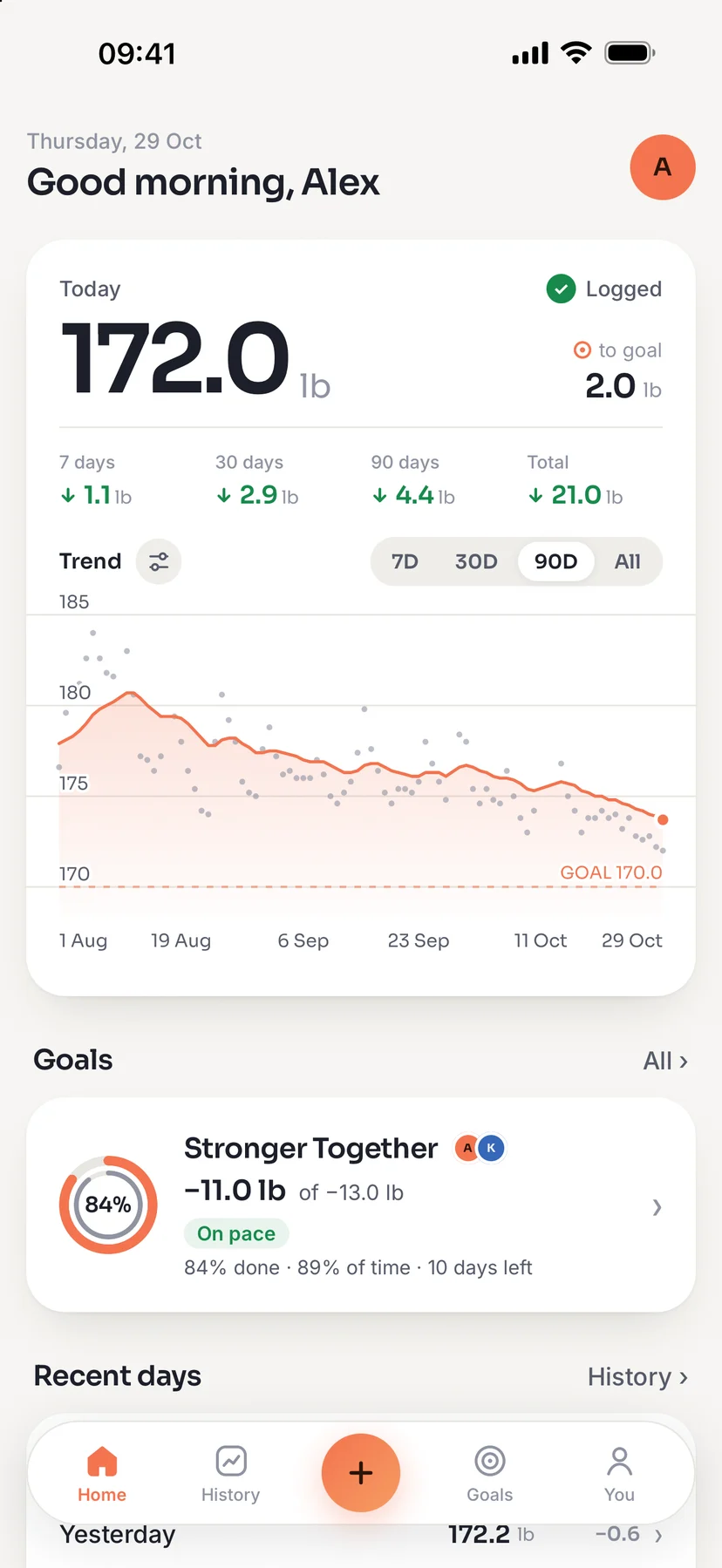
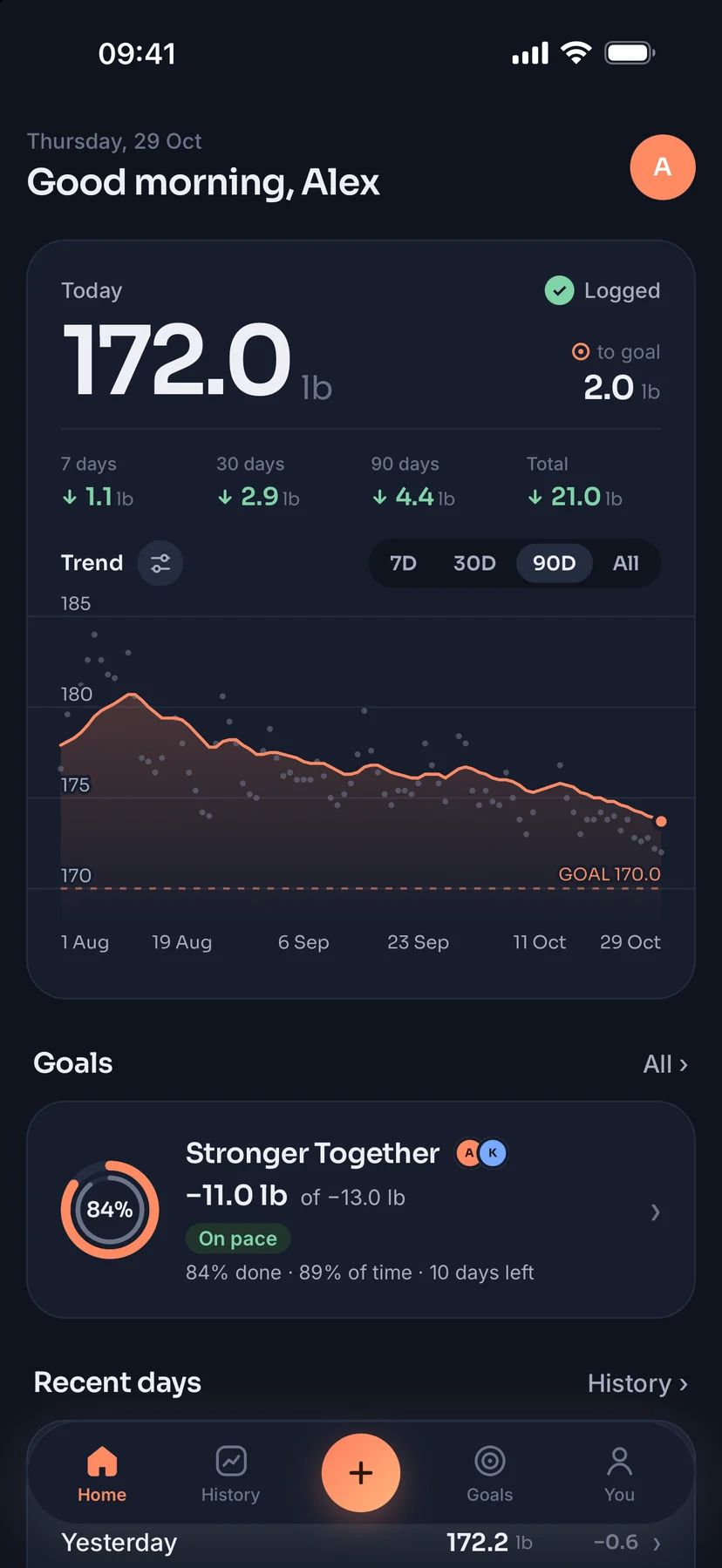
Weight Tracker draws a smoothed trend line under your daily weigh-ins and shows how it has changed over 7, 30, and 90 days. A stall and a sudden drop both sit in context, so you can see the direction over weeks instead of waiting for a whoosh. That trend is the app’s own smoothing, not the 7-day average used in the example above. See weight history and trends.
Questions
Is the whoosh effect real?
The sudden drop is real; the usual explanation is not proven. No published study has tested the idea that emptied fat cells fill with water and then release it. Water, glycogen, and gut contents explain sudden drops after a stall without it.
Why did I lose 2 or 3 pounds overnight?
Almost certainly water, glycogen, or food still being digested, not fat. Cleveland Clinic puts a normal daily swing at about 5 to 6 pounds, and each gram of stored glycogen holds at least 3 grams of water.
What is “squishy fat”?
A term from the trainer Lyle McDonald for fat that looks dimpled and feels squishy as people get very lean. No study has looked at it, so there is no evidence that it predicts a drop.
How long until a whoosh after a plateau?
No study has measured it. Glycogen and salt-related water usually settles within days, and period-related water within a cycle; beyond that there is no data. Judge your progress on two to four weeks of trend rather than waiting for a sudden drop.
Does the whoosh effect happen on keto?
Keto’s fast start is mostly water. In a study of six people on an 800-kcal ketogenic diet, 61% of the weight lost over 10 days was water. Later stalls and drops on keto have the same water causes as on any other diet.
Can a cheat meal or alcohol trigger a whoosh?
No study shows that either does. Research on cheat meals is thin and mixed, and alcohol’s effect on urine is weaker when you are already short of water. Laxatives remove water and very few calories, and misusing them can be dangerous.
Where does fat go when you lose it?
Mostly out through your lungs. When 10 kg of fat is burned, 8.4 kg leaves as carbon dioxide you breathe out and 1.6 kg becomes water.
When is a sudden weight change a concern?
When you keep losing weight without trying, especially 5% or more of your body weight over 6 to 12 months (the threshold doctors use for older adults), or a big change comes with no clear cause or with other symptoms. See a doctor.
Sources
Show all 32 sourcesHide sources
- McDonald L. Of whooshes and squishy fat. BodyRecomposition.com, 6 May 2009, updated 25 May 2020.
- Wang J, Pierson RN Jr. Disparate hydration of adipose and lean tissue require a new model for body water distribution in man. J Nutr 1976;106(12):1687–1693. PMID 993849.
- Martin AD, Daniel MZ, Drinkwater DT, Clarys JP. Adipose tissue density, estimated adipose lipid fraction and whole body adiposity in male cadavers. Int J Obes Relat Metab Disord 1994;18(2):79–83. PMID 8148928.
- Laaksonen DE, et al. Changes in abdominal subcutaneous fat water content with rapid weight loss and long-term weight maintenance in abdominally obese men and women. Int J Obes Relat Metab Disord 2003;27(6):677–683. PMID 12833111.
- Ganesan G, et al. Diffuse optical spectroscopic imaging of subcutaneous adipose tissue metabolic changes during weight loss. Int J Obes 2016;40(8):1292–1300. PMC4970874.
- Cabeza de Baca T, et al. Adipocyte size, adipose tissue calories, and circulating adipokines, before and after diet-induced weight loss in humans. Endocrine 2024;84(2):490–499. PMID 38172345.
- Spalding KL, et al. Dynamics of fat cell turnover in humans. Nature 2008;453(7196):783–787. PMID 18454136.
- Cleveland Clinic. 7 possible reasons why your weight fluctuates. 26 July 2024.
- Murray B, Rosenbloom C. Fundamentals of glycogen metabolism for coaches and athletes. Nutr Rev 2018;76(4):243–259. PMC6019055.
- Fernández-Elías VE, Ortega JF, Nelson RK, Mora-Rodriguez R. Relationship between muscle water and glycogen recovery after prolonged exercise in the heat in humans. Eur J Appl Physiol 2015;115(9):1919–1926. PMID 25911631.
- Shiose K, et al. Segmental extracellular and intracellular water distribution and muscle glycogen after 72-h carbohydrate loading using spectroscopic techniques. J Appl Physiol 2016;121(1):205–211. PMID 27231310.
- Heer M, et al. High dietary sodium chloride consumption may not induce body fluid retention in humans. Am J Physiol Renal Physiol 2000;278(4):F585–F595. PMID 10751219.
- Kanellakis S, et al. Changes in body weight and body composition during the menstrual cycle. Am J Hum Biol 2023;35(11):e23951. PMID 37395124.
- Rose C, Parker A, Jefferson B, Cartmell E. The characterization of feces and urine: a review of the literature to inform advanced treatment technology. Crit Rev Environ Sci Technol 2015;45(17):1827–1879. PMID 26246784.
- Orsama AL, et al. Weight rhythms: weight increases during weekends and decreases during weekdays. Obes Facts 2014;7(1):36–47. PMID 24504358.
- Turicchi J, et al. Weekly, seasonal and holiday body weight fluctuation patterns among individuals engaged in a European multi-centre behavioural weight loss maintenance intervention. PLoS One 2020;15(4):e0232152. doi:10.1371/journal.pone.0232152.
- Tomiyama AJ, et al. Low calorie dieting increases cortisol. Psychosom Med 2010;72(4):357–364. PMC2895000.
- Yang MU, Van Itallie TB. Composition of weight lost during short-term weight reduction. Metabolic responses of obese subjects to starvation and low-calorie ketogenic and nonketogenic diets. J Clin Invest 1976;58(3):722–730. PMC333231.
- Bhutani S, Kahn E, Tasali E, Schoeller DA. Composition of two-week change in body weight under unrestricted free-living conditions. Physiol Rep 2017;5(13):e13336. PMC5506524.
- Hall KD. What is the required energy deficit per unit weight loss? Int J Obes 2008;32(3):573–576. PMC2376744.
- Thomas DM, et al. Can a weight loss of one pound a week be achieved with a 3500-kcal deficit? Commentary on a commonly accepted rule. Int J Obes 2013;37(12):1611–1613. PMC4024447.
- Heymsfield SB, et al. Energy content of weight loss: kinetic features during voluntary caloric restriction. Metabolism 2012;61(7):937–943. PMID 22257646.
- Hall KD, Kahan S. Maintenance of lost weight and long-term management of obesity. Med Clin North Am 2018;102(1):183–197. PMC5764193.
- Meerman R, Brown AJ. When somebody loses weight, where does the fat go? BMJ 2014;349:g7257. PMID 25516540.
- Tsang JH, et al. The role of cheat meals in dieting: a scoping review of physiological and psychological responses. Nutr Rev 2025;83(11):2240–2252. PMC12512235.
- Byrne NM, et al. Intermittent energy restriction improves weight loss efficiency in obese men: the MATADOR study. Int J Obes 2018;42(2):129–138. PMID 28925405.
- Hobson RM, Maughan RJ. Hydration status and the diuretic action of a small dose of alcohol. Alcohol Alcohol 2010;45(4):366–373. PMID 20497950.
- Bo-Linn GW, et al. Purging and calorie absorption in bulimic patients and normal women. Ann Intern Med 1983;99(1):14–17. PMID 6190422.
- Roerig JL, et al. Laxative abuse: epidemiology, diagnosis and management. Drugs 2010;70(12):1487–1503. PMID 20687617.
- Steinberg DM, et al. Weighing every day matters: daily weighing improves weight loss and adoption of weight control behaviors. J Acad Nutr Diet 2015;115(4):511–518. PMID 25683820.
- Gaddey HL, Holder KK. Unintentional weight loss in older adults. Am Fam Physician 2021;104(1):34–40.
- NHS. Unintentional weight loss. Reviewed 28 July 2025.
This guide is general information, not medical advice.