The short answer
The CDC says people who lose weight at a gradual, steady pace of about 1 to 2 pounds a week are more likely to keep it off. Over an average month of about 4.3 weeks, that adds up to:
4.3–8.7 lb
a month, at the CDC’s gradual pace of 1 to 2 pounds a week
About 2.0 to 3.9 kg.
If you think in kilograms, the NHS gives a similar range: aim to lose 0.5 to 1 kg a week, which is about 2.2 to 4.3 kg over a month.
Treat that as a guide to a sustainable pace rather than a target everyone should hit. Your own pace depends on your starting point, your health, and what you can keep doing.
Free toolWeight loss calculator by dateEnter your weight and a goal to see the date a steady pace gets you there, or the weekly pace a target date would need.Plan your datesWhat each weekly pace adds up to
The same weekly pace looks small after one month and much bigger after six:
| Pace a week | 1 month | 2 months | 3 months | 6 months |
|---|---|---|---|---|
| 0.5 lb0.2 kg | 2.2 lb1.0 kg | 4.3 lb2.0 kg | 6.5 lb2.9 kg | 13.0 lb5.9 kg |
| 1 lb0.5 kg | 4.3 lb2.0 kg | 8.7 lb3.9 kg | 13.0 lb5.9 kg | 26.0 lb11.8 kg |
| 1.5 lb0.7 kg | 6.5 lb2.9 kg | 13.0 lb5.9 kg | 19.5 lb8.8 kg | 39.0 lb17.7 kg |
| 2 lb0.9 kg | 8.7 lb3.9 kg | 17.3 lb7.9 kg | 26.0 lb11.8 kg | 52.0 lb23.6 kg |
Is 10 pounds in a month possible?
A 10-pound drop in a month can show up on the scale, especially in a first month, when water comes off too. To do it at an even pace takes about 2.3 pounds a week, which is faster than the CDC’s gradual range of 1 to 2 pounds a week.
Two things are worth knowing before you aim for it. First, a fast first month is partly water, which does not keep coming off at the same speed (see why month one looks bigger). Second, a fixed number means more for a smaller person:
| Starting weight | 10 lb is |
|---|---|
| 150 lb | 6.7% of body weight |
| 200 lb | 5.0% of body weight |
| 250 lb | 4.0% of body weight |
At the CDC’s pace, 10 pounds takes about 5 to 10 weeks. It just needs a little more time than a month.
Why month one often looks bigger
The first weeks of losing weight often show the biggest drop on the scale, and much of it is water. Your muscles store carbohydrate as glycogen, and a 2015 study of aerobically trained people recovering from exercise in the heat by Fernández-Elías and colleagues found that each gram of glycogen is stored with at least 3 grams of water. When those stores shrink, the water goes with them.
A classic study by Yang and Van Itallie measured what people lost over 10 days on two very low-calorie diets: water made up about 37% of the loss on one and 61% on the other. That early drop is real, but it is not the pace you can expect to keep. The water weight guide explains the rest.
Why your month will not be a straight line
Even at a steady pace, the scale moves around from day to day. Cleveland Clinic puts the average daily swing at about 2 to 3 pounds in either direction, from water, food, exercise, hormones, and routine. That can be more than a whole week of loss at 1 to 2 pounds a week, so a month can include a week where nothing seems to happen and a week that looks too good to be true.
Compare weekly averages, or the same weekday each week, and judge the month as a whole. The free weight loss calendar fits a month on one page, with a summary that compares your first week with your last. The weight fluctuation guide explains what is normal. If a whole month passes with no change, see weight loss plateaus and why you might not be losing weight.
Why small losses count
A month of slow progress can feel like nothing, but small losses add up to something that matters. The CDC gives an example for people with overweight or obesity: a 5% loss for someone who weighs 200 pounds is 10 pounds, and a change like that could lower the risk of some chronic diseases, such as heart disease, prediabetes, and type 2 diabetes. The NHS says losing 5 to 10% of your body weight can improve your health.
Percentages also make goals fair across body sizes. NIDDK, part of the US National Institutes of Health, gives losing 5% of your body weight over six months as an example of a good initial goal. Spread evenly, that is a little under 1% a month:
| Starting weight | 5% in 6 months | Per month |
|---|---|---|
| 70 kg | 3.5 kg | 0.6 kg |
| 85 kg | 4.3 kg | 0.7 kg |
| 100 kg | 5.0 kg | 0.8 kg |
| 115 kg | 5.8 kg | 1.0 kg |
Work out your own numbers with the weight loss percentage calculator.
The risks of losing weight too fast
Faster is not always better. The NIDDK says losing weight very quickly may raise your chances of forming gallstones. It also says that weight cycling, losing and regaining weight repeatedly, may lead to gallstones, and that the more you lose and regain in a cycle, the greater the chances.
Regain is the other risk. The CDC says people who lose weight at a gradual, steady pace are more likely to keep it off than people who lose it faster. A modest month on the scale is not a failed month.
Talk to a healthcare professional before setting a weight loss goal if you have a health condition, take medicines that affect weight, or have a history of disordered eating.
If you take a weight loss medicine
The NHS lists semaglutide, tirzepatide, and liraglutide, which reduce appetite, and orlistat among treatments for obesity, depending on your BMI and other health conditions (NHS). The monthly numbers on this page assume lifestyle changes alone, so ask your prescriber what to expect. Weekly averages and a goal with dates still help you judge a month.
Setting a goal you can keep
The CDC’s plan has five steps: understand your why, track where you are, set specific goals you can reach in a realistic time, find support, and monitor your progress (CDC). Weight Tracker covers the tracking and monitoring. A goal with dates shows your pace each week, so one slow week sits in the context of the month.
- Smaller goals are easier to keep. The CDC warns that unrealistic goals, such as 20 pounds in 2 weeks, can leave you feeling defeated and frustrated.
- A date helps. A goal with an end date shows whether you are ahead of or behind the pace you set. The weight loss planner works out the date for you.
- Judge the month, not the morning. Use weekly averages so one salty dinner does not decide how the month went.
- Plan for after. Reaching a goal is easier to enjoy when you know how you will hold it. See weight maintenance.
Setting a monthly pace in Weight Tracker
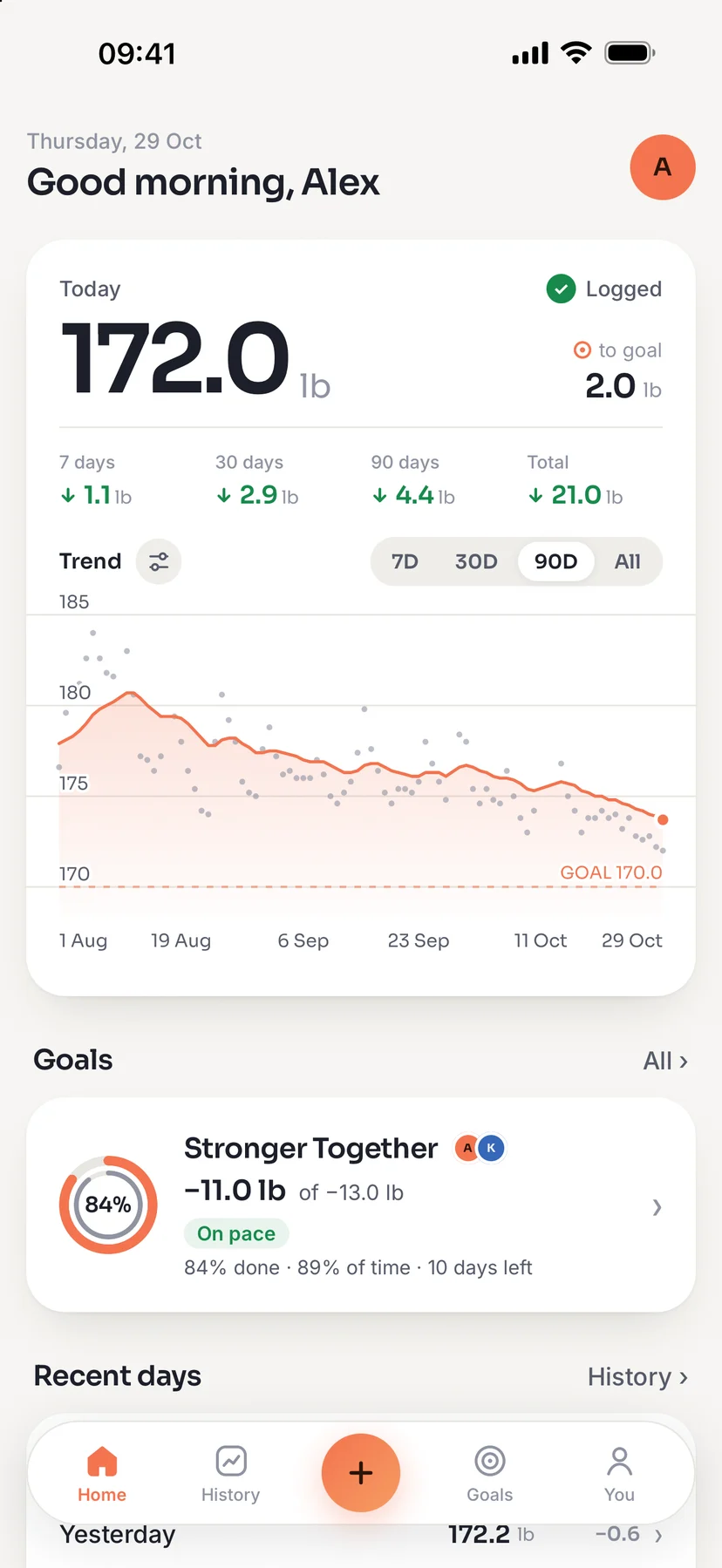
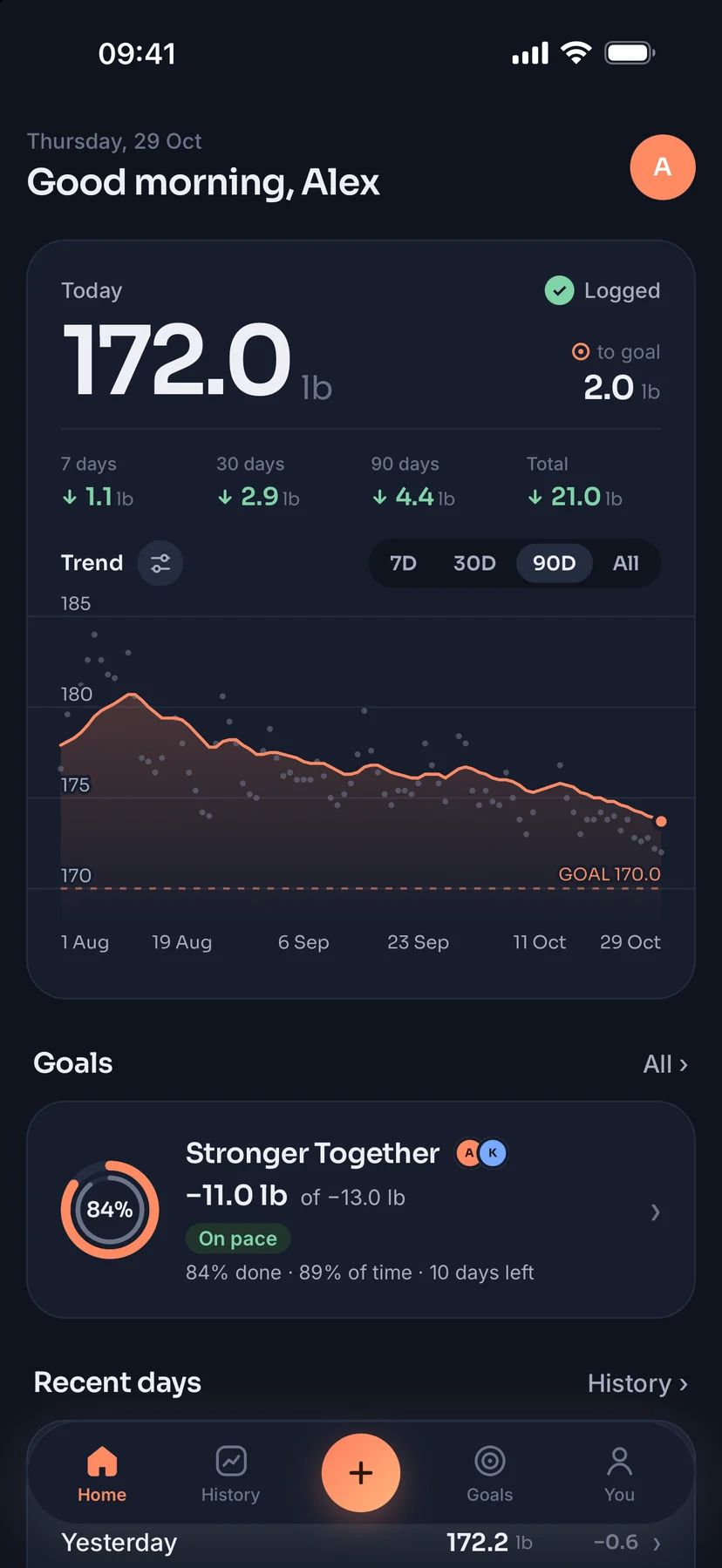
Create a Lose weight or Lose percentage goal, choose the dates, and log as usual. The goal shows your progress from 0 to 100% and whether you are ahead of pace, on pace, or behind, so you can see a slow week in the context of the whole month.
85% of the goal reached
Questions
Can you lose 10 pounds in a month?
It can happen on the scale, especially in a first month when water comes off too, but it takes about 2.3 pounds a week, which is faster than the CDC’s gradual pace of 1 to 2 pounds a week. At that pace, 10 pounds takes about 5 to 10 weeks.
How many kg can you lose in a month?
The NHS suggests aiming for 0.5 to 1 kg a week, which is about 2 to 4 kg a month. The CDC’s 1 to 2 pounds a week works out to about 2.0 to 3.9 kg a month.
Why did I lose so much weight in the first week?
Early losses include a lot of water. In a classic 10-day study of six adults with obesity on 800-calorie diets, about 37 to 61% of the weight they lost was water, depending on the diet. That part does not keep going at the same speed, so the pace usually slows after the first weeks.
Is it bad to lose weight too fast?
The NIDDK says losing weight very quickly may raise your chances of forming gallstones, and so may losing and regaining weight repeatedly. The CDC says people who lose at a gradual, steady pace are more likely to keep the weight off.
What is a realistic weight loss goal?
The NIDDK gives losing 5% of your body weight over 6 months as an example of a good initial goal, which is about 0.8% a month. The CDC says even a 5% loss could lower the risk of some chronic diseases.
Why did I lose nothing this month?
Daily swings of a few pounds can hide a slow loss for a while, so compare weekly averages rather than single mornings. If the weekly average has not moved for three to four weeks while you weigh the same way, our guides on plateaus and on why you might not be losing weight go through the usual reasons.
Sources
Show all 7 sourcesHide sources
- CDC. Steps for losing weight. 17 January 2025.
- NHS. Overweight and obesity in adults. Reviewed 29 April 2026.
- NIDDK. Treatment for overweight and obesity. Reviewed May 2023.
- NIDDK. Dieting and gallstones. Reviewed November 2017.
- Fernández-Elías VE, Ortega JF, Nelson RK, Mora-Rodriguez R. Relationship between muscle water and glycogen recovery after prolonged exercise in the heat in humans. Eur J Appl Physiol 2015;115(9):1919–1926. PubMed 25911631.
- Yang MU, Van Itallie TB. Composition of weight lost during short-term weight reduction. J Clin Invest 1976;58(3):722–730. PMC333231.
- Cleveland Clinic. 7 possible reasons why your weight fluctuates. 26 July 2024.
This guide is general information, not medical advice.