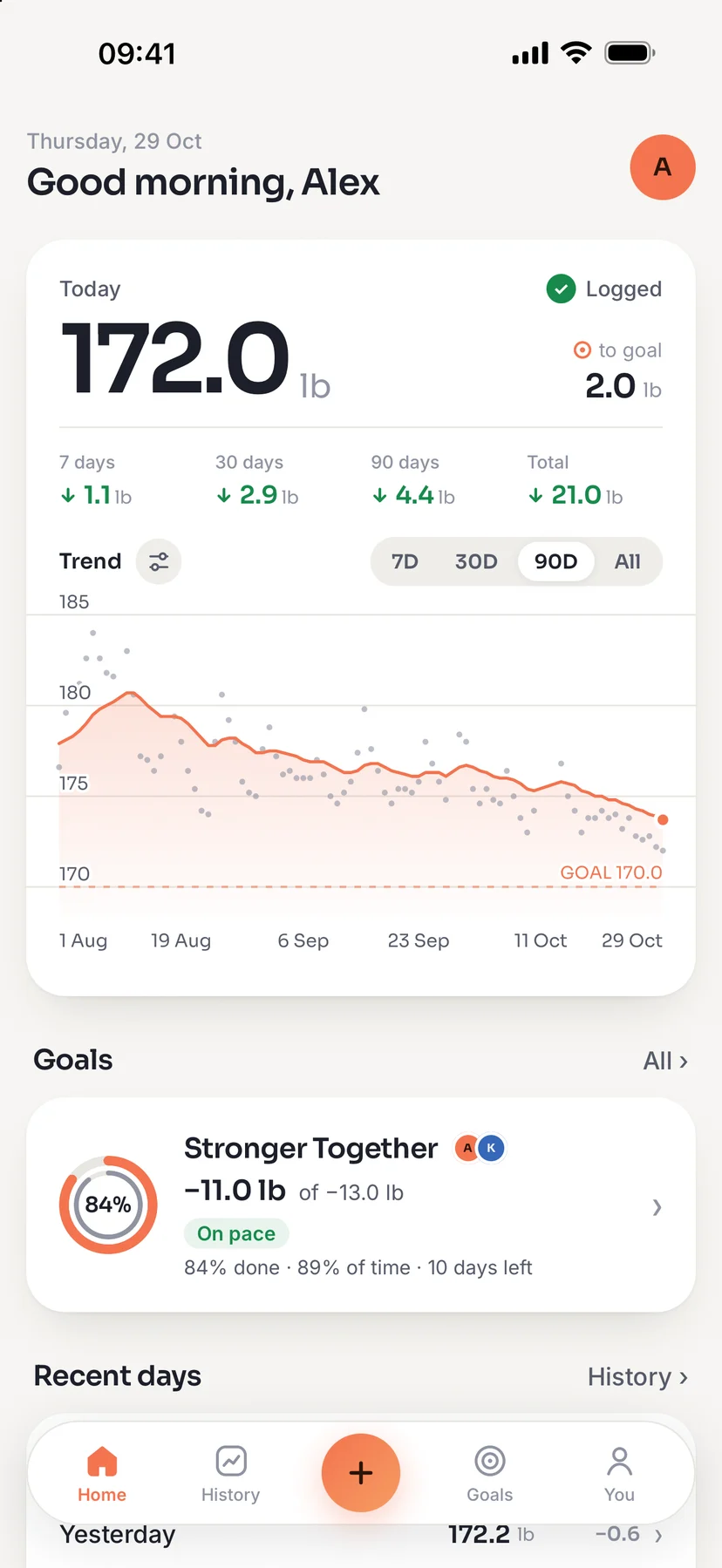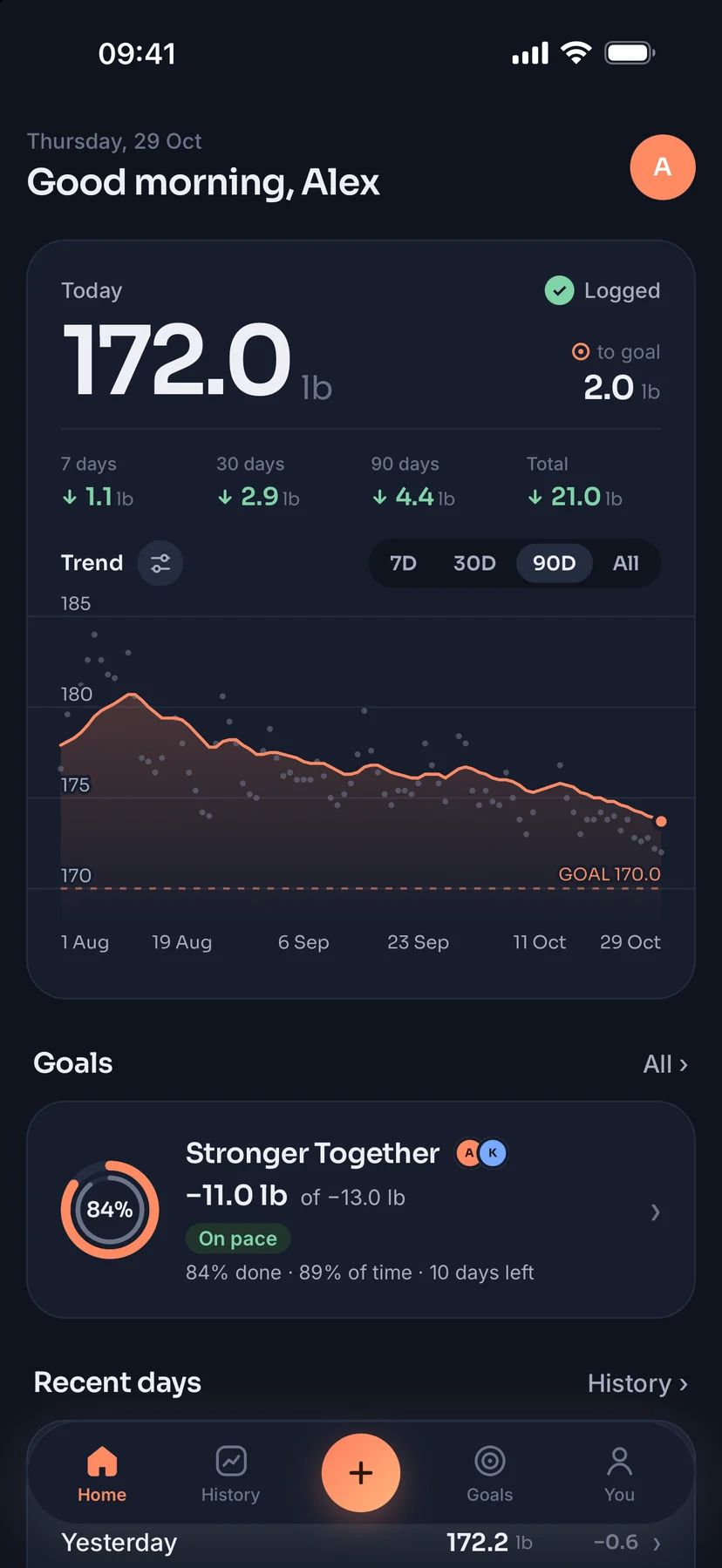
You can keep this log on paper, in a spreadsheet, or in an app. Weight Tracker is a free iPhone app built around this routine, and every step below works with any of them.
Why the trend tells you more than one reading
Body weight moves from day to day for reasons that have little to do with long-term change. Cleveland Clinic lists water retention, recent meals, exercise, hormones, stress, and some medicines among the usual causes, and describes daily swings of about 5 to 6 pounds (roughly 2.5 kg) as typical for people in a healthy weight range.
That is why a single morning rarely answers the question you care about. A log you keep for a few weeks does.
Choose where to keep your log
| Tool | Good for | Watch out for |
|---|---|---|
| Notebook | Free, private, no setup | You work out weekly averages yourself |
| Spreadsheet | Averages and charts with formulas | A mistyped number is easy to miss |
| App | Charts and averages done for you | Check what it does with your data |
| Smart scale | Readings saved without typing | University Hospitals says body composition readings are only approximate |
Want to start today? The free printable weight loss tracker is a 31-day log with a chart to plot by hand, the weight loss tracker spreadsheet works out the weekly average for you in Excel or Google Sheets, and the weight loss calendar fits a month on one page.
Step 1: Keep the setup the same
Most noise you can control comes from the way you weigh yourself. The NHS guidance on recording your weight comes down to a few habits:
- Same time of day. The NHS suggests the morning.
- Same scale, same spot. Use a firm, level floor. A bathroom is fine.
- Similar clothing. Little or none, no shoes, and nothing heavy in your pockets.
- Stand still. Keep both feet on the scale and wait until the number stops moving.
The best time to weigh yourself guide goes through each of these in more detail.
Step 2: Pick a rhythm you can keep
The NHS suggests weighing at regular intervals, from weekly to monthly, and the CDC lists recording your weight once a week among its tips for keeping weight off. Some people prefer a quick daily check instead. Both work if you stay consistent, so choose the one you are likely to keep for months, and skip any plan that makes a missed day feel like a failure.
If a reminder helps, set one for the same time you plan to weigh yourself. For what the research says about each rhythm, see how often you should weigh yourself.
Step 3: Write down the date, time, and number
Here is a two-week sample log. It includes the things that happen in real logs: a missed day, a later weigh-in, a typo, and a day with two entries. The weights are made up for this guide.
| Date | Time | Weight | Note |
|---|---|---|---|
| Mon 7 Sep | 07:05 | 78.6 kg | |
| Tue 8 Sep | 07:10 | 78.9 kg | |
| Wed 9 Sep | 06:55 | 78.4 kg | |
| Thu 10 Sep | – | Not logged | Left empty, no guess. |
| Fri 11 Sep | 07:20 | 78.2 kg | Typed as 87.2, then corrected. |
| Sat 12 Sep | 08:30 | 78.7 kg | Later than usual. |
| Sun 13 Sep | 07:15 | 78.3 kg | |
| Mon 14 Sep | 07:00 | 78.1 kg | |
| Tue 15 Sep | 07:10 | 78.4 kg | Weighed again at 21:30: 79.3. |
| Wed 16 Sep | 07:05 | 78.0 kg | |
| Thu 17 Sep | 06:50 | 77.9 kg | |
| Fri 18 Sep | – | Not logged | |
| Sat 19 Sep | 07:40 | 78.2 kg | |
| Sun 20 Sep | 07:10 | 77.6 kg |
Three habits keep a log like this useful:
- Leave missed days empty. Do not guess a number to fill the gap.
- Correct typos straight away. If Friday’s 78.2 stayed in as 87.2, week one would average 80.0 kg instead of 78.5 kg, and week two would look like a drop of about 2 kg.
- Note anything unusual. A late weigh-in or a second reading explains a number later.
Step 4: Decide what counts when you weigh twice
On Tuesday 15 September the sample log has two entries: 78.4 kg in the morning and 79.3 kg in the evening. That is a 0.9 kg difference within one day. Which number represents the day depends on the rule you pick:
| Daily value | Tue 15 Sep | Week 2 average |
|---|---|---|
| First entry | 78.4 kg | 78.0 kg |
| Latest entry | 79.3 kg | 78.2 kg |
| Average entry | 78.9 kg | 78.1 kg |
None of these is more correct than the others. If you weigh in the morning, “first” keeps your days comparable. Whichever you choose, keep it, so every week is calculated the same way.
A same-day average is not a moving average. It only combines entries from one day. A moving average blends several days together, which is a different calculation.
Step 5: Compare weeks, not days
In week one of the sample, daily weights ranged over 0.7 kg even though nothing meaningful changed.
Averaging the logged days in each week gives a steadier comparison:
| Week | Logged days | Average | Change |
|---|---|---|---|
| 7 to 13 Sep | 6 | 78.5 kg | – |
| 14 to 20 Sep | 6 | 78.0 kg | −0.5 kg |
Two weeks is still a short window. Keep going for a month or more before drawing conclusions, and look at the direction over several weeks.
Beyond the scale
The scale tells you how much you weigh, not where the change happened. A second measure is useful when the weekly average moves slowly, and some people simply find it more motivating than a number in kilograms or pounds.
Your waist
A tape measure shows change around the middle, which matters for health. NIDDK says waist sizes of 35 inches or more for women and 40 inches or more for men increase the risk of obesity-related health problems. To keep readings comparable, measure at the same spot and time of day each time, with the tape level and snug but not tight.
Free toolWaist-to-height ratio calculatorCompare your waist with your height, and see the waist size that keeps you under half your height. It also explains where to place the tape.Open the toolHow your clothes fit
Pick one item you wear often, such as a pair of jeans or a belt, and notice how it fits every few weeks. It costs nothing and needs no numbers.
Progress photos
Photos show changes you stop noticing in the mirror. Take them in the same place, light, clothes, and pose, about once a month, and keep them private unless you choose to share. Compare the first and latest photo rather than last week’s.
Steps, activity, and food habits
The CDC says monitoring can include a daily record of your steps, physical activity, and how many fruits and vegetables you eat, alongside weighing yourself once a week. They give you something to act on day to day while the weight trend builds.
How often to measure each thing
You do not need all of these. Pick one or two you will actually keep up.
| Measure | How often | Why |
|---|---|---|
| Weight | Weekly, or daily if you compare weekly averages | The CDC lists recording your weight once a week among its tips for keeping weight off. |
| Steps, activity, fruit and vegetables | Daily, if you want to | The CDC says monitoring can include a daily record of these. |
| Waist | Every 2 to 4 weeks | Our suggestion. Waist size changes slowly, so frequent measurements add little. |
| Progress photo | Every 4 weeks | Our suggestion. Same place, light, clothes, and pose. |
| How clothes fit | Whenever you wear your reference item | Our suggestion. No numbers needed. |
Put your progress in context
The same number of pounds means more at a lower starting weight, so a percentage of your starting weight is often a fairer way to see how far you have come. The CDC gives this example of a 5% loss:
The CDC adds that for people with overweight or obesity, a change like this could lower the risk for some chronic diseases, such as heart disease, prediabetes, and type 2 diabetes. Work out your own figure with the weight loss percentage calculator. To see where your weight sits for your height, the BMI calculator shows your BMI and the healthy weight range for your height.
When to talk to a professional
Cleveland Clinic advises speaking to a healthcare provider about sudden or large weight changes that have no clear explanation. If tracking starts to feel stressful, it is fine to step back or to ask a professional what to measure and how often.
Keeping this log in Weight Tracker
Weight Tracker follows the same routine without a spreadsheet:
- Log in seconds, or later. Add a weight now, or backdate an entry you forgot to save.
- Fix typos. Open the day in History and correct the weight on a manual entry, or delete it.
- Pick your daily value. Choose first, latest, or average under You → Measurements. Every entry stays in History either way.
- Skip the pressure. There are no streaks, and the optional daily reminder skips days you have already logged.
Bring your history with you. If a smart scale or another app already saves weights to Apple Health, you can import them read-only, so your trend starts with past readings.
Track with friends. A Shared Goal for 2 to 4 people shows each other’s progress and pace, never weights. To hold a steady weight once you get there, see maintenance goals.
Questions
What is the best way to track weight loss?
Weigh yourself under the same conditions each time, write down the date, time, and number, and compare weekly averages instead of single days. A waist measurement or how your clothes fit adds a second view when the scale is slow.
How often should I weigh myself to track weight loss?
The CDC lists recording your weight once a week among its tips for keeping weight off. Weighing daily also works if you judge progress by the weekly average and the number does not affect your mood.
Should I measure my waist as well as my weight?
It can help, because the scale cannot tell you where weight comes off. NIDDK says waist sizes of 35 inches or more for women and 40 inches or more for men increase the risk of obesity-related health problems.
Why does my weight go up some days when I am losing weight?
Water, food, exercise, hormones, and some medicines move the number from day to day. Cleveland Clinic describes daily swings of about 5 to 6 pounds as typical, so look at the weekly average over several weeks.
What should I do if I miss a weigh-in?
Leave the day empty and carry on. Do not guess a number to fill the gap; a weekly average of the days you did log still works.
Sources
Show all 6 sourcesHide sources
- NHS England. How to record your weight. Published 1 December 2023.
- Cleveland Clinic. 7 possible reasons why your weight fluctuates. 26 July 2024.
- CDC. Tips for keeping weight off. 15 November 2023.
- CDC. Steps for losing weight. 17 January 2025.
- University Hospitals. How often should you weigh yourself? October 2026.
- NIDDK. Am I at a healthy weight? Reviewed May 2023.
This guide is general information, not medical advice.