First, check that it has really stopped
A slow loss and no loss look the same over a few days. At the CDC’s gradual pace of 1 to 2 pounds a week, a single week’s change can be smaller than a normal daily swing.
- Weigh the same way. Morning, after the bathroom, before food or drink. See the best time to weigh yourself.
- Use weekly averages. Compare this week’s average with the one two or three weeks ago, not today with yesterday.
- Give it three to four weeks. A trend that is flat for that long is worth looking into. A flat week is not.
Common reasons the scale is not moving
| Reason | What is going on |
|---|---|
| It is water, not a stall | Salt, a period, a new workout, or a late meal can hide a real loss for a while. See Water weight. |
| The trend is still too short | Day-to-day swings of 2 to 3 lb either way can cover a slow loss. Two or three weeks of averages say more than a few mornings. See Weight fluctuation. |
| Expecting a faster pace | At the CDC’s gradual pace of 1 to 2 lb a week, a month adds up to about 4 to 9 lb, and daily swings of 2 to 3 lb either way can hide that for a week or two. |
| Exercising more | If the scale went up after you started working out, that can be normal. Cleveland Clinic says exercise, particularly strength training, can lead to short-term weight gain from added muscle. A tape measure gives a second view. See Measure progress another way. |
| Eating more than it seems | In a small, well-known study of ten people who said diets did not work for them, they underreported what they ate by almost half, on average, and overreported exercise. |
| Drinks add up | The NIDDK lists drinking a lot of beverages high in added sugars among the habits that can lead to weight gain. Drinks are easy to leave out when you think back over a day. |
| Alcohol | A standard 175 ml glass of 12% wine can contain up to 158 calories, and a pint of 5% beer up to 222, according to the NHS. Drinks are easy to leave out when you think back over a week. |
| Weight loss has slowed down | A smaller body uses less energy and appetite rises as you lose, so the same habits do less over time. See Weight loss plateaus. |
| Sleep and stress | The NIDDK links not getting enough sleep with weight gain, and lists long-term stress among the health problems that may lead to weight gain. |
| A medicine or a health condition | The NIDDK lists some medicines and conditions, such as hypothyroidism, PCOS, and Cushing’s syndrome, that can affect weight. See Medicines and health conditions. |
47%
how much ten people who said diets did not work for them underreported their food, on average
Lichtman and colleagues, 1992. They also overreported exercise by 51%.
The ten people in that study had a history of diet resistance, and their metabolism was within 5% of what was expected. It is a small study, but it shows how easy it is to misjudge what we eat. Writing everything down for a week, drinks included, is a simple way to check.
Medicines and health conditions
The NIDDK says some medicines can affect your energy balance by making you hungry or by making your body burn fewer calories. It lists, among others:
- Some medicines for epilepsy, depression, or psychotic disorders
- Corticosteroids
- Some diabetes medicines, such as insulin and sulfonylureas
- Some blood pressure medicines, including beta-blockers, alpha-blockers, and calcium channel blockers
- Some antihistamines
It also lists conditions such as hypothyroidism, polycystic ovary syndrome (PCOS), and Cushing’s syndrome. If you think a medicine is affecting your weight, the doctor who prescribed it can tell you whether there is an alternative; stopping some medicines suddenly can be harmful.
What about my thyroid?
Hypothyroidism means the thyroid makes too little thyroid hormone. The NIDDK lists weight gain among its symptoms, but it also says that symptoms such as fatigue and weight gain are common and do not necessarily mean you have a thyroid problem. A diagnosis cannot be based on symptoms alone; a blood test might confirm it. If you are worried, ask your doctor whether a test makes sense for you.
Work through it in order
Start with the simple explanations, which are also the quickest to check, and move down the list only when one does not fit.
- Confirm the stall. Three to four weeks of flat weekly averages, weighed the same way each time.
- Rule out daily swings. A few heavy mornings can hide a slow loss. See how much weight fluctuates in a day.
- Rule out water. Salt, a period, or a new workout can hold water for a while. See water weight.
- Check the quiet things. Portions, drinks, snacks, sleep, and stress. A week of writing things down often shows where.
- Check for a plateau. If you had been losing for months before it stopped, see weight loss plateaus.
- Revisit the plan, not just the effort. The weight loss planner shows a date at a steady pace, with the pace easing off as you lose.
- Think about medicines and health. Especially if nothing above fits, you have new symptoms, or you started a new medicine. See medicines and health conditions.
Measure progress another way
The scale is one view. A tape measure gives you a second one, which helps when the two seem to disagree, for example after you start strength training. Your waist also says something about health on its own. The NIDDK says these waist sizes increase the risk of obesity-related health problems:
| Group | Waist size |
|---|---|
| Women | 35 inches or more (about 89 cm) |
| Men | 40 inches or more (about 102 cm) |
Measure the same way each time, and compare every few weeks rather than every day.
Free toolWaist-to-height ratio calculatorEnter your waist and height to see your waist-to-height ratio, where you sit, and the waist size at each NICE class for your height.Check your waistWhen to talk to a doctor
Talk to a doctor if your weight stays flat or rises for several weeks with no change in your habits, if you have other new symptoms, or if you started a new medicine around the time things changed. Cleveland Clinic also advises seeing a provider about sudden or drastic weight changes with no clear cause.
Checking the trend in Weight Tracker
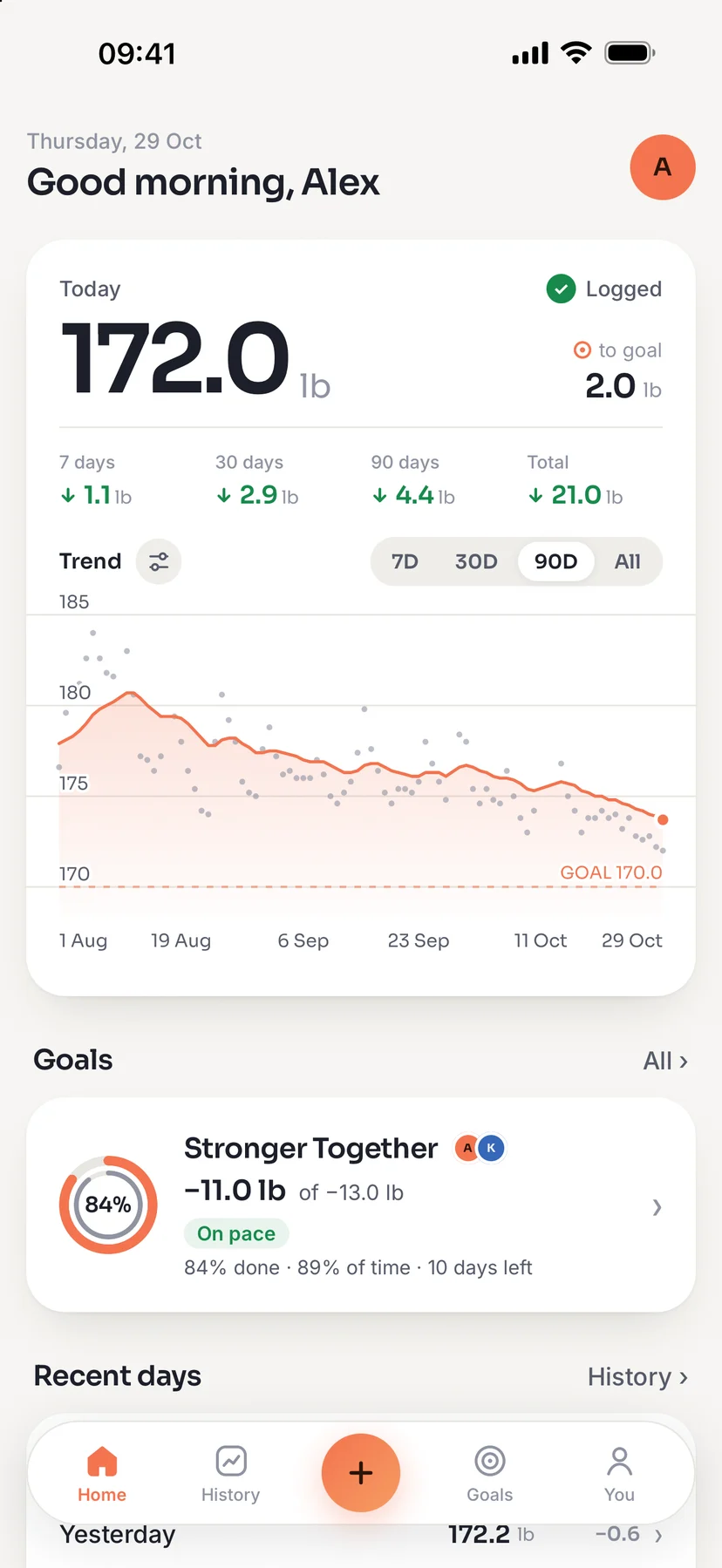
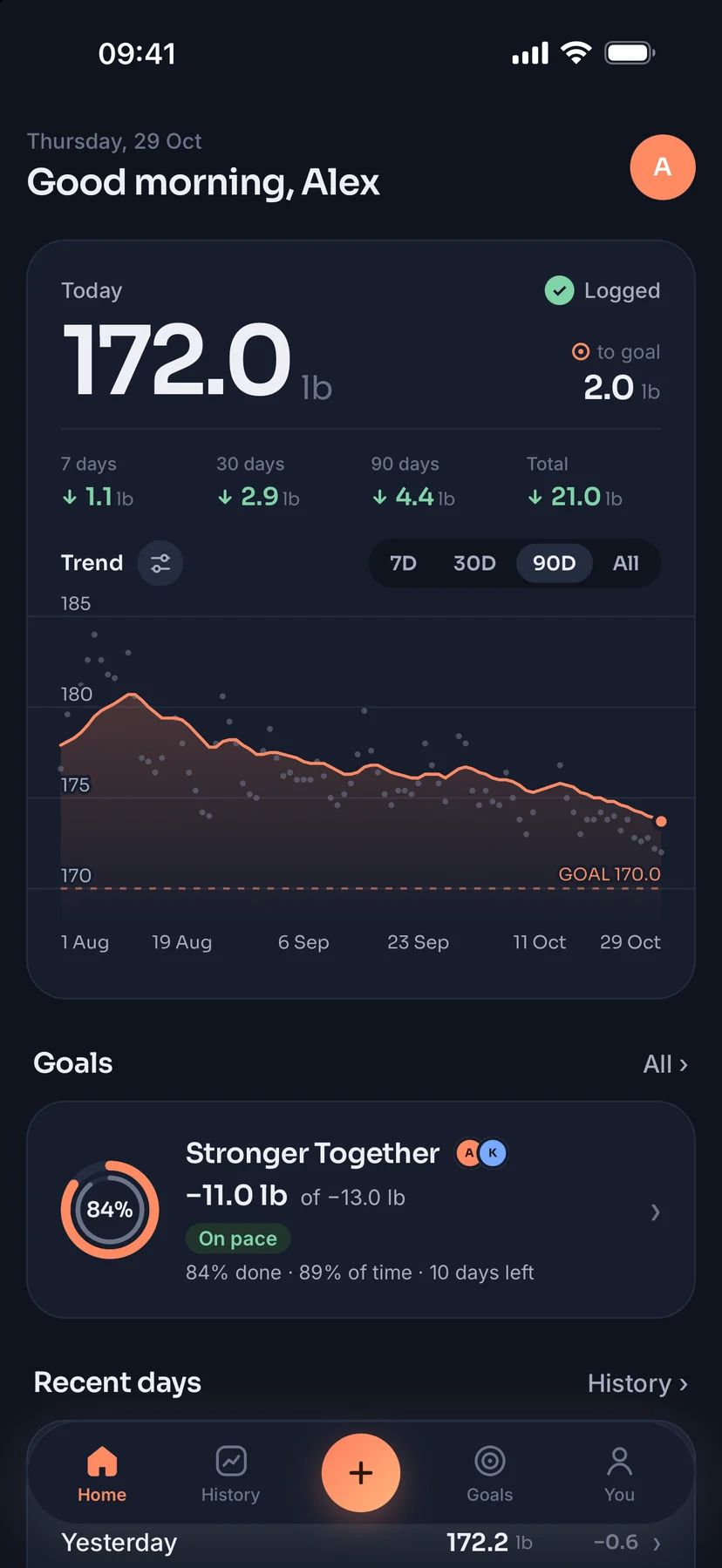
Weight Tracker charts your daily values and shows how your smoothed trend has changed over 7, 30, and 90 days, so you can see whether you have really stalled before changing anything. See weight history and trends.
If you weigh more than once a day, set Weight Tracker to use your first weigh-in of the day, so every day is measured the same way.
Questions
How long should I wait before worrying that the scale is not moving?
A flat week is normal, because daily swings can be bigger than a week of slow loss. A practical rule is to look into it once your weekly average has stayed flat for three to four weeks while you weigh the same way.
Why am I gaining weight when I work out?
Cleveland Clinic says exercise, particularly strength training, can lead to short-term weight gain from added muscle. Judge it by your weekly average over a few weeks, and consider measuring your waist as well.
Why am I not losing weight when I eat so little?
It is easy to misjudge: in a small 1992 study, people who said diets did not work for them underreported their food by 47% on average. Writing down everything you eat and drink for a week, drinks included, is a simple way to check.
Could a thyroid problem stop me losing weight?
The NIDDK lists weight gain as a symptom of hypothyroidism, but says symptoms like fatigue and weight gain are common and do not necessarily mean you have a thyroid problem. A diagnosis cannot be made on symptoms alone; a blood test might confirm it, so ask your doctor.
Can medicines make it harder to lose weight?
Yes. The NIDDK says some medicines can affect your energy balance by making you hungry or making your body burn fewer calories, including some corticosteroids, antidepressants, diabetes medicines, and blood pressure medicines. Stopping some medicines suddenly can be harmful, so changes are a conversation with the doctor who prescribed them.
What waist size is a health risk?
The NIDDK says a waist of 35 inches (about 89 cm) or more for women, or 40 inches (about 102 cm) or more for men, increases the risk of obesity-related health problems.
Sources
Show all 8 sourcesHide sources
- NIDDK. Factors affecting weight and health. Reviewed May 2023.
- NIDDK. Hypothyroidism (underactive thyroid). Reviewed March 2021.
- NIDDK. Am I at a healthy weight? Reviewed May 2023.
- Lichtman SW, et al. Discrepancy between self-reported and actual caloric intake and exercise in obese subjects. N Engl J Med 1992;327(27):1893–1898. PubMed 1454084.
- Hall KD, Kahan S. Maintenance of lost weight and long-term management of obesity. Med Clin North Am 2018;102(1):183–197. PMC5764193.
- NHS. Calories in alcohol.
- CDC. Steps for losing weight. 17 January 2025.
- Cleveland Clinic. 7 possible reasons why your weight fluctuates. 26 July 2024.
This guide is general information, not medical advice.