The short answer
Divide the weight you want to lose by the amount you expect to lose each week. The CDC says people who lose weight at a gradual, steady pace of about 1 to 2 pounds a week are more likely to keep it off, and the NHS suggests 0.5 to 1 kg a week. At those paces:
- 10 pounds takes about 5 to 10 weeks.
- 20 pounds takes about 10 to 20 weeks, or 2.3 to 4.6 months.
- 50 pounds takes about 25 to 50 weeks, around half a year to a year.
Those are constant-pace numbers. Real progress is rarely that even, which the rest of this guide explains.
How long common goals take, in pounds
| To lose | At 2 lb a week | At 1 lb a week |
|---|---|---|
| 5 lb | 3 weeks0.6 months | 5 weeks1.2 months |
| 10 lb | 5 weeks1.2 months | 10 weeks2.3 months |
| 15 lb | 8 weeks1.7 months | 15 weeks3.5 months |
| 20 lb | 10 weeks2.3 months | 20 weeks4.6 months |
| 25 lb | 13 weeks2.9 months | 25 weeks5.8 months |
| 30 lb | 15 weeks3.5 months | 30 weeks6.9 months |
| 40 lb | 20 weeks4.6 months | 40 weeks9.2 months |
| 50 lb | 25 weeks5.8 months | 50 weeks11.5 months |
| 60 lb | 30 weeks6.9 months | 60 weeks13.8 months |
| 70 lb | 35 weeks8.1 months | 70 weeks16.2 months |
| 80 lb | 40 weeks9.2 months | 80 weeks18.5 months |
| 100 lb | 50 weeks11.5 months | 100 weeks23.1 months |
How long common goals take, in kilograms
| To lose | At 1 kg a week | At 0.5 kg a week |
|---|---|---|
| 5 kg | 5 weeks1.2 months | 10 weeks2.3 months |
| 10 kg | 10 weeks2.3 months | 20 weeks4.6 months |
| 15 kg | 15 weeks3.5 months | 30 weeks6.9 months |
| 20 kg | 20 weeks4.6 months | 40 weeks9.2 months |
| 30 kg | 30 weeks6.9 months | 60 weeks13.8 months |
Why it usually takes longer than the sum
The first weeks include water. When people start eating less, much of the first drop is water rather than fat. In a classic study of six adults with obesity on two 800-calorie diets, Yang and Van Itallie found water made up more than a third of the weight lost over 10 days, and more than half on the diet very low in carbohydrate. The water weight guide explains why. A fast first fortnight does not set the pace for the weeks after it.
Later weeks slow down. A smaller body uses a little less energy, so the same habits take off less each week. Hall and colleagues showed this with a model of how the body adapts, and Hall and Chow explained why the old rule of 3,500 calories per pound predicts more loss than people see. The planner’s eased path is a simpler stand-in, not their model: it keeps the same share of your weight each week, so the weekly loss shrinks as you go:
| Goal | At a constant 1 lb a week | Easing from 1 lb a week |
|---|---|---|
| 200 to 180 lb | 20 weeks | 21 weeks |
| 230 to 200 lb | 30 weeks | 32 weeks |
| 250 to 200 lb | 50 weeks | 56 weeks |
| 300 to 200 lb | 100 weeks | 122 weeks |
Small goals barely change. Bigger ones stretch, because the end of the journey runs at a slower weekly pace than the start. Stalls of a few weeks can happen too; the weight loss plateau guide covers why.
Goal by goal, from 10 to 100 pounds
Each answer gives the range at the CDC’s 1 to 2 pounds a week, then the planner’s eased path at 1 pound a week from an example starting weight. Open the plan to change the numbers to yours.
How long does it take to lose 10 pounds?
About 5 to 10 weeks, or 1.2 to 2.3 months, at a constant 1 to 2 pounds a week. Easing from 1 pound a week, going from 180 to 170 lb takes about 10 weeks. Open this plan in the calculator.
How long does it take to lose 20 pounds?
About 10 to 20 weeks, or 2.3 to 4.6 months, at a constant 1 to 2 pounds a week. Easing from 1 pound a week, going from 200 to 180 lb takes about 21 weeks. Open this plan in the calculator.
30 pounds, in short
About 15 to 30 weeks, or 3.5 to 6.9 months, at a constant 1 to 2 pounds a week. Easing from 1 pound a week, going from 210 to 180 lb takes about 32 weeks. Open this plan in the calculator. The 30-pound guide shows how your starting weight changes this, with milestones week by week.
50 pounds, in short
About 25 to 50 weeks, or 5.8 to 11.5 months, at a constant 1 to 2 pounds a week. Easing from 1 pound a week, going from 250 to 200 lb takes about 56 weeks. Open this plan in the calculator. The 50-pound guide shows why the second half takes longer and how to split it into three goals.
How long does it take to lose 100 pounds?
About 50 to 100 weeks, or 11.5 to 23.1 months, at a constant 1 to 2 pounds a week. Easing from 1 pound a week, going from 300 to 200 lb takes about 122 weeks. Open this plan in the calculator.
For a goal of 100 pounds, a doctor can help you plan, and may talk about options beyond lifestyle changes.
What changes your pace
The tables assume the same pace from start to finish. A few things move it.
- Your starting weight. Two pounds a week is 1% of a 200 lb body and about 1.3% of a 150 lb one, so the same pace asks more of a smaller person.
- Sleep and stress. The NIDDK links not getting enough sleep with weight gain, and lists long-term stress among the problems that may lead to weight gain.
- Medicines and health conditions. The NIDDK names some medicines for depression and epilepsy, corticosteroids, and insulin, and conditions such as hypothyroidism and PCOS (NIDDK).
- Weight loss medicines. The NHS lists semaglutide, tirzepatide, and liraglutide among obesity treatments (NHS). These tables assume lifestyle changes alone, so ask your prescriber what pace to expect on one.
Faster goals, and the pace they need
A deadline turns the sum around: pounds to lose divided by the weeks you have gives the weekly pace it needs.
| Goal | Pace a week | Within 1 to 2 lb a week? |
|---|---|---|
| 10 lb in 1 month | 2.3 lb | No, faster than that |
| 20 lb in 2 months | 2.3 lb | No, faster than that |
| 20 lb in 3 months | 1.5 lb | Yes |
| 30 lb in 3 months | 2.3 lb | No, faster than that |
| 50 lb in 6 months | 1.9 lb | Yes |
Faster is not always better. The CDC warns that unrealistic goals, such as 20 pounds in two weeks, can leave you feeling defeated, and the NIDDK says losing weight very quickly may raise your chances of forming gallstones. A date that needs more than 2 pounds a week is beyond the CDC’s steady pace. The how much weight can you lose in a month guide goes deeper on pace.
Milestones on the way
A long timeline is easier with stops along it. The NIDDK gives losing 5% of your body weight over six months as an example of a good first goal, and the CDC says that for people with overweight or obesity, even a 5% loss could lower the risk of some chronic diseases. From 200 pounds, 5% is 10 pounds: NIDDK’s example spreads it over six months, and at the CDC’s steady pace it would take about 5 to 10 weeks. The weight loss percentage calculator shows where you are against 5, 10, and 15%.
Day to day, the scale will not follow the plan exactly. Cleveland Clinic describes a normal daily window of about 5 to 6 lb, 2 to 3 lb either way, so judge progress by the weekly trend. See how much weight fluctuates in a day.
Putting a date on your goal
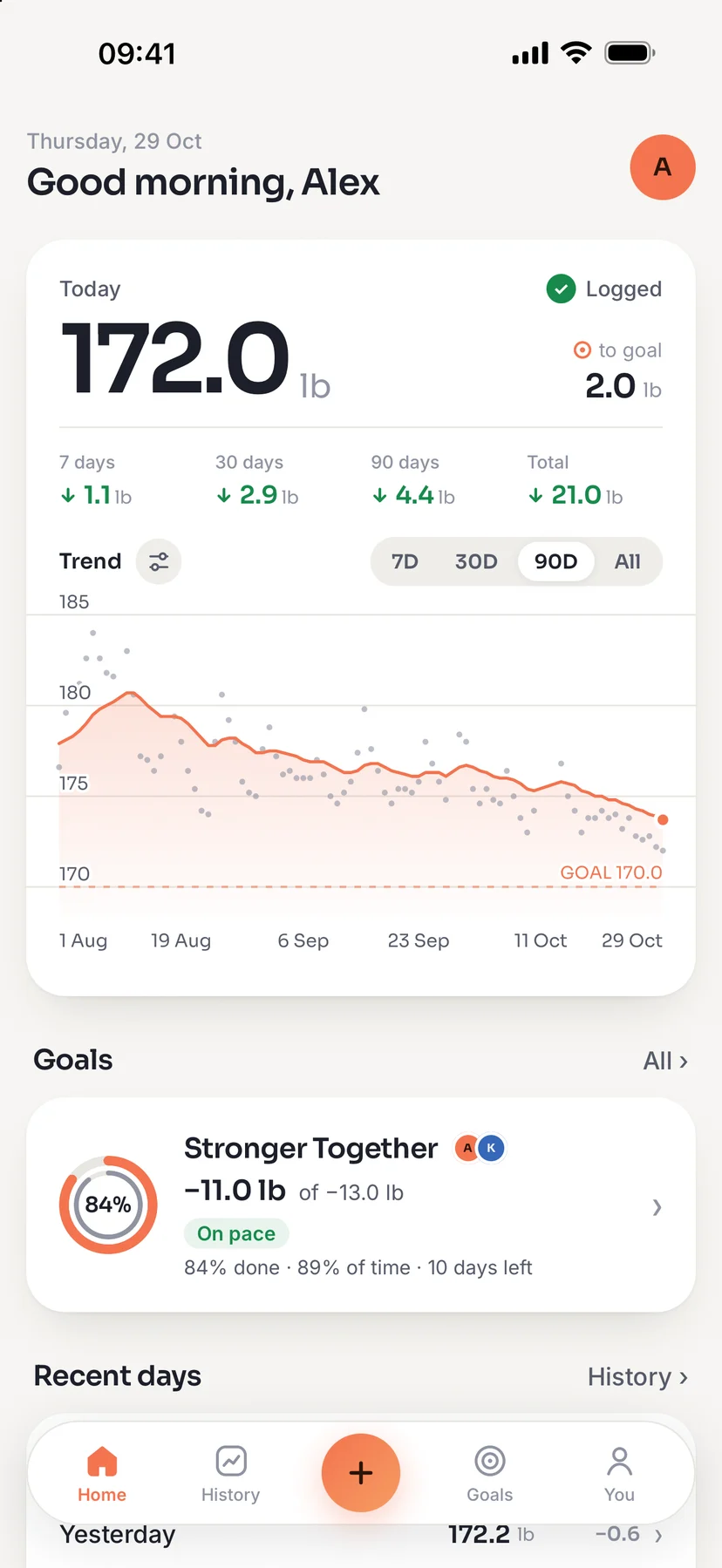
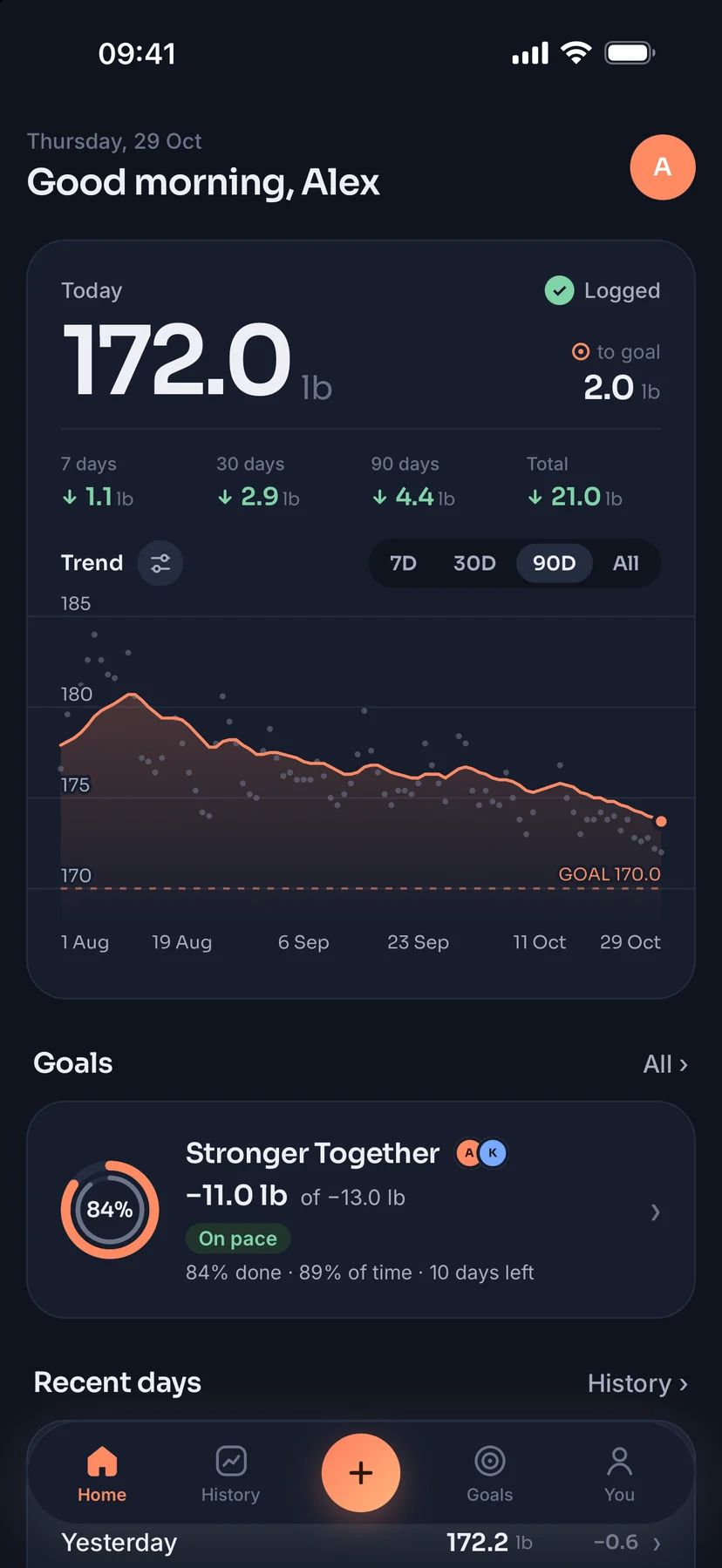
Set a goal with a start and end date, and Weight Tracker shows whether you are ahead, on pace, or behind, using how much of the goal’s time has passed. See personal weight goals.
If you already weigh yourself on a smart scale, Weight Tracker can read your past weights from Apple Health, so your goal starts from your real trend instead of one morning.
85% of the goal reached
Questions
How long does it take to lose 20 pounds?
About 10 to 20 weeks, or 2.3 to 4.6 months, at the CDC’s steady pace of 1 to 2 pounds a week. Because the weekly loss usually shrinks as you go, plan for a little longer.
How long does it take to lose 10 pounds?
About 5 to 10 weeks at 1 to 2 pounds a week. The first week or two can look faster, because some of the early loss is water.
Can you lose 20 pounds in a month?
It needs about 4.6 pounds a week, more than twice the top of the CDC’s steady range. The CDC warns that goals like losing 20 pounds in two weeks can leave you feeling defeated. A longer timeline is easier to keep.
How long does it take to lose 10 kg?
About 10 to 20 weeks, or 2.3 to 4.6 months, at the NHS’s suggested 0.5 to 1 kg a week.
Why is my weight loss slower than at the start?
Two reasons. The first weeks include water, which comes off quickly. Later, a smaller body uses a little less energy, so the same habits take off less each week. Both are normal.
How long before I see results on the scale?
The first week or two often show a drop, partly from water. After that, a loss of 1 lb a week is smaller than a normal daily swing of 2 to 3 lb either way (Cleveland Clinic), so compare weekly averages over two or three weeks before judging. A tape measure and the fit of your clothes give a second view.
Sources
Show all 9 sourcesHide sources
- CDC. Steps for losing weight. 17 January 2025.
- Cleveland Clinic. 7 possible reasons why your weight fluctuates. 26 July 2024.
- NHS. Overweight and obesity in adults. Reviewed 29 April 2026.
- NIDDK. Treatment for overweight and obesity. Reviewed May 2023.
- NIDDK. Factors affecting weight and health.
- NIDDK. Dieting and gallstones. Reviewed November 2017.
- Yang MU, Van Itallie TB. Composition of weight lost during short-term weight reduction. J Clin Invest 1976;58(3):722–730. PMC333231.
- Hall KD, Sacks G, Chandramohan D, et al. Quantification of the effect of energy imbalance on bodyweight. Lancet 2011;378(9793):826–837. PMID 21872751.
- Hall KD, Chow CC. Why is the 3500 kcal per pound weight loss rule wrong? Int J Obes 2013;37(12):1614. PMC3859816.
This guide is general information, not medical advice.