Pick a pace or a date to see when you reach your goal, what a normal day looks like on the scale, and whether you are on track.
Printed from https://weightracker.app/tools/weight-loss-planner/. For general information, not medical advice.
Choosing a pace
The same goal at three paces
The CDC describes about 1 to 2 lb (0.5 to 0.9 kg) a week as gradual and steady, and people who lose weight that way are more likely to keep it off. Here is roughly what each pace means for losing 10 kg, about 22 lb, at a constant pace; the planner’s eased path adds a little time.
Gentle
40weeks
0.25 kg (½ lb) a week. Easy to fit around life. Takes the longest.
Steady
20weeks
0.5 kg (1 lb) a week. The lower end of the CDC’s gradual, steady range.
Faster
11weeks
0.9 kg (2 lb) a week. The top of that range. The planner flags anything faster.
The CDC also warns that goals like losing 20 pounds in two weeks can leave you feeling defeated.
How long common goals take
In pounds
To lose
At 1 lb a week
At 2 lb a week
10 lb
10 weeks2.3 months
5 weeks1.2 months
20 lb
20 weeks4.6 months
10 weeks2.3 months
30 lb
30 weeks6.9 months
15 weeks3.5 months
50 lb
50 weeks11.5 months
25 weeks5.8 months
100 lb
100 weeks23.1 months
50 weeks11.5 months
In kilograms
To lose
At 0.5 kg a week
At 0.9 kg a week
5 kg
10 weeks2.3 months
6 weeks1.3 months
10 kg
20 weeks4.6 months
11 weeks2.6 months
15 kg
30 weeks6.9 months
17 weeks3.8 months
20 kg
40 weeks9.2 months
22 weeks5.1 months
30 kg
60 weeks13.8 months
33 weeks7.7 months
At a constant pace. Because progress usually slows as you go, bigger goals take longer on the planner’s eased path. Put in your own numbers above to see yours, or read how long it takes to lose 10 to 100 pounds, with full timelines for 30 pounds and 50 pounds.
How it works
How long will it take to lose weight?
The planner runs one simple sum, by pace or by date, then lets the pace ease off as you lose, because loss tends to slow over time.
Plan by pace
10 kg0.5 kg/wk=20 weeks
Going from 90 kg to 80 kg at a constant 0.5 kg a week.
Plan by date
10 kg16 weeks=0.6 kg/wk
The same sum the other way: the weight to lose divided by the weeks you have.
Eases as you lose
100 kg75 kg
Straight line, 25 weeksEased, about 29 weeks
From 100 to 75 kg starting at 1 kg a week. A lighter body uses less energy, so the planner keeps the same share of your weight each week, and near the goal the weekly loss is about 0.75 kg. Choose Straight line for the simple sum.
Treat the date as a guide. Your scale will bounce around the line and some weeks will be flat. Why weight fluctuates explains how much of that is normal.
Reading your plan
Your plan
The line is the weight the plan expects on each day from your start to your goal. With Eases as you lose, it curves a little as the weekly loss gets smaller.
Normal range
The shaded band is a normal daily swing of up to about 3 lb (1.4 kg) either side, the top of the 2 to 3 lb Cleveland Clinic describes. A weigh-in inside it is on plan.
Milestones
Dates for losing 5% and 10% of your starting weight, for halfway, and for your goal. Add your height to see when your BMI drops under 25.
Weigh-in plan
Week by week, where the plan expects you and the range that counts as a normal day. Save it as a CSV or add weekly weigh-in reminders to your calendar.
Many weight loss calculators use an old rule of thumb: a deficit of 3,500 calories takes off one pound, every time. Followed to the letter, it predicts the same loss every week until you reach your goal, and it never slows down.
Researchers at the National Institutes of Health showed that the rule overestimates weight loss. As you lose weight your body needs less energy, so the same habits take off a little less each week. In their model, about half of the change from a lasting change in eating shows up in the first year, and nearly all of it within about three.
That is why this planner eases the pace by default, with a simple steady-share curve rather than their full model, and why its dates land a little later than a straight line. If a calculator shows a steady 2 pounds a week for a whole year, it is assuming the loss never slows.
What usually happensThe 3,500-calorie ruleIllustration, not to scale.
Picking a goal
Choosing a goal weight
There is no single right goal weight. These are three common ways to set one, and the planner works with any of them. The healthy weight for height chart shows the range at each height, and a doctor can help you choose a goal that fits your health.
In the healthy BMI range
For adults, the CDC puts a BMI of 18.5 to under 25 in the healthy weight category. BMI is a screening measure, so treat it as one input, not a verdict.
A goal like 5% or 10% of your starting weight grows with you and is easy to check on the scale. It also works when a healthy BMI is still a long way off.
For general information, not medical advice. A doctor can help you choose goals that are right for you.
How long will it take to reach my goal weight?
Divide the weight you want to lose by your weekly pace for a rough answer: 10 kg at 0.5 kg a week is 20 weeks. The planner goes a step further and lets the pace ease as your weight falls, reflecting that loss slows over time, then shows the date, milestones, and when your BMI drops under 25.
How long does it take to lose 20 pounds?
At the CDC’s gradual, steady pace of 1 to 2 pounds a week, losing 20 pounds takes about 10 to 20 weeks, or roughly 2 to 5 months. Progress usually slows a little as you go, so the planner’s eased path adds some time. Enter your own numbers above for a date.
How much weight can I lose in a month?
At 1 to 2 pounds a week, a month adds up to about 4 to 9 pounds, or about 2 to 4 kg. Daily swings from water and food mean a single month can look better or worse than the real trend. Our guide on how much weight you can lose in a month goes into more detail.
What is a realistic weekly pace?
The CDC says people who lose weight at a gradual, steady pace of about 1 to 2 pounds a week (about 0.5 to 0.9 kg) are more likely to keep it off. The slider marks that range in green, and the planner flags any starting pace faster than that.
What if my date needs more than 2 pounds a week?
The planner marks the pace as faster than the CDC’s steady range and shows the dates you would reach your goal at 1 to 2 pounds a week instead. From there you can move the date, plan a goal on the way to your final one, or keep the date and see what it asks of you.
Why does the plan slow down over time?
A smaller body uses less energy, so the same habits take off a little less each week. Research by Hall and colleagues found that weight responds slowly to a change in eating, with about half of the change in the first year. Eases as you lose is a simple stand-in for that slowing, not their model: it keeps the same share of your weight each week. Choose Straight line if you prefer a simple constant pace.
How do I know if I am on track?
Enter a weigh-in under Check your progress. The planner compares it with the plan for that day, allowing for a normal day-to-day swing of up to about 3 lb (1.4 kg), and tells you whether you are ahead, on pace, or behind, with an updated goal date.
Why doesn’t my weight follow the line?
Daily weight moves with water, food, and salt, so real weigh-ins zigzag around the plan. The shaded band on the chart and the range in the weigh-in plan show what counts as a normal day. Judge your progress by the trend over a few weeks, not one morning.
Do I need to count calories to use this?
No. The plan works on weight alone. The optional energy estimate shows roughly how much energy your body uses now and at your goal, using the Mifflin–St Jeor equation and an activity level like the NIH Body Weight Planner’s. Treat it as background, not a target. If you want a daily calorie number for a date, the NIH Body Weight Planner estimates the calories to reach your goal by that date and to hold it afterwards. It is meant for adults 18 and over, and not during pregnancy or breastfeeding.
Can I put the plan in my calendar?
Yes. Add weigh-ins to calendar saves a calendar file with a weekly weigh-in reminder and your goal date, for Apple Calendar, Google Calendar, or Outlook. The weigh-in plan can also be saved as a CSV. Both are made in your browser; nothing is sent to us.
Is what I enter private?
Yes. The planner runs in your browser and does not send your numbers to us. A share link keeps them after the # in the address, a part browsers do not send to the website. Numbers are also remembered in your open tab so the other tools can reuse them, and they are cleared when you close it.
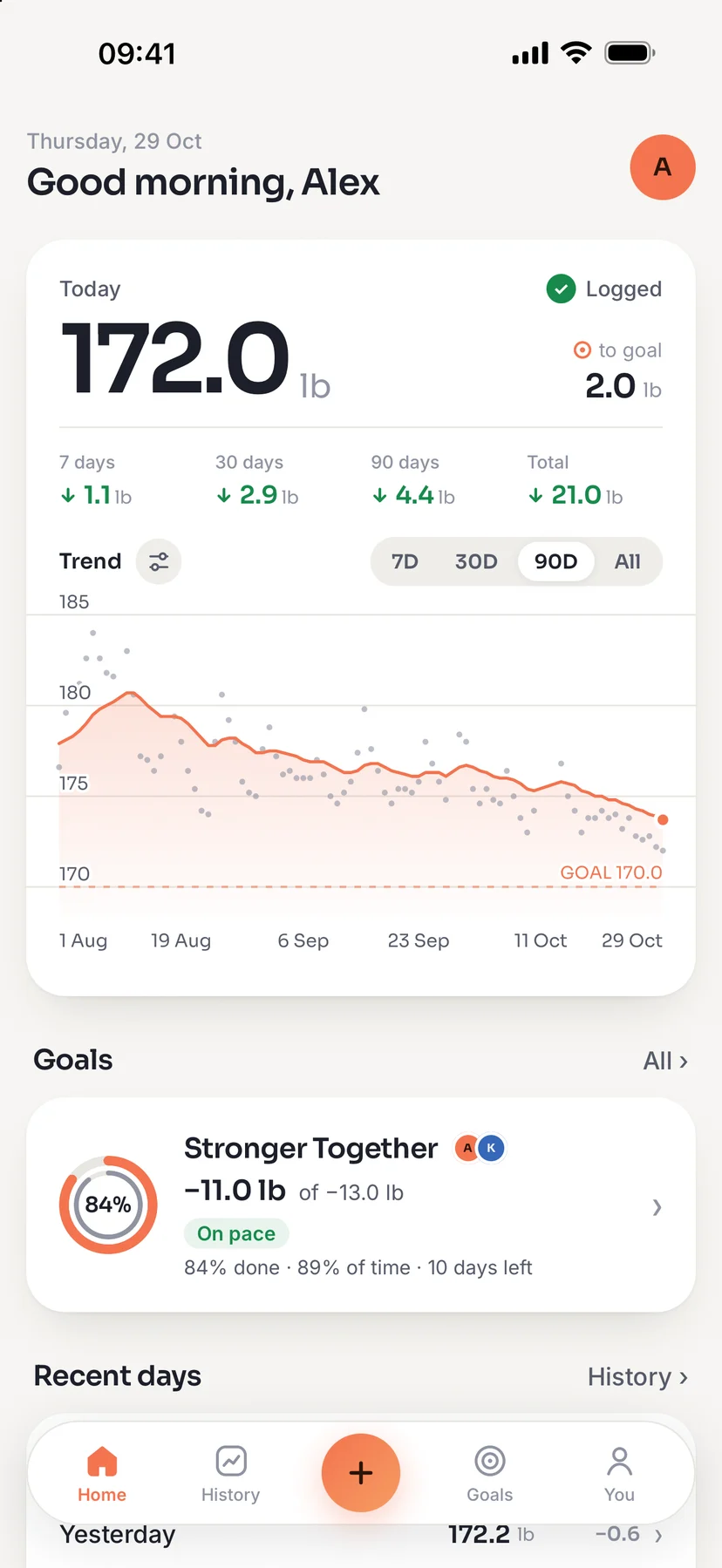
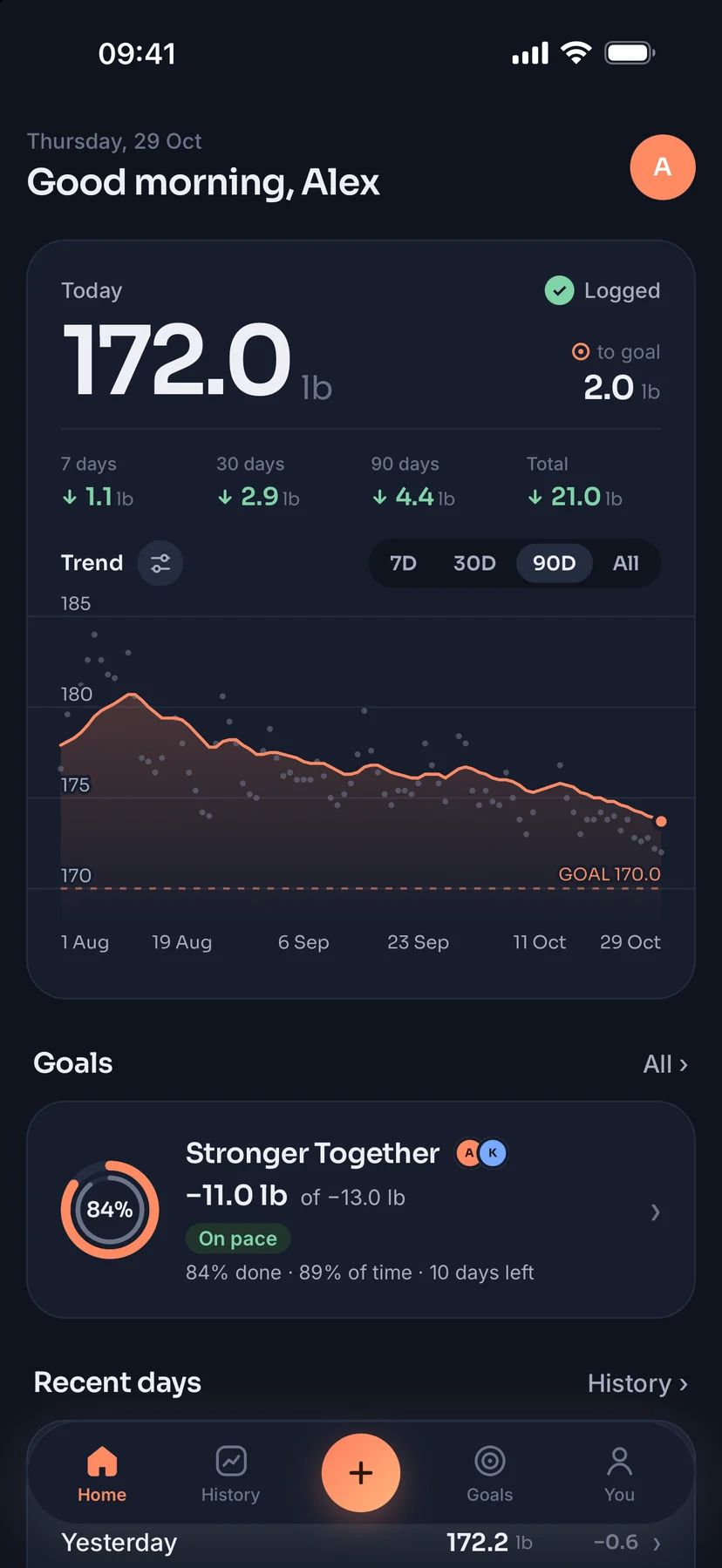
Pick a target weight and your own dates, and progress and pace show whether you are on track. If you already weigh yourself on a smart scale, Weight Tracker reads your past weights from Apple Health, so the goal starts from your real trend.