The short answer
Divide 30 by the pounds you expect to lose each week. The CDC says people who lose weight at a gradual, steady pace of about 1 to 2 pounds a week are more likely to keep it off. At 2 pounds a week, 30 pounds takes 15 weeks (3.5 months); at 1 pound a week, 30 weeks (6.9 months). In kilograms, 30 pounds is about 13.6 kg, and the NHS’s 0.5 to 1 kg a week gives about 14 to 27 weeks.
Those are straight-line numbers. Real weeks are uneven, and the weekly loss usually gets smaller as you go, which is why the rest of this guide plans for the longer end. Our guide to how long it takes to lose weight has the same sum for 5 to 100 pounds.
How your starting weight changes the answer
Thirty pounds is a different job at 160 pounds than at 300. One way to see it is as a share of your body weight:
| Start | 30 lb is | Easing from 1 lb a week | Easing from 0.5% a week |
|---|---|---|---|
| 160 to 130 lb | 18.8% | 33 weeks | 42 weeks |
| 180 to 150 lb | 16.7% | 33 weeks | 36 weeks |
| 200 to 170 lb | 15.0% | 33 weeks | 33 weeks |
| 230 to 200 lb | 13.0% | 32 weeks | 28 weeks |
| 260 to 230 lb | 11.5% | 32 weeks | 25 weeks |
| 300 to 270 lb | 10.0% | 32 weeks | 21 weeks |
Both right-hand columns use the planner’s eased path, which keeps the same share of your weight each week, so the weekly loss shrinks as you go. Starting at a fixed 1 pound a week, every row takes about 32 to 33 weeks: the start barely matters. Starting at 0.5% of your weight a week, the planner’s steady preset, the gap is wide: about 42 weeks from 160 pounds and 21 from 300.
The second view is closer to how bodies tend to behave: a larger body uses more energy, so the same habits usually take off more pounds a week at the start. If you begin nearer the top of the table, the 2-pounds-a-week end of the range is more realistic; nearer the bottom, plan for 1 pound a week or less.
Free toolWeight loss calculator by dateEnter your own start and goal, pick a pace in pounds or as a share of your weight, and get a date.Plan your 30 poundsA 30-pound plan, week by week
Here is the planner’s eased path from 210 to 180 pounds, starting at 1.5 pounds a week. It reaches the goal in about 22 weeks, around 5.0 months, and by the end the weekly loss is down to about 1.3 pounds.
| Milestone | Weight | Around week |
|---|---|---|
| First 5% | 199.5 lb | 7 |
| First 10 lb | 200.0 lb | 7 |
| 10% of the start | 189.0 lb | 15 |
| 20 lb down | 190.0 lb | 14 |
| Goal: 30 lb down | 180.0 lb | 22 |
The first 10 pounds take about 7 weeks and the last 10 about 8. Nothing went wrong in between: the plan expects the slowdown. Open this plan in the calculator and change the numbers to yours.
Three stages of a 30-pound goal
The first month: fast, partly water
The first week or two often drop quickly. Part of that is water: in a classic study of six adults with obesity on 800-calorie diets, water made up more than a third of the weight lost over 10 days (Yang and Van Itallie). Enjoy it, but do not set your expectations by it. The water weight guide explains why it happens.
The middle: steady, with bumps
Most of the 30 pounds come off here, at something close to your steady pace. Expect weeks that stall and weeks that drop more than usual. Day to day the scale can swing by 2 to 3 pounds either way (Cleveland Clinic), more than a whole week of loss, so judge by weekly averages. If the average has not moved for three or four weeks, see the weight loss plateau guide.
The last 10 pounds: slower on purpose
A smaller body uses a little less energy, so the same routine takes off less each week. Hall and colleagues showed this adaptation in their model of energy balance, and it is why the old 3,500-calories-per-pound rule promises more than people see (Hall and Chow). Plan the last stretch at a slower pace from the start, and it will not feel like failure when it arrives.
30 pounds by a deadline: the pace each one needs
Turn the sum around and a deadline tells you the weekly pace it asks for.
| 30 lb in | Pace a week | Compared with the CDC range |
|---|---|---|
| 2 months | 3.5 lb | Faster than 2 lb a week |
| 3 months | 2.3 lb | Faster than 2 lb a week |
| 4 months | 1.7 lb | Within 1 to 2 lb a week |
| 5 months | 1.4 lb | Within 1 to 2 lb a week |
| 6 months | 1.2 lb | Within 1 to 2 lb a week |
| 9 months | 0.8 lb | Gentler than 1 lb a week |
| 12 months | 0.6 lb | Gentler than 1 lb a week |
Two or three months asks for more than 2 pounds a week. The CDC warns that unrealistic goals can leave you feeling defeated, and the NIDDK says losing weight very quickly may raise the chance of gallstones. Four to six months sits inside the steady range, and nine to twelve months is a gentle pace that leaves room for holidays and slow weeks. More on monthly pace in how much weight you can lose in a month.
What 30 pounds can change
For many people, 30 pounds is 10 to 15% of their starting weight. The NIDDK gives losing 5% of your body weight over six months as an example of a good first goal, and the CDC says that for people with overweight or obesity, a loss of 5 to 10% may improve blood pressure, blood cholesterol, and blood sugar. So the first 5% is a real milestone, not just a step toward 30 pounds.
Body mass index moves too. For someone 5 feet 7 inches tall, going from 210 to 180 pounds takes BMI from about 32.9 to 28.2. BMI is a screening number, not a verdict on health; the BMI calculator shows the healthy range for your height, and the weight loss percentage calculator shows where you are against 5, 10, and 15%.
Keeping track of a 30-pound goal
- Weigh the same way each time. Morning, after the toilet, before eating, on the same scale. See the best time to weigh yourself.
- Compare weekly averages. Over four to seven months there will be dozens of odd mornings. The average of a week is the number to plan with.
- Check in at each milestone. 5%, 10 pounds, 10%, 20 pounds. Each one is a chance to adjust the plan rather than a test you pass or fail.
- Write it down somewhere you will see it. The free printable weight loss tracker covers 12 weeks of averages per page, and the weight loss tracker spreadsheet keeps a year of weigh-ins and works out the 7-day average for you.
Putting a date on your 30 pounds
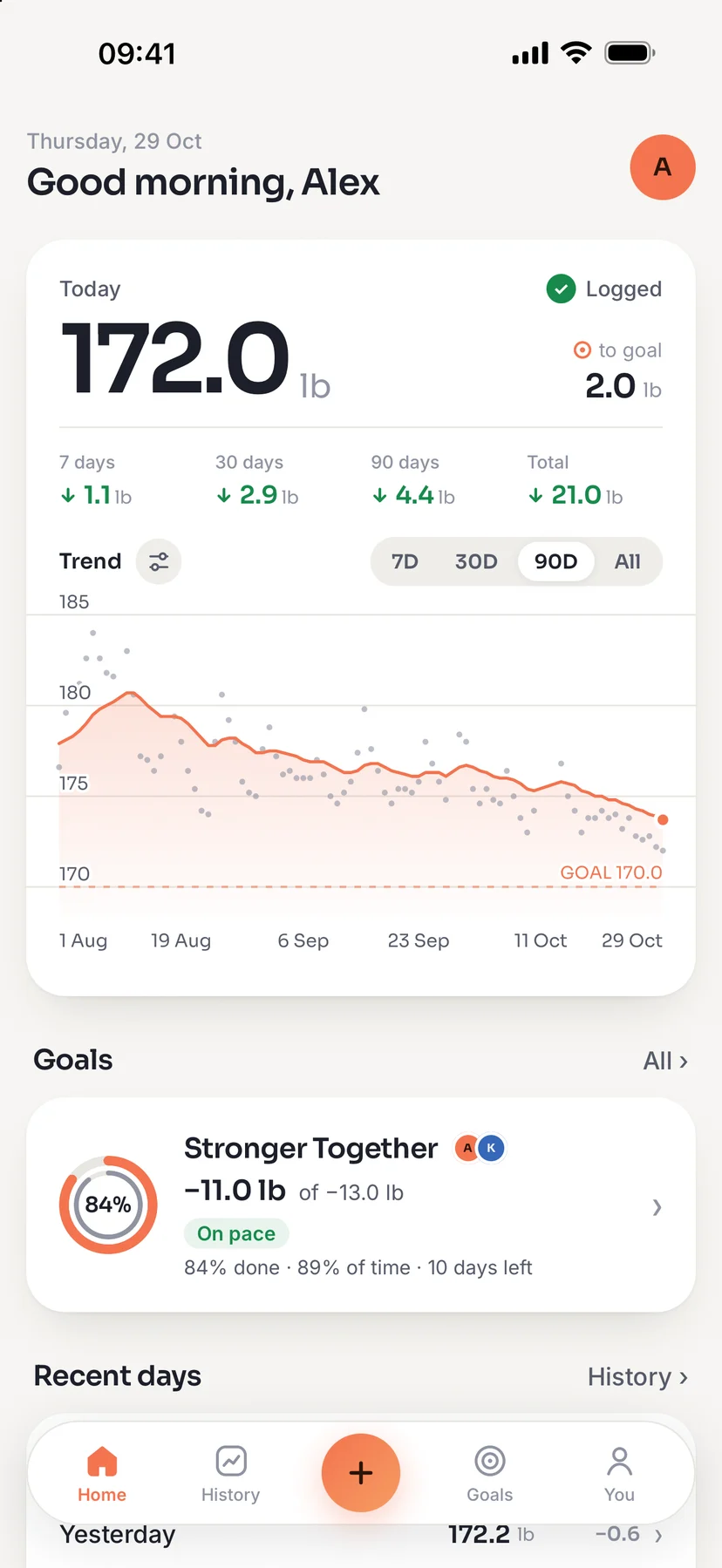
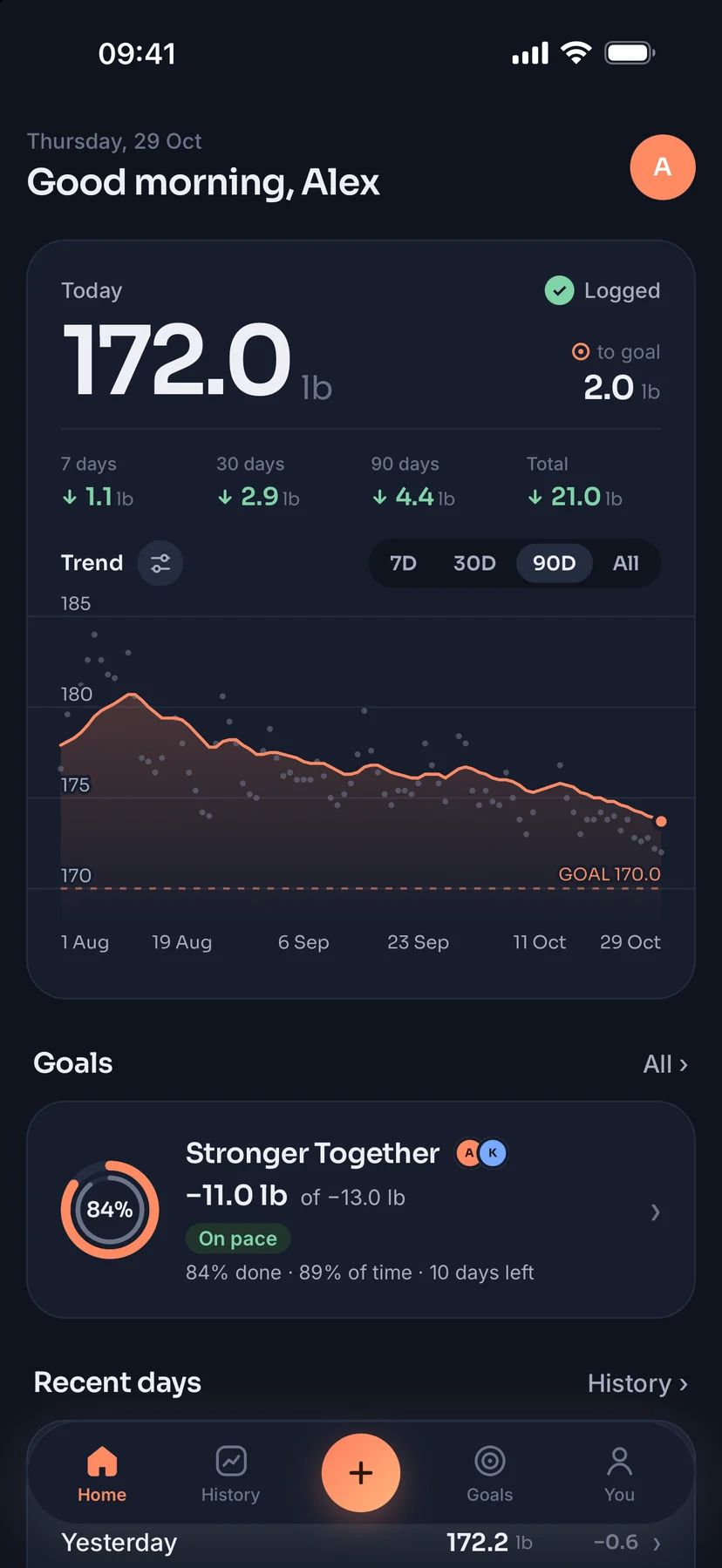
In Weight Tracker, set a goal to lose 30 pounds with a start and end date, and Pace shows each day whether you are ahead, on pace, or behind, using how much of the goal’s time has passed. See personal weight goals. To hold the new weight once you get there, see maintenance.
85% of the goal reached
Questions
How long does it take to lose 30 pounds?
About 15 to 30 weeks, or 3.5 to 6.9 months, at the CDC’s steady pace of 1 to 2 pounds a week. Because the weekly loss usually shrinks as you go, plan for the longer end, or a little beyond it.
Can I lose 30 pounds in 3 months?
It needs about 2.3 pounds a week for 13 weeks, faster than the top of the CDC’s 1 to 2 pounds a week. Four months (about 1.7 lb a week) or five (about 1.4 lb a week) fits the steady range.
Is 30 pounds in 2 months possible?
It would take about 3.5 pounds a week, well beyond a steady pace. The NIDDK says losing weight very quickly may raise the chance of gallstones, so a goal like this is one to plan with a doctor, not alone.
How much is 30 pounds in kilograms, and how long does that take?
30 pounds is about 13.6 kg. At the NHS’s suggested 0.5 to 1 kg a week, that is about 14 to 27 weeks.
Why did the first 10 pounds come off faster than the rest?
Part of the early loss is water, which comes off quickly when you start eating less. Later, a smaller body uses a little less energy, so the same habits take off less each week. Both are normal and expected.
Is losing 30 pounds a lot?
It depends on where you start: 30 pounds is 18.8% of 160 pounds and 10.0% of 300. The NIDDK gives 5% over six months as an example first goal, so for most people 30 pounds is two or three goals in a row rather than one.
Sources
Show all 8 sourcesHide sources
- CDC. Steps for losing weight. 17 January 2025.
- NHS. Overweight and obesity in adults. Reviewed 29 April 2026.
- NIDDK. Treatment for overweight and obesity. Reviewed May 2023.
- NIDDK. Dieting and gallstones. Reviewed November 2017.
- Cleveland Clinic. 7 possible reasons why your weight fluctuates. 26 July 2024.
- Yang MU, Van Itallie TB. Composition of weight lost during short-term weight reduction. J Clin Invest 1976;58(3):722–730. PMC333231.
- Hall KD, Sacks G, Chandramohan D, et al. Quantification of the effect of energy imbalance on bodyweight. Lancet 2011;378(9793):826–837. PMID 21872751.
- Hall KD, Chow CC. Why is the 3500 kcal per pound weight loss rule wrong? Int J Obes 2013;37(12):1614. PMC3859816.
This guide is general information, not medical advice.