How much daily fluctuation is normal
More than most people expect. In its article on why weight fluctuates, Cleveland Clinic says that even for people within a healthy weight range, the average fluctuation is a window of about 5 to 6 pounds a day.
5–6 lb
the average daily swing, according to Cleveland Clinic
That is 2 to 3 lb (0.9 to 1.4 kg) in either direction, or about 2.3–2.7 kg from low to high.
Cleveland Clinic’s guide to weighing yourself calls a change of a pound or two from day to day realistic, and a 5-pound range common. A bigger jump is still usually water and food, not fat.
Weekly patterns exist too. In a European study using smart scales, weight rose slightly over weekends and fell during the week, and rose by about 1.35% on average over the Christmas period (Turicchi and colleagues, 2020).
What causes weight to fluctuate
Your weight fluctuates from day to day mostly because of water and food, not fat. Salt and carbohydrate make your body hold extra water, food and drink weigh something until they are digested and passed, and hormones and exercise shift fluid too. So a jump overnight is usually water or food.
| Cause | What happens |
|---|---|
| Water retention | The most common cause of short-term changes, often after salty or carbohydrate-heavy meals. |
| Food and digestion | Everything you eat or drink adds a little weight while it passes through your body. |
| Carbohydrate | Stored carbohydrate (glycogen) holds water, so a carbohydrate-heavy day can show on the scale the next morning. |
| Exercise | Strength training can add weight as muscle grows, and fluid shifts after a session can move the number either way. |
| Hormones | Changes across the menstrual cycle, in pregnancy, or around menopause. |
| Alcohol | Cleveland Clinic lists drinking alcohol, along with salty food and travel, among the reasons you may hold water overnight. |
| Stress, sleep, and routine | Stress, travel, and changes to sleep or routine can shift eating and water balance. |
| Medicines | Some, including certain antidepressants, insulin, and beta-blockers, can affect weight. |
Constipation can also add weight until it passes. These causes come from Cleveland Clinic. Day to day, most of them move water, food, and waste rather than body fat.
Some of these have rough sizes. Nick Fuller of the University of Sydney writes that we lose about 1 litre of sweat in an hour of moderate exercise and pass around 100 grams a day in bowel movements (The Conversation, 2024). Drinking afterwards puts the sweat back, so a reading straight after a workout runs low. The weight gain after exercise guide covers what a new routine does to the scale.
Why carbohydrate moves the scale
Your body stores some carbohydrate as glycogen, and glycogen is stored with water. In a study of muscle biopsies, Fernández-Elías and colleagues concluded that each gram of glycogen is stored in muscle with at least 3 grams of water. Fill those stores after a carbohydrate-heavy day and the scale rises; run them down and it drops. The water weight guide explains why this makes the first week of a diet look so fast.
Why you weigh more at night and less in the morning
By evening, the day’s food and drink are still in your system. That is why Cleveland Clinic recommends weighing first thing in the morning, after using the toilet and before eating or drinking, when the previous day has had time to digest. An evening reading a kilo above your morning one is normal and tells you very little.
Here is a sample day, weighed on the same scale three times and again the next morning.
From 07:10 to 21:30 the reading rose 0.9 kg, about 2.0 lb. That sits inside Cleveland Clinic’s 2 to 3 pounds either side. By the next morning, after a night’s sleep and a trip to the bathroom, it was back to 78.5 kg. None of the change was fat.
If you weigh more than once a day, decide which reading counts and stick with it. The first, latest, or average guide shows how much the choice can change a day’s number, and the best time to weigh yourself covers the morning routine.
The monthly pattern for people with periods
If you have periods, there is often a monthly rhythm on top of the daily one. In a year-long study of 62 women and 765 cycles, White and colleagues found that self-reported fluid retention peaked on the first day of flow. It was lowest in the middle of the first half of the cycle, then rose gradually around ovulation.
The study measured how bloated women felt rather than their weight on a scale, but it fits a common pattern: a higher reading around a period that settles again afterwards. Cleveland Clinic also lists the menstrual cycle, pregnancy, and menopause as hormonal causes of weight fluctuation.
- Compare the same point in each cycle. This week against the same week last month is fairer than this week against last week.
- Look at a whole month. A 30-day view usually spans a whole cycle, so one high week does not stand out as a gain.
The period weight gain guide covers how much, when it starts, and when it goes away.
How to see the trend through the noise
In this sample week, daily weights moved over a range of 0.7 kg without any real change. Averaging the six logged days gives 78.5 kg, a steadier number to compare with next week.
- Weigh the same way every time. See the best time to weigh yourself.
- Compare weeks, not days. A weekly average, or the same weekday each week, smooths out much of the noise. The free weight loss tracker spreadsheet works out a 7-day average as you type.
- Look over a month or more. The direction over several weeks matters more than any single reading.
If your weekly average has not moved for three or four weeks, that may be a real stall rather than noise. See the weight loss plateau guide and why am I not losing weight? To see how much a normal day can swing around a realistic path to your goal, try the weight loss calculator by date.
When to talk to a professional
Cleveland Clinic advises talking to a healthcare provider about sudden or drastic weight changes that have no clear cause, and, in its guide to weighing yourself, about water retention with no obvious reason. Swelling in the legs, ankles, or feet has its own warning signs, listed in the water weight guide.
If you have heart failure, kidney disease, or diabetes, a fast rise can be fluid building up. University Hospitals says people with these conditions may need to tell their doctor about a gain of 2 or more pounds in a day. If your care team has given you a plan, follow it.
Reading the trend in Weight Tracker
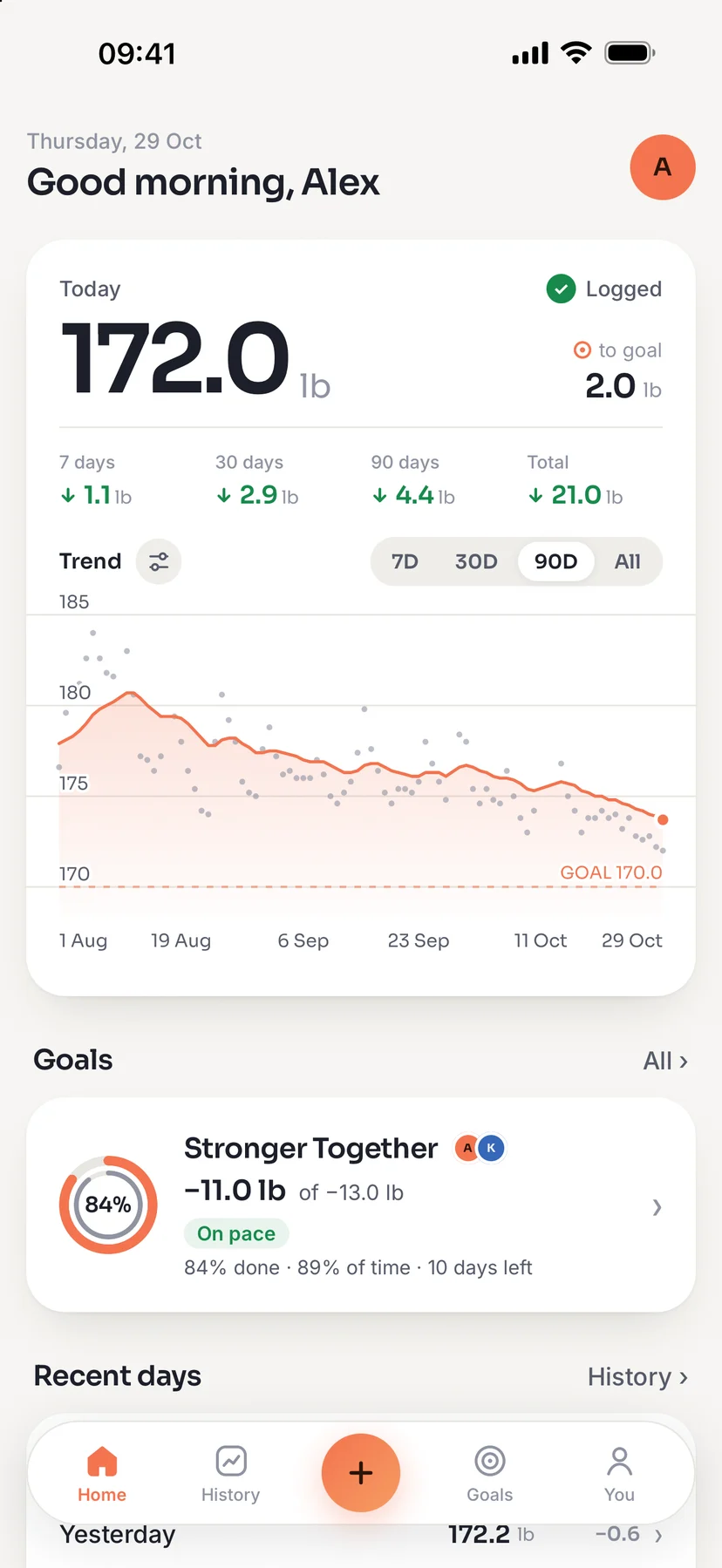
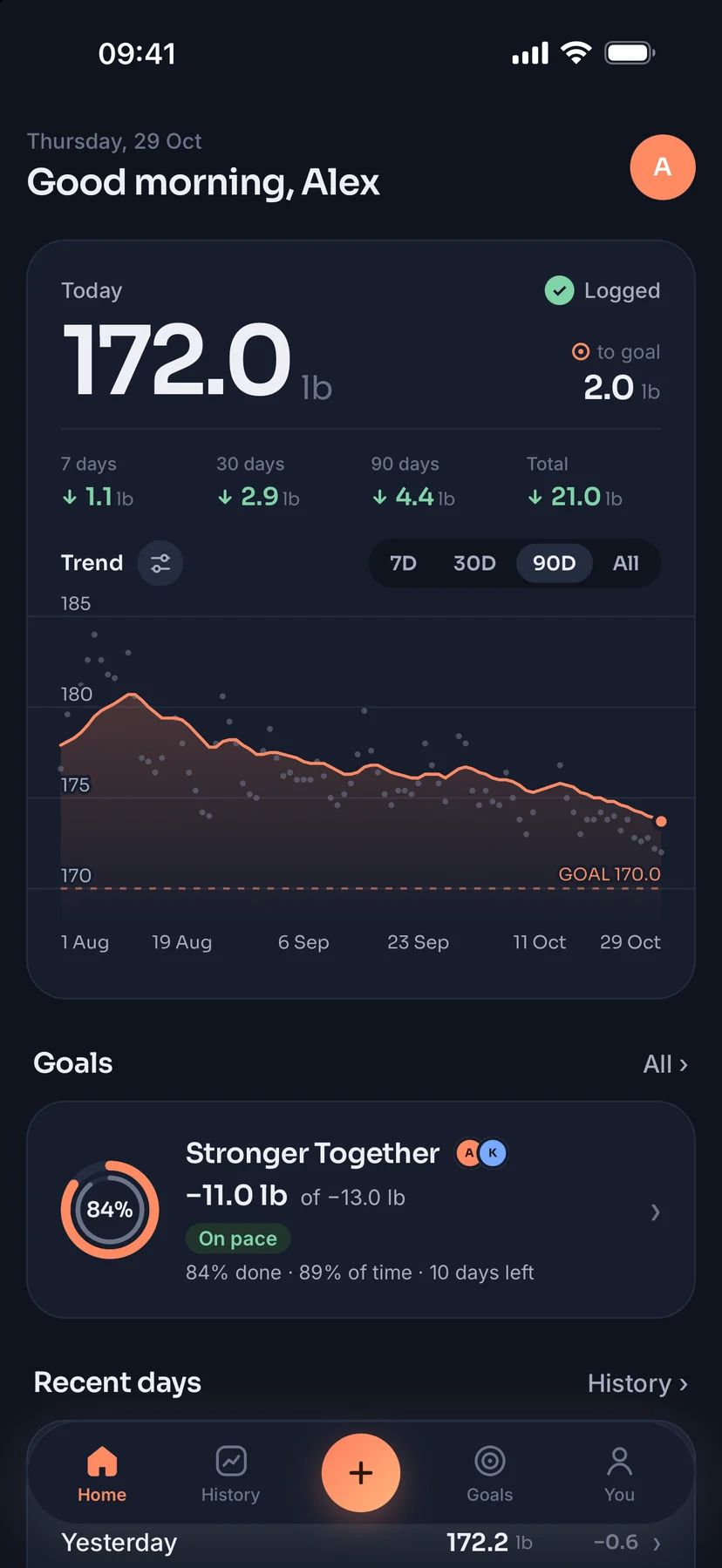
Weight Tracker shows how your smoothed trend has changed over 7, 30, and 90 days, and charts your daily values over any period, so a single high morning sits in context. See weight history and trends.
Questions
Why does my weight fluctuate so much day to day?
Mostly water and food, not fat. Salt and carbohydrate make your body hold extra water, food and drink weigh something until they are digested and passed, and hormones and exercise shift fluid too. Cleveland Clinic puts a normal daily swing at about 5 to 6 pounds.
How much weight fluctuation in a day is normal?
Cleveland Clinic puts the average at a window of about 5 to 6 pounds a day, or 2 to 3 pounds in either direction. That is roughly 2.3–2.7 kg from the lowest reading to the highest.
Why did I gain 2 pounds overnight?
Almost always water and food, not fat. A salty or carbohydrate-heavy meal, a hard workout, or the start of a period can all add short-term weight that settles again.
Why do I weigh more at night?
The day’s food and drink are still in your system. In our sample day, the reading at 21:30 is 0.9 kg (about 2.0 lb) above the morning one, and the next morning is back within 0.1 kg.
Does your weight go up on your period?
It often does, from water. In a year-long study, self-reported fluid retention peaked on the first day of flow and was lowest in the middle of the first half of the cycle.
Can carbs make the scale go up?
For a while, yes. The body stores carbohydrate as glycogen, and each gram of glycogen in muscle is stored with at least 3 grams of water. That is water, not fat.
How do I know if I am really gaining weight?
Weigh the same way each time and compare weekly averages over several weeks. A rise that keeps showing up week after week is real; a single high morning usually is not.
Sources
Show all 7 sourcesHide sources
- Cleveland Clinic. 7 possible reasons why your weight fluctuates. 26 July 2024.
- Cleveland Clinic. The best time to weigh yourself. 12 June 2023.
- Fuller N. How often should you really weigh yourself? The Conversation, 1 July 2024.
- University Hospitals. How often should you weigh yourself? October 2026.
- Fernández-Elías VE, Ortega JF, Nelson RK, Mora-Rodriguez R. Relationship between muscle water and glycogen recovery after prolonged exercise in the heat in humans. Eur J Appl Physiol 2015;115(9):1919–1926. PMID 25911631.
- White CP, Hitchcock CL, Vigna YM, Prior JC. Fluid retention over the menstrual cycle: 1-year data from the Prospective Ovulation Cohort. Obstet Gynecol Int 2011;2011:138451. PMC3154522.
- Turicchi J, et al. Weekly, seasonal and holiday body weight fluctuation patterns among individuals engaged in a European multi-centre behavioural weight loss maintenance intervention. PLoS One 2020;15(4):e0232152. doi:10.1371/journal.pone.0232152.
This guide is general information, not medical advice.