What water weight is
Most of your body is water, and the amount it holds changes from day to day. When it holds a little more, the scale goes up; when it lets go, the scale goes down. None of that is fat. Cleveland Clinic names water retention as the most common cause of short-term changes in weight, and puts the average daily fluctuation at a window of about 5 to 6 pounds. The weight fluctuation guide covers that daily swing in detail.
Sometimes extra fluid collects in one place, most often the feet, ankles, and legs. The NHS calls this oedema, or edema, and it shows as swelling.
What makes water weight change
| Cause | What happens |
|---|---|
| Salty food | The NHS lists eating too much salty food as a common cause of fluid build-up. A salty meal can show on the scale the next morning. |
| Less carbohydrate | Cutting carbohydrate sharply makes much more of the early weight loss water, as the study below shows. |
| Periods | Self-reported bloating peaks on the first day of a period, in a year-long study of 62 women. |
| Standing or sitting still | Staying in the same position for a long time lets fluid collect in the legs and feet. |
| Some medicines | The NHS mentions some blood pressure medicines, contraceptive pills, and steroids. |
| Pregnancy | The NHS lists being pregnant among the causes of swollen feet and ankles. |
None of these is a change in body fat. Carbohydrate matters because the body stores it as glycogen, and Fernández-Elías and colleagues found that each gram of glycogen is stored in muscle with at least 3 grams of water.
How long does water weight last?
There is no fixed number of days. It depends on what caused it, and the scale usually settles once the salty meal, the period, or the long flight is behind you.
- After a salty meal. The extra can show up the next morning and settles once your meals are back to usual. The worked example below shows one way it can look.
- Around a period. In a year-long study of 62 women, self-reported fluid retention peaked on the first day of flow. It was lowest in the middle of the first half of the cycle and rose gradually around ovulation, so the pattern repeats each month. See the period weight gain guide.
- After a change in carbohydrate. Cutting carbohydrate releases water stored with glycogen, and eating more of it again brings that water back. That is why weight can jump after a low-carbohydrate stretch ends.
- Swelling in the legs and feet. The NHS says swelling should go away on its own. If it has not improved after a few days of looking after it at home, see a doctor.
A salty dinner, step by step
Here is a made-up week of morning weigh-ins, with a salty dinner on Tuesday evening. Nothing else changed.
The next three mornings read 79.3, 79.0, 78.7 kg. Wednesday is 0.9 kg above Tuesday, which can feel like a setback. By Sunday the reading is back to 78.4 kg.
The weekly average tells a calmer story. At 78.7 kg, it sits only 0.3 kg above Tuesday’s reading, because one salty dinner is spread across seven mornings. Comparing that average with next week’s is how you see what is really happening.
Can you get rid of water weight?
Water weight usually goes once the cause is behind you, but a few everyday things change how much you hold.
- Salt. The NHS says adults should have no more than 6 g of salt a day, and that around three quarters of the salt we eat comes from packaged and everyday foods (NHS).
- Carbohydrate. Glycogen is stored with water, so a lower-carbohydrate day can show as a drop and a higher one as a rise. Both are changes in water. A sudden drop after a stall is often this kind of change; see the whoosh effect.
- Exercise. You lose about 1 litre of sweat in an hour of moderate exercise, according to Nick Fuller of the University of Sydney (The Conversation, 2024). Drinking puts it back.
- Coffee. In a study of 10 regular coffee drinkers, about 537 mg of caffeine increased urine output over three hours, while about 269 mg did not disturb fluid balance (Seal and colleagues, Frontiers in Nutrition, 2017).
For mild swelling in the legs and feet, the NHS self-help advice adds a few more:
- Move gently. The NHS suggests gentle exercise, like walking, to improve blood flow.
- Raise your legs. Rest them on a chair or pillows when you can.
- Break up long stretches. Avoid standing or sitting in the same position for long periods, for example on a long journey or at a desk.
- Notice salty food. The NHS lists eating too much salty food among the common causes of fluid build-up, so a salty day is worth keeping in mind when you read the next morning’s number.
Water pills (diuretics) are medicines. Cleveland Clinic describes diuretics as medicines that help the body move extra fluid and salt out, used for conditions such as high blood pressure and heart failure. Too high a dose, or not drinking enough, can lead to dehydration, and it advises checking with your provider before changing how you take them.
Why the first week of weight loss is so fast
When people start eating less, the first drop on the scale is often surprisingly large. Much of it is water. In a classic metabolic study, Yang and Van Itallie measured what six adults with obesity lost over 10 days on two 800-calorie diets.
| 800-calorie diet | Water | Fat |
|---|---|---|
| Very low in carbohydrate | 61.2% | 35.0% |
| Mixed, with carbohydrate | 37.1% | 59.5% |
On the diet very low in carbohydrate, more than half of the weight lost was water, and people lost more weight in total. Because that loss is mostly water rather than fat, it is one reason a fast start often slows down, and why the pace you can keep over a month is a better guide than week one. The weight loss calculator by date plans from that steadier pace. If the scale then stalls for weeks, the weight loss plateau guide and why am I not losing weight? explain what else may be going on.
Water weight vs fat: how to tell the difference
- Look at the speed. A jump of a kilo or more overnight is almost always water and food, not fat.
- Weigh the same way every time. First thing in the morning, after the bathroom and before eating or drinking. See the best time to weigh yourself.
- Compare weeks, not days. A weekly average smooths out a salty dinner or the start of a period.
- Expect the pattern. If you have periods, a higher reading around the first day is normal and usually drops back within days.
When swelling needs a doctor
The NHS advises seeing a doctor if swelling in both legs has not improved after a few days, gets worse, or you have a heart, kidney, or vein condition. It advises getting help urgently if one leg, ankle, or foot is swollen for no clear reason, if the swelling is severe, painful, sudden, red, or hot, or if you have diabetes and swollen feet, ankles, or legs.
Call emergency services if swelling comes with shortness of breath, a tight or painful chest, or coughing up blood. The NHS says these can be signs of a blood clot in the lungs.
Watching water weight settle
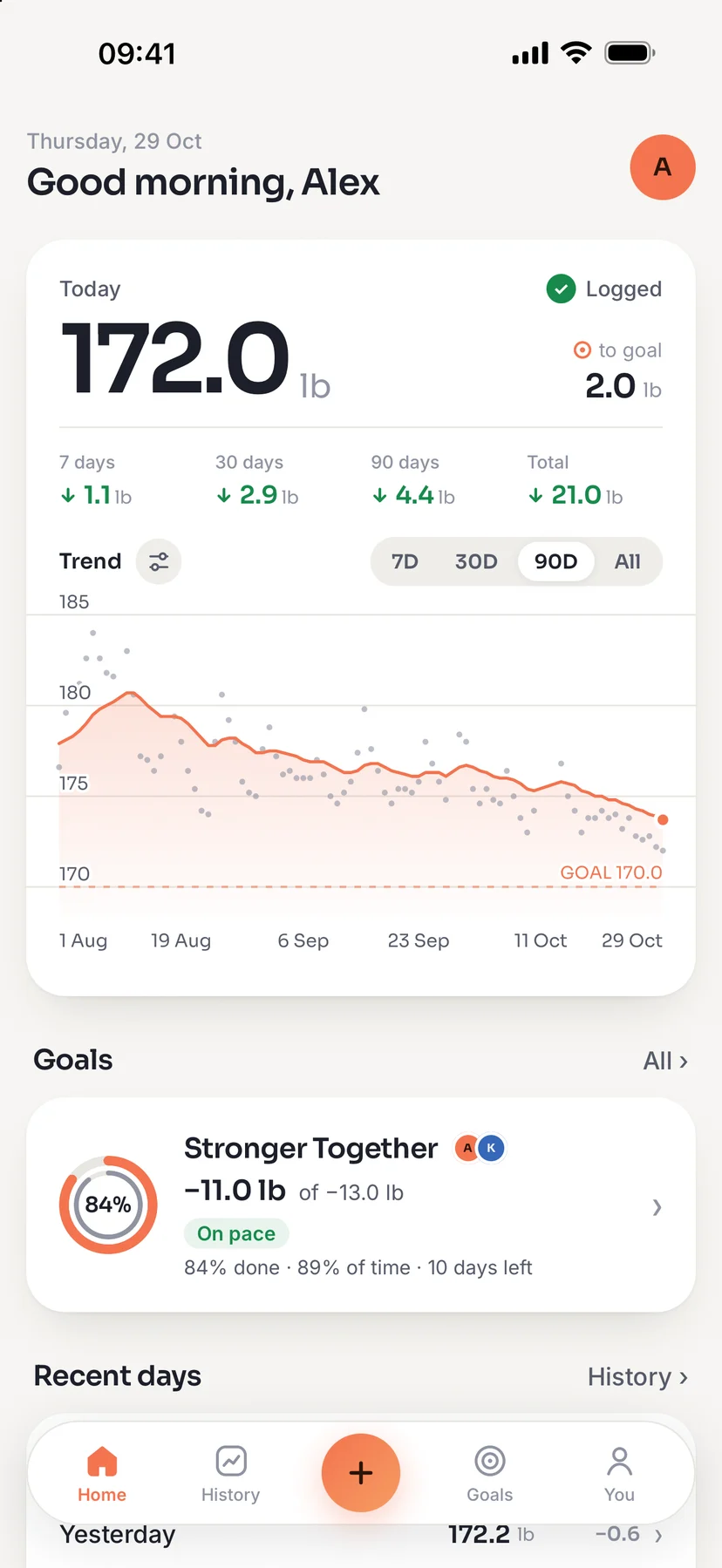
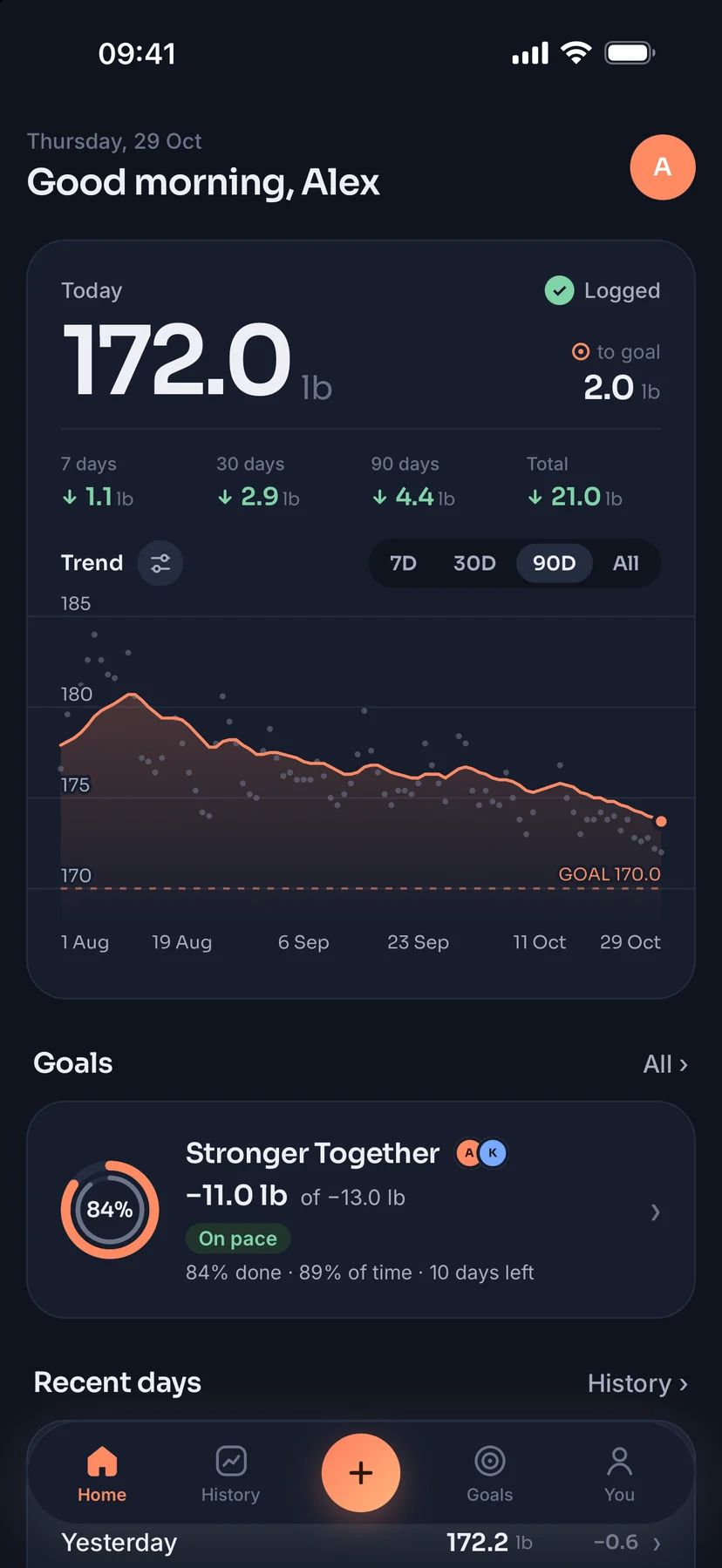
Had a salty dinner or a long flight? Log the next morning anyway. Weight Tracker keeps the reading in History and shows it against your 7, 30, and 90-day trend, so you can watch it settle over the next few days. See weight history and trends.
Questions
How do you get rid of water weight?
Usually it goes on its own once the salty meal, the period, or the long journey is behind you. For mild swelling in the legs and feet, the NHS suggests gentle exercise such as walking, raising your legs, and not standing or sitting still for long.
How long does water weight last?
It depends on the cause. Water from a salty meal settles once your meals are back to usual, and period-related fluid retention peaks on the first day of flow and falls after that. Swelling that has not improved after a few days of self-care is worth showing a doctor.
How much water weight can you gain in a day?
Cleveland Clinic gives the average daily fluctuation from all causes as a window of about 5 to 6 pounds, or 2 to 3 pounds either side, with water retention the most common cause. In our sample, one salty dinner added 0.9 kg by the next morning.
Do water pills help you lose weight?
Water pills, or diuretics, are medicines that help the body pass extra fluid and salt, not fat. Cleveland Clinic advises checking with your provider rather than changing how you take them yourself.
Why do I retain water before and during my period?
Fluid retention follows the menstrual cycle. In a year-long study of 62 women, it was lowest in the middle of the first half of the cycle, rose around ovulation, and peaked on the first day of flow.
How do I know if it is water weight or fat?
Look at the speed. A jump of a kilo or more overnight is almost always water and food; fat changes slowly and shows up as a weekly average that keeps moving in one direction.
How fast can you lose water weight?
Faster than fat, which is why the first week of a diet can look dramatic. In Yang and Van Itallie’s study, 61.2% of the weight lost over 10 days on a very low carbohydrate 800-calorie diet was water. It can come back just as quickly once carbohydrate returns.
Sources
Show all 9 sourcesHide sources
- NHS. Swollen ankles, feet and legs (oedema). Reviewed 26 February 2026.
- Yang MU, Van Itallie TB. Composition of weight lost during short-term weight reduction. J Clin Invest 1976;58(3):722–730. PMC333231.
- White CP, Hitchcock CL, Vigna YM, Prior JC. Fluid retention over the menstrual cycle: 1-year data from the Prospective Ovulation Cohort. Obstet Gynecol Int 2011;2011:138451. PMC3154522.
- Fernández-Elías VE, Ortega JF, Nelson RK, Mora-Rodriguez R. Relationship between muscle water and glycogen recovery after prolonged exercise in the heat in humans. Eur J Appl Physiol 2015;115(9):1919–1926. PMID 25911631.
- Cleveland Clinic. 7 possible reasons why your weight fluctuates. 26 July 2024.
- NHS. Salt: the facts.
- Fuller N. How often should you really weigh yourself? The Conversation, 1 July 2024.
- Seal AD, Bardis CN, Gavrieli A, et al. Coffee with high but not low caffeine content augments fluid and electrolyte excretion at rest. Front Nutr 2017;4:40. doi:10.3389/fnut.2017.00040.
- Cleveland Clinic. Diuretics. 4 December 2024.
This guide is general information, not medical advice.