Why you weigh more after working out
Weight gain after exercise is mostly water. Worked muscles hold fluid while they repair, training expands the volume of your blood, and as you keep training, your muscles store more glycogen, each gram with at least 3 grams of water. None of this is fat, and it arrives too fast to be muscle.
Glycogen refills, and brings water with it
Your muscles store carbohydrate as glycogen. A review for coaches and athletes puts a typical adult’s muscle glycogen at about 500 grams (normal range 300 to 700 g), with about 80 grams more in the liver (Murray and Rosenbloom, 2018). Glycogen is stored with water: in a study using muscle biopsies, Fernández-Elías and colleagues concluded that each gram of glycogen is stored in muscle with at least 3 grams of water.
Restocking after a workout only replaces what the session used, so it lifts the next morning above the light reading straight after training, not above where you started. What adds weight is that training makes the stores bigger, and every extra 100 grams of glycogen brings at least 300 grams of water, about 0.4 kg (0.9 lb) in total. Murray and Rosenbloom note that endurance training increases muscle glycogen stores, and in an older study, five months of heavy resistance training raised resting glycogen in the trained arm muscle by 66% (MacDougall and colleagues, 1977).
Muscle repair and swelling
Exercise your muscles are not used to causes small amounts of damage, especially movements where the muscle lengthens under load, such as lowering into a squat or walking downhill (Clarkson and Hubal, 2002). Soreness, known as delayed onset muscle soreness or DOMS, typically appears 12 to 24 hours later, peaks between 24 and 72 hours, and disappears within 5 to 7 days (Hody and colleagues, 2019).
The muscle also swells with fluid while it repairs. In a lab study of hard arm exercise in 11 untrained women, the volume of the worked muscles rose to a peak on the fourth day, about 26% above normal, then returned to normal over days 7 to 11 (Chleboun and colleagues, 1998). That was a deliberately punishing protocol, so a normal session swells less. No study we found has measured how much this swelling adds to your weight on the scale, so be wary of exact figures such as “leg day adds 3 pounds”.
Your blood volume grows
Training expands your blood plasma, which is mostly water. After one hard interval session, eight 4-minute bouts at 85% of maximal aerobic capacity, plasma volume was about 10% higher 24 hours later (Gillen and colleagues, 1991). That was 4.5 ml for every kilogram of body weight, roughly 0.3 kg (0.7 lb) for someone weighing 75 kg.
Keep training and it grows further. In eight fit young men, after eight days of two hours of cycling a day, plasma volume rose by 427 ml (Convertino and colleagues, 1980). Convertino describes this extra blood volume as a net gain in total body water, with the kidneys holding on to more sodium.
Food, drink, and salt
A new routine often changes eating too: a recovery snack, a bigger dinner, a sports drink. Food and drink weigh something until they are digested and passed, and salty food makes the body hold water. The NHS lists eating too much salty food among the common causes of swollen ankles and feet. The water weight guide covers salt and carbohydrate in more detail, and the whoosh effect explains why water can also leave all at once.
Creatine, if you take it
A creatine loading phase, typically 20 grams a day for 5 to 7 days, usually adds 1 to 3 kg (about 2 to 7 lb) of body weight, mostly water, according to a 2021 review of common questions about creatine (Antonio and colleagues). The same review notes that several training studies lasting 5 to 10 weeks found no increase in total body water, though not all studies agree.
Why you might weigh more after leg day
Leg day works the body’s biggest muscles, often with a lot of lowering under load, the kind of movement that damages unaccustomed muscle most. Leg muscles are not especially fragile: in one comparison of four muscle groups, the arm muscles were more prone to this damage than the leg muscles (Chen and colleagues, 2011). But there is far more muscle in your legs. In ten untrained men starting a resistance training program, Damas and colleagues measured the thigh muscle about 2.7% larger by week 3. They concluded the early increase was not purely muscle growth: swelling from muscle damage may account for a large part of it.
Muscles adapt quickly. One session of this kind of exercise protects the muscle against damage from the next, which researchers call the repeated bout effect (McHugh, 2003). In a second paper on the same ten men, muscle damage after a session was highest in week 1, smaller by week 3, and smaller again by week 10. Cheung and colleagues advise bringing in new or eccentric exercises gradually over 1 or 2 weeks.
How long water retention lasts after exercise
Each cause has its own timescale. Most fade within a few weeks of starting; the ones that come from getting fitter stay as long as you keep training.
Right after a workout
Sweat loss makes the scale read lower, until you drink.
In a study of 1,303 athletes, average sweat losses ran from about 0.8 to 1.5 litres an hour, depending on the sport.
The next morning
Muscles restock the glycogen the session used, with its water, so the scale climbs back from the light post-workout reading to about where you started.
At least 3 g of water for every gram of glycogen.
24 hours after a hard session
Blood plasma, which is mostly water, expands.
About 10% after one hard interval session: roughly 0.3 kg (0.7 lb) for a 75 kg person.
12 hours to 7 days
Soreness starts after 12 to 24 hours, peaks at 24 to 72 hours, and is gone within 5 to 7 days.
A sign of muscle damage, not extra weight in itself.
Up to about 11 days
Worked muscles swell with fluid while they repair, after exercise they are not used to.
In a lab study of hard arm exercise, muscle volume peaked on day 4 and was back to normal by days 7 to 11.
First 2 to 3 weeks of a new routine
Muscles adapt, so each session causes less damage.
Muscle damage after a session was highest in week 1 and smaller by week 3, though some swelling was still there in week 3.
As long as you keep training
Fitter muscles store more glycogen, and you carry more blood.
Each extra 100 g of glycogen brings at least 300 g of water, about 0.4 kg (0.9 lb). A new, slightly higher baseline, not a steady climb.
Months
Real muscle.
About 1.5 kg (3.3 lb) over roughly 10 weeks, on average across studies in men.
So the scale often rises in the first week or two and then levels off. If you keep training, part of the rise stays, because fitter muscles hold more glycogen and you carry more blood. That is a new baseline, not fat, and it is one reason the scale can look stuck while your clothes fit better.
Is it muscle? How fast muscle really grows
Not in the first weeks. Muscle grows, but slowly.
≈1.5 kg
of muscle gained over about 10 weeks of resistance training, on average across 111 studies in men
About 3.3 lb, or roughly 150 grams (a third of a pound) a week. Benito and colleagues, 2020.
In a separate review of adults over 50, resistance training added an average of 1.1 kg (2.4 lb) of lean mass over about 20 weeks (Peterson and colleagues, 2011). So a jump of 1 kg in a week is several times faster than muscle grows. It is water, glycogen, or food.
Strength training still changes your body underneath the scale. A review of 58 randomised trials (54 pooled) found that resistance training reduced body fat by about 0.55 kg and body fat percentage by about 1.5 points on average (Wewege and colleagues, 2022).
Muscle vs fat: losing inches but not weight
A pound of muscle weighs the same as a pound of fat. The difference is space. Muscle is denser, about 1.06 kg per litre (the standard value cited by Ward and Lieber, 2005), while whole fat tissue measured 0.925 to 0.970 kg per litre in six male cadavers (Martin and colleagues, 1994). The same weight of fat therefore takes up roughly 9 to 15% more room. That is a real difference, but far smaller than the pictures that show fat as a lump several times the size of muscle.
If you lose a little fat while your muscles fill up with glycogen and water, the scale can stay still while your waist shrinks. That is why it helps to track more than one number:
- Waist. The NHS says to find the midpoint between your lowest rib and the top of your hip bone, roughly level with your belly button, wrap the tape around it, and breathe out naturally without holding your tummy in. The waist-to-height ratio calculator turns that measurement into a health check.
- Photos and clothes. The same spot, light, and clothing every few weeks, or how one pair of trousers fits.
- Strength. More weight or more repetitions on the same exercise is progress the scale cannot show.
Muscle does use more energy at rest than fat, though less than is often claimed: about 13 kcal per kilogram a day, against 4.5 for fat tissue (Elia, as quoted by Wang and colleagues, 2010). That is roughly 6 kcal per pound of muscle a day, not the 50 sometimes quoted.
When the weight gain is real
Water usually lifts the scale in a step and then levels off. A weekly average that keeps rising for three or four weeks in a row points to eating more energy than you use, and exercise makes that easier than it sounds:
- Workouts burn less than they feel like. In a small study of 16 adults, people estimated that a workout had burned about 825 kcal when it had burned about 200, roughly four times too high (Willbond and colleagues, 2010).
- The body partly makes up for it. A review found that weight loss from exercise programs tends to be lower than predicted, mostly because the exercise doses are small and people eat more (Thomas and colleagues, 2012). In one trial, people asked to burn 1,500 or 3,000 kcal a week through exercise made up for about 943 and 1,007 kcal of it each week; only the higher-dose group lost fat (Flack and colleagues, 2018).
- One workout rarely triggers overeating. A meta-analysis of 29 studies (51 trials) found exercise has a trivial effect on how much people eat in the hours after it (Schubert and colleagues, 2013). When people do eat more, it shows up over weeks of training rather than after one session (King and colleagues, 2008).
- People differ a lot. In 12 weeks of supervised exercise, average weight loss was 3.7 kg, but individual results ranged from a loss of 14.7 kg to a gain of 1.7 kg (King and colleagues, 2008).
On its own, exercise produces modest weight loss: an overview of reviews in adults with overweight or obesity found average losses of 1.5 to 3.5 kg (Bellicha and colleagues, 2021). If your weekly average keeps climbing, look at food and drink first. Why am I not losing weight? walks through the usual reasons, and the plateau guide covers the opposite problem, when nothing moves at all.
Should you weigh yourself after a workout?
No. A workout makes you lighter for a few hours, because you lose water as sweat, and drinking afterwards puts it back. Weighing before and after exercise is how sports scientists estimate sweat loss; the American College of Sports Medicine recommends it for estimating your sweat rate, so you can plan how much to drink. It is not a way to track your weight.
For your weight, weigh first thing in the morning, before exercising. Even then one morning is not enough. In 65 active men whose fluids were fully replaced, first-morning weight still varied by about 0.5 kg from day to day (Cheuvront and colleagues, 2004). The best time to weigh yourself covers the routine, and how often to weigh yourself covers how many readings to compare.
Worked example: the first three weeks at the gym
Here is a made-up but typical pattern: a week of normal mornings, then three weeks of a new routine with three full-body sessions a week, eating about the same as before.
| Week | Average | Change |
|---|---|---|
| Week before | 176.0 lb | — |
| Gym week 1 | 177.7 lb | +1.7 lb (+0.8 kg) |
| Gym week 2 | 177.2 lb | +1.2 lb (+0.5 kg) |
| Gym week 3 | 176.9 lb | +0.9 lb (+0.4 kg) |
The highest single morning, day 5, is 2.6 lb above the earlier average. It lands in the window when soreness and swelling peak, on top of refilled glycogen and extra plasma. The first week’s average is up 1.7 lb. By week 3 the average has eased back to 0.9 lb above where it started and is barely moving, as muscles adapt and swell less. What is left is the new baseline of glycogen and blood volume.
Real fat gain looks different: an average that climbs week after week without levelling off. If your second and third weeks look like this example, keep going and judge by the month, not the morning.
Weight after a marathon or long race
During a long race you lose weight. In a study of 643 marathon finishers, runners lost 2.3% of their body weight on average, more in the faster runners (Zouhal and colleagues, 2011). Afterwards the body holds on to water while it recovers. Plasma volume was 16% higher two days after a marathon in one study (Schmidt and colleagues, 1989), and after a 56 km race it rose over the following three days, along with the total amount of sodium in the plasma (Irving and colleagues, 1990). Weighing more in the days after a race is expected.
Gaining weight during a race is different. It usually means drinking more than you sweat. In a study of 488 Boston Marathon runners, 13% finished with low blood sodium (hyponatremia), and weight gain during the race was linked to it (Almond and colleagues, 2005).
When to get medical help
Get medical help right away if, after exercise, muscle pain is worse than you would expect, your muscles feel weak, or your urine turns dark, like tea or cola. The CDC lists these as signs of rhabdomyolysis, a serious breakdown of muscle tissue. Cleveland Clinic warns that jumping into an exercise program too fast can cause it, and that symptoms usually develop one to three days after the muscle injury.
Swelling has its own warning signs. The NHS advises urgent help if one ankle, foot, or leg swells and you do not know why, if swelling is severe, painful, or comes on very suddenly, or if the area is red or hot. Call emergency services if swelling comes with shortness of breath or a tight, heavy, or painful chest.
If you have heart failure, kidney disease, or another condition where your care team has asked you to watch your weight, follow their plan rather than this guide. A fast rise can mean fluid building up, as the weight fluctuation guide explains.
Reading the trend in Weight Tracker
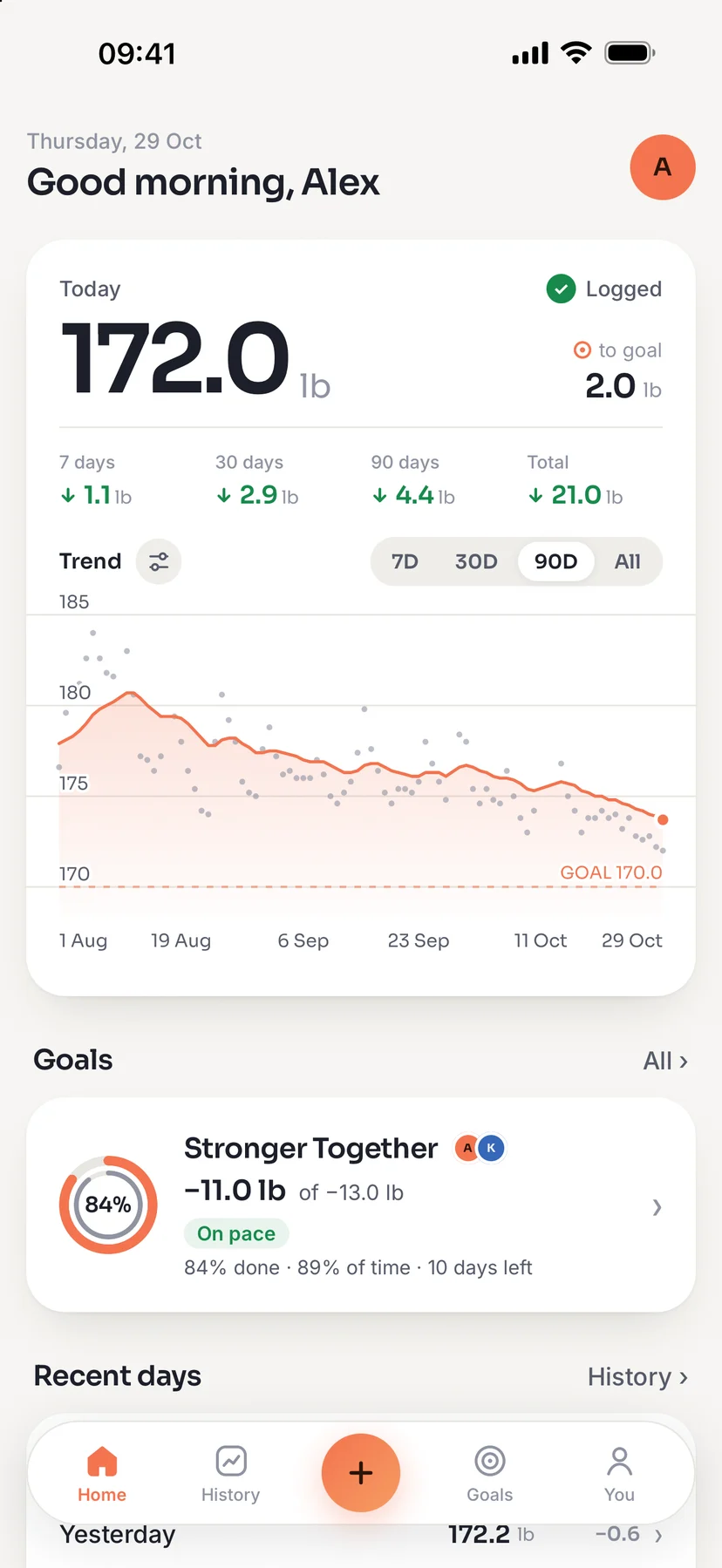
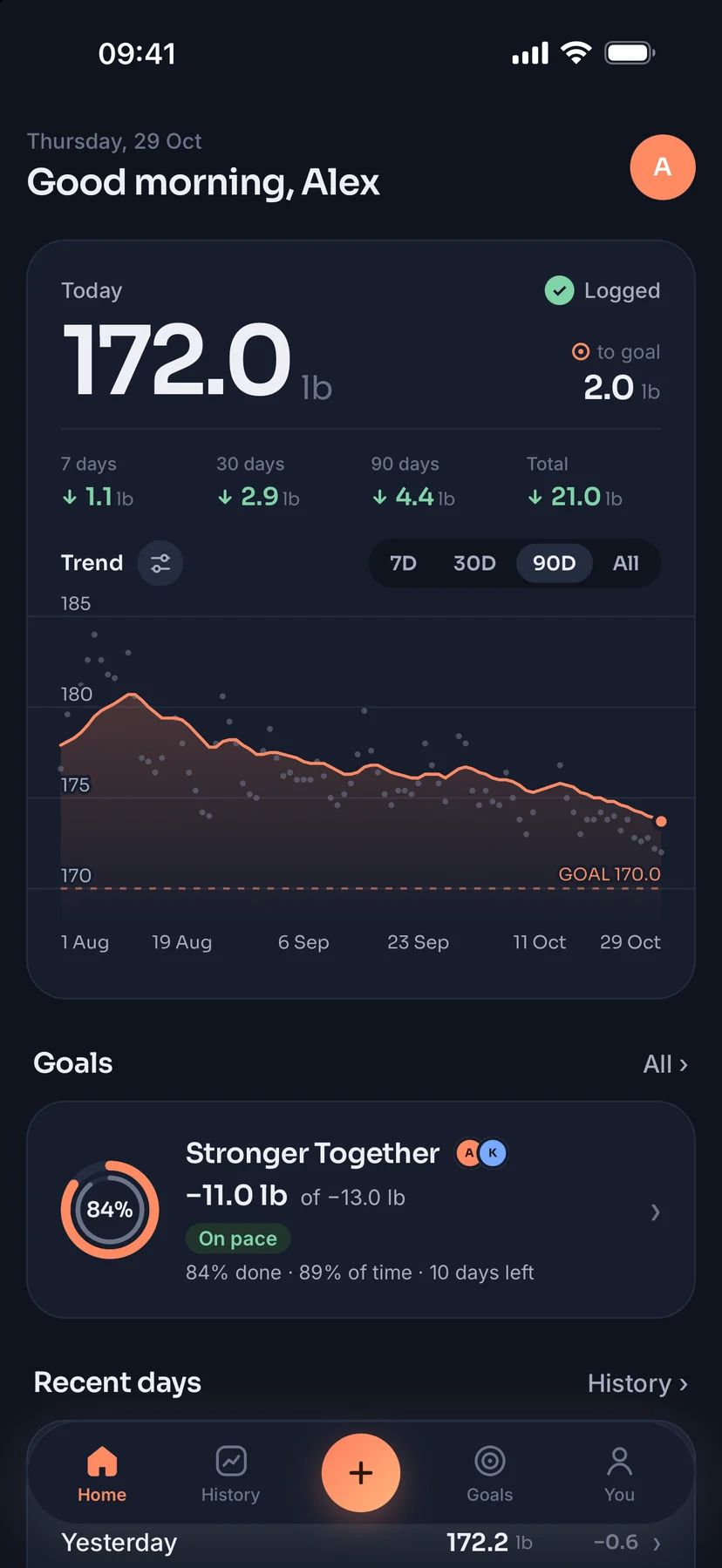
Weight Tracker draws a smoothed trend line under your daily weigh-ins and shows how it has changed over 7, 30, and 90 days, so a sore, puffy week sits in context instead of looking like a setback. That trend is the app’s own smoothing, not the 7-day average used in the example above. See weight history and trends, and the weight fluctuation guide for how much a normal day can move.
Questions
Why do I weigh more the day after a workout?
Mostly water. A hard session expands your blood plasma by about 10% within 24 hours, worked muscles hold fluid while they repair, and as you keep training your muscles store more glycogen, each gram with at least 3 grams of water.
Is it normal to gain weight when you start working out?
Yes. Muscles you are not used to working get sore and swell, glycogen stores fill up, and blood volume rises. Muscle damage is greatest in the first week and shrinks as your muscles adapt, so the rise tends to level off within a few weeks, though no study has tracked this on the scale.
How long does water retention last after exercise?
Soreness peaks 24 to 72 hours after a workout and is usually gone within 5 to 7 days. In one lab study, swelling in the worked arm muscles was back to normal by days 7 to 11. The extra glycogen and blood volume that come with training stay while you keep training.
Do sore muscles retain water?
Yes. Exercise your muscles are not used to causes small amounts of damage, and the muscle swells with fluid while it repairs. No study we found has measured how much this adds to your weight on the scale, so treat exact figures with caution.
Can I gain 2 pounds of muscle in a week?
No. Across 111 studies in men, resistance training added about 1.5 kg (3.3 lb) of muscle over roughly 10 weeks. In adults over 50, the average was 1.1 kg over about 20 weeks. A jump of 2 pounds in a week is water, glycogen, or food.
Does muscle weigh more than fat?
A pound is a pound. Muscle is denser, about 1.06 kg per litre against roughly 0.93 to 0.97 for fat tissue, so a pound of fat takes up about 9 to 15% more room.
Should I weigh myself after a workout?
No. You lose water as sweat, so a reading right after exercise runs low until you drink. Weigh in the morning before exercising, and compare averages over several days.
Why do I weigh more after a marathon?
In the days after a long race, your body holds extra sodium and water while it recovers. In one study, plasma volume was 16% higher two days after a marathon. Gaining weight during a race is different: it can mean drinking more than you sweat, which is linked to low blood sodium.
Sources
Show all 38 sourcesHide sources
- Fernández-Elías VE, Ortega JF, Nelson RK, Mora-Rodriguez R. Relationship between muscle water and glycogen recovery after prolonged exercise in the heat in humans. Eur J Appl Physiol 2015;115(9):1919–1926. PMID 25911631.
- Murray B, Rosenbloom C. Fundamentals of glycogen metabolism for coaches and athletes. Nutr Rev 2018;76(4):243–259. PMC6019055.
- MacDougall JD, Ward GR, Sale DG, Sutton JR. Biochemical adaptation of human skeletal muscle to heavy resistance training and immobilization. J Appl Physiol Respir Environ Exerc Physiol 1977;43(4):700–703. PMID 908686.
- Clarkson PM, Hubal MJ. Exercise-induced muscle damage in humans. Am J Phys Med Rehabil 2002;81(11 Suppl):S52–S69. PMID 12409811.
- Chen TC, Lin KY, Chen HL, Lin MJ, Nosaka K. Comparison in eccentric exercise-induced muscle damage among four limb muscles. Eur J Appl Physiol 2011;111(2):211–223. PMID 20852880.
- Hody S, Croisier JL, Bury T, Rogister B, Leprince P. Eccentric muscle contractions: risks and benefits. Front Physiol 2019;10:536. PMC6510035.
- Chleboun GS, Howell JN, Conatser RR, Giesey JJ. Relationship between muscle swelling and stiffness after eccentric exercise. Med Sci Sports Exerc 1998;30(4):529–535. PMID 9565934.
- Damas F, et al. Early resistance training-induced increases in muscle cross-sectional area are concomitant with edema-induced muscle swelling. Eur J Appl Physiol 2016;116(1):49–56. PMID 26280652.
- Damas F, et al. Resistance training-induced changes in integrated myofibrillar protein synthesis are related to hypertrophy only after attenuation of muscle damage. J Physiol 2016;594(18):5209–5222. PMID 27219125.
- McHugh MP. Recent advances in the understanding of the repeated bout effect: the protective effect against muscle damage from a single bout of eccentric exercise. Scand J Med Sci Sports 2003;13(2):88–97. PMID 12641640.
- Cheung K, Hume P, Maxwell L. Delayed onset muscle soreness: treatment strategies and performance factors. Sports Med 2003;33(2):145–164. PMID 12617692.
- Gillen CM, et al. Plasma volume expansion in humans after a single intense exercise protocol. J Appl Physiol 1991;71(5):1914–1920. PMID 1761491.
- Convertino VA, Brock PJ, Keil LC, Bernauer EM, Greenleaf JE. Exercise training-induced hypervolemia: role of plasma albumin, renin, and vasopressin. J Appl Physiol Respir Environ Exerc Physiol 1980;48(4):665–669. PMID 6991463.
- Convertino VA. Blood volume: its adaptation to endurance training. Med Sci Sports Exerc 1991;23(12):1338–1348. PMID 1798375.
- Antonio J, et al. Common questions and misconceptions about creatine supplementation: what does the scientific evidence really show? J Int Soc Sports Nutr 2021;18:13. PMC7871530.
- Benito PJ, Cupeiro R, Ramos-Campo DJ, Alcaraz PE, Rubio-Arias JÁ. A systematic review with meta-analysis of the effect of resistance training on whole-body muscle growth in healthy adult males. Int J Environ Res Public Health 2020;17(4):1285. PMC7068252.
- Peterson MD, Sen A, Gordon PM. Influence of resistance exercise on lean body mass in aging adults: a meta-analysis. Med Sci Sports Exerc 2011;43(2):249–258. PMC2995836.
- Wewege MA, et al. The effect of resistance training in healthy adults on body fat percentage, fat mass and visceral fat: a systematic review and meta-analysis. Sports Med 2022;52(2):287–300. PMID 34536199.
- Ward SR, Lieber RL. Density and hydration of fresh and fixed human skeletal muscle. J Biomech 2005;38(11):2317–2320. PMID 16154420.
- Martin AD, Daniel MZ, Drinkwater DT, Clarys JP. Adipose tissue density, estimated adipose lipid fraction and whole body adiposity in male cadavers. Int J Obes Relat Metab Disord 1994;18(2):79–83. PMID 8148928.
- Wang Z, et al. Specific metabolic rates of major organs and tissues across adulthood: evaluation by mechanistic model of resting energy expenditure. Am J Clin Nutr 2010;92(6):1369–1377. PMC2980962.
- Willbond SM, Laviolette MA, Duval K, Doucet E. Normal weight men and women overestimate exercise energy expenditure. J Sports Med Phys Fitness 2010;50(4):377–384. PMID 21178922.
- Thomas DM, et al. Why do individuals not lose more weight from an exercise intervention at a defined dose? An energy balance analysis. Obes Rev 2012;13(10):835–847. PMC3771367.
- Flack KD, Ufholz K, Johnson L, Fitzgerald JS, Roemmich JN. Energy compensation in response to aerobic exercise training in overweight adults. Am J Physiol Regul Integr Comp Physiol 2018;315(4):R619–R626. PMC6230893.
- Schubert MM, Desbrow B, Sabapathy S, Leveritt M. Acute exercise and subsequent energy intake. A meta-analysis. Appetite 2013;63:92–104. PMID 23274127.
- King NA, Hopkins M, Caudwell P, Stubbs RJ, Blundell JE. Individual variability following 12 weeks of supervised exercise: identification and characterization of compensation for exercise-induced weight loss. Int J Obes (Lond) 2008;32(1):177–184. PMID 17848941.
- Bellicha A, et al. Effect of exercise training on weight loss, body composition changes, and weight maintenance in adults with overweight or obesity: an overview of 12 systematic reviews and 149 studies. Obes Rev 2021;22(Suppl 4):e13256. PMC8365736.
- Sawka MN, et al. American College of Sports Medicine position stand. Exercise and fluid replacement. Med Sci Sports Exerc 2007;39(2):377–390. PMID 17277604.
- Barnes KA, et al. Normative data for sweating rate, sweat sodium concentration, and sweat sodium loss in athletes: an update and analysis by sport. J Sports Sci 2019;37(20):2356–2366. PMID 31230518.
- Cheuvront SN, Carter R, Montain SJ, Sawka MN. Daily body mass variability and stability in active men undergoing exercise-heat stress. Int J Sport Nutr Exerc Metab 2004;14(5):532–540. PMID 15673099.
- Zouhal H, et al. Inverse relationship between percentage body weight change and finishing time in 643 forty-two-kilometre marathon runners. Br J Sports Med 2011;45(14):1101–1105. PMID 21160081.
- Schmidt W, Maassen N, Tegtbur U, Braumann KM. Changes in plasma volume and red cell formation after a marathon competition. Eur J Appl Physiol Occup Physiol 1989;58(5):453–458. PMID 2759069.
- Irving RA, et al. Plasma volume and renal function during and after ultramarathon running. Med Sci Sports Exerc 1990;22(5):581–587. PMID 2233195.
- Almond CS, et al. Hyponatremia among runners in the Boston Marathon. N Engl J Med 2005;352(15):1550–1556. PMID 15829535.
- CDC, NIOSH. Signs and symptoms of rhabdomyolysis.
- Cleveland Clinic. Rhabdomyolysis.
- NHS. Swollen ankles, feet and legs (oedema).
- NHS. How to measure your waist.
This guide is general information, not medical advice.