What official guidance says
Health bodies mostly land on weekly, with room on either side:
- NHS England suggests weighing at the same time of day, preferably in the morning, at regular weekly to monthly intervals, with the same scale and similar clothing each time.
- The CDC lists recording your weight once a week among its tips for keeping weight off.
- NIDDK, part of the US National Institutes of Health, describes weekly weight monitoring as part of safe, successful weight-loss programs.
- Harvard Health notes that daily checks may help some people, and that weekly weigh-ins are also reasonable.
None of them sets a strict rule, and the NHS stresses weighing the same way each time.
The exception: when your care team asks you to weigh daily. Some medical conditions make daily weighing part of treatment. University Hospitals lists diabetes, heart failure, and kidney disease as conditions where daily weigh-ins can help catch fluid building up. It says a gain of 2 or more pounds in a day may be a reason to call your doctor. People with heart failure, for example, are usually asked to weigh every day, because a quick rise can be a sign of fluid building up. The Heart Failure Association’s patient site, Heart Failure Matters, says “It’s important to weigh yourself every day, at the same time,” and to tell your doctor or nurse if your weight goes up quickly. If you have a plan like this, follow your care team’s advice, including when to contact them, rather than the general guidance on this page.
What research shows
Most studies of self-weighing involve adults who are trying to lose weight or keep it off, and many show associations rather than cause and effect. With that in mind:
- Regular weighing tends to go with more weight loss. A 2015 systematic review of 17 studies found that regular self-weighing was associated with more weight loss, and was not linked to depression or anxiety in those studies (Zheng and colleagues).
- Weighing alone does little. A 2015 meta-analysis found about 1.7 kg more weight loss in programs that combined self-weighing with other behaviour-change techniques, no clear benefit when it was used on its own, and no significant difference between daily and weekly weighing (Madigan and colleagues).
- Daily weighing helped in a supported trial. In a six-month trial of 91 adults, daily weighing with a smart scale, a weight graph, and weekly feedback emails led to an average 6.55% weight loss against 0.35% in the comparison group. The scale came bundled with that feedback, so the result cannot be credited to weighing alone (Steinberg and colleagues, 2013).
- Weekly weighing gave most of the benefit. Nick Fuller of the University of Sydney summarises a review of 12 studies in which people who weighed weekly or daily for several months lost 1 to 3 more BMI units and regained less. Weighing daily added no benefit over weekly (The Conversation, 2024).
- People who maintain a loss often keep weighing. In the US National Weight Control Registry, people who weighed themselves less often over time regained more weight. The participants were self-selected successful maintainers (Butryn and colleagues, 2007).
Taken together, the research does not show that daily weighing beats a regular weekly rhythm, as long as you look back at the numbers.
Possible downsides
For most adults, research finds that regular weighing is mostly not linked to harm. A 2016 meta-analysis concluded that self-weighing is mostly not associated with adverse psychological outcomes, though it found a small negative association with psychological functioning (Benn and colleagues).
The picture is less reassuring for some groups. A 2015 review found negative associations mostly among women and younger people, while adults seeking weight-loss treatment generally showed no link or a positive one (Pacanowski and colleagues). In a trial of young adults, more frequent weighing went with more dietary restraint, both rigid and flexible, and with better quality of life. The authors reported no harmful effects overall (Gorin and colleagues, 2019).
If the number changes how you eat or feel, weigh less often or stop. Cleveland Clinic advises people with a history of eating disorders, or anxiety about the scale, to avoid the numbers and talk to a behavioral health specialist.
Why daily numbers jump around
Cleveland Clinic describes daily swings of about 5 to 6 pounds (roughly 2.5 kg) as typical for people in a healthy weight range, mostly from water, food, and activity. Its guidance on the best time to weigh yourself is first thing in the morning, after using the toilet and before eating or drinking.
Weekends show up too. In a European weight-maintenance study using smart scales, weight rose slightly over weekends and fell during the week, and rose by about 1.35% on average over the Christmas period (Turicchi and colleagues, 2020). If you weigh daily, judge the direction over weeks, not after a weekend.
Weigh daily, judge weekly
If you weigh every day, judge the week as a whole rather than each morning. Here are two sample weeks for one person, made up for this guide. Each Monday comes in higher after the weekend.
Now compare week two with week one in three ways:
| Compare | Week 1 | Week 2 | Change |
|---|---|---|---|
| Monday only | 80.2 kg | 80.4 kg | +0.2 kg |
| Friday only | 79.6 kg | 79.2 kg | −0.4 kg |
| Weekly average | 79.9 kg | 79.7 kg | −0.2 kg |
The Monday readings suggest a gain of 0.2 kg. The Friday readings suggest a loss of 0.4 kg. The weekly average, which uses all seven days, shows a change of −0.2 kg. Single days can point in opposite directions; the average is the steadier answer.
If you weigh once a week instead, the same logic applies: keep the same day, and look at three or four weeks together before deciding anything.
To keep weekly averages without the sums, the free weight loss tracker spreadsheet works out a 7-day average as you log. On paper, the printable weight loss tracker has a shaded row for each week’s average.
Choosing a rhythm
| Rhythm | Can suit you if | Keep in mind |
|---|---|---|
| Daily | A quick morning check fits your routine and the number does not affect your mood. | Single days are noisy. Compare weekly averages, not mornings. |
| A few times a week | You want a clear trend without a daily habit. | Use the same days and time each week so readings are comparable. |
| Weekly | You prefer a calm check-in. This is the rhythm most health bodies suggest. | One reading a week can land on an unusual day. Look at several weeks together. |
| Monthly or less | Frequent weighing feels stressful, or you mostly want to stay in a range. | Changes take longer to notice. That is a fair trade if it keeps tracking comfortable. |
Whatever you choose, keep the setup the same and treat a missed weigh-in as a gap, not a failure. The tracking guide has a sample log that shows how. To turn a weekly trend into a goal date, use the weight loss calculator by date.
Weighing on your own rhythm
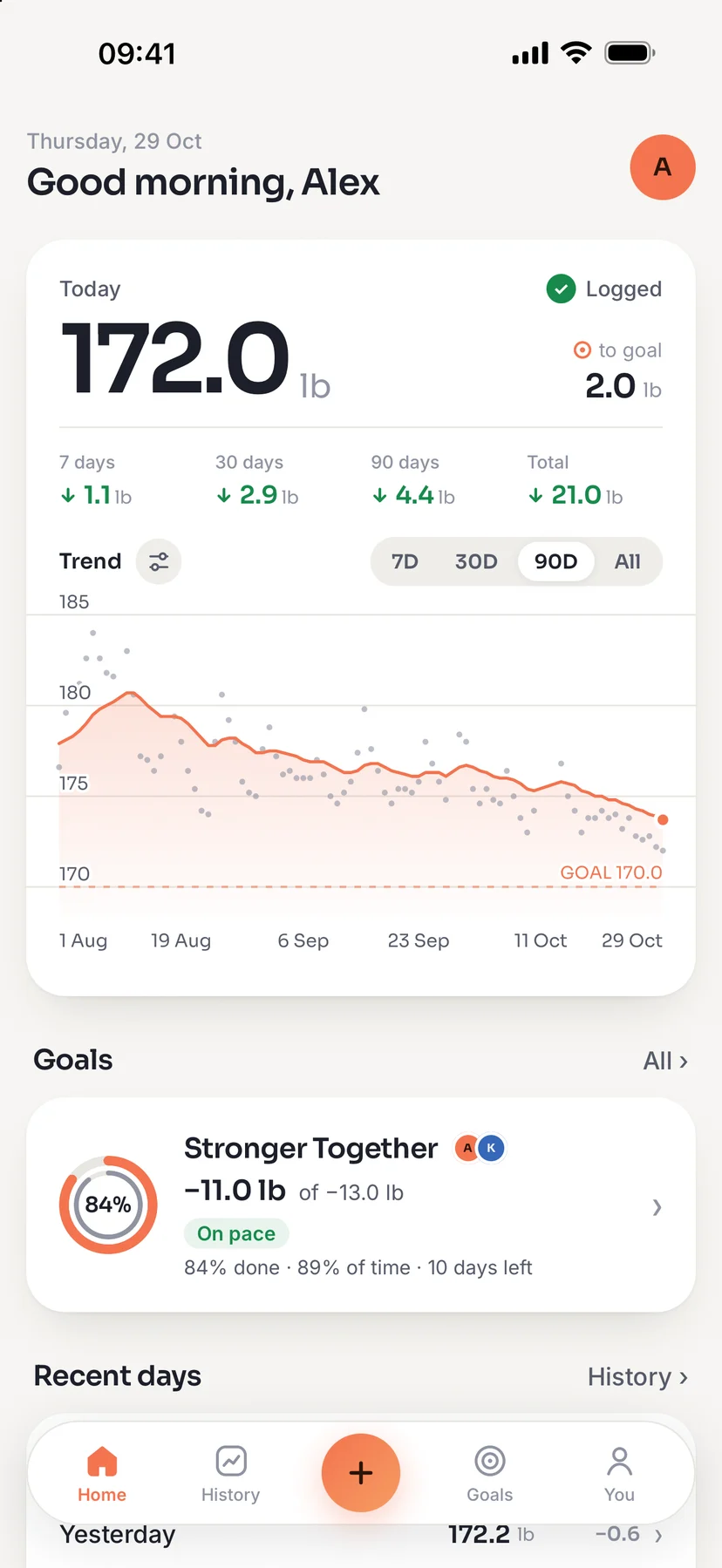
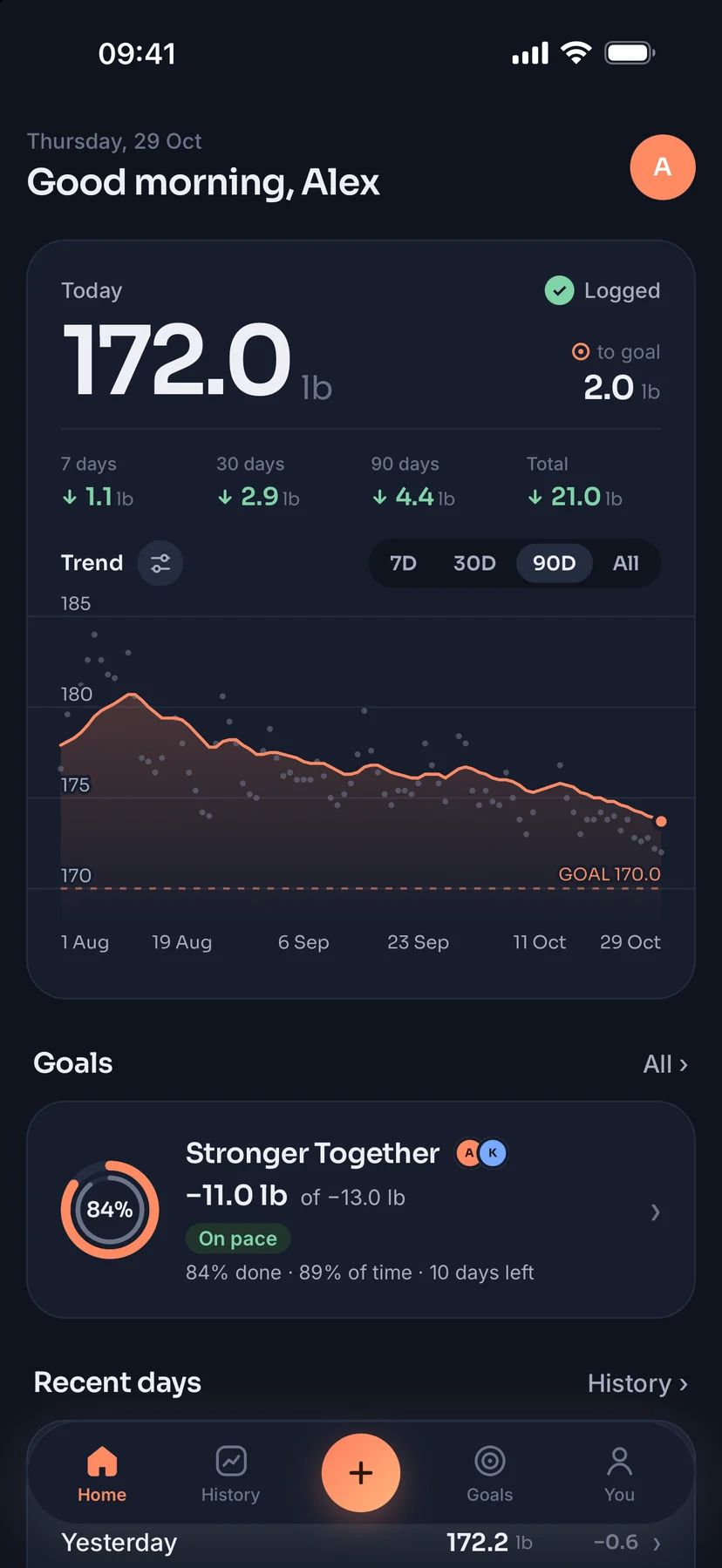
- No streaks. Weight Tracker never counts days in a row, so weighing weekly or monthly costs you nothing.
- An optional reminder. Set one daily reminder at a time you choose, or none. It skips days you have already logged.
- Charts that fit any rhythm. The trend connects the days you did log, and comparisons use your nearest earlier log.
Questions
Is it OK to weigh yourself every day?
For most adults, yes. Research mostly finds regular weighing is not linked to harm, and daily weighing works well if you compare weekly averages instead of single mornings. If the number changes how you eat or feel, weigh less often.
How often should you weigh yourself when trying to lose weight?
Weekly is what most health bodies suggest, and daily or a few times a week works too. A 2015 meta-analysis found no significant difference between daily and weekly weighing, so pick the rhythm you can keep.
How often should you weigh yourself to keep weight off?
The CDC lists recording your weight once a week among its tips for keeping weight off. In the US National Weight Control Registry, people who weighed themselves less often over time regained more weight.
What day of the week is best for a weekly weigh-in?
In one large study, weight was highest on Monday and lowest on Friday, after rising slightly over weekends, so Monday readings can run high. Whichever day you pick, keep it the same each week.
Can weighing yourself too often be bad for you?
For some people. A 2015 review found negative associations mostly among women and younger people. If weighing affects how you eat or feel, weigh less often or stop, and talk to a healthcare professional.
Why do doctors tell some people to weigh every day?
Some conditions, such as heart failure, can cause fluid to build up, and a quick rise on the scale can be an early sign. If your care team has given you a daily weighing plan, follow it, including when to contact them.
Sources
Show all 17 sourcesHide sources
- NHS England. How to record your weight. Published 1 December 2023.
- CDC. Tips for keeping weight off. 15 November 2023.
- NIDDK. Treatment for overweight and obesity. Reviewed May 2023.
- Harvard Health. Device of the month: body-weight scale. 1 March 2024.
- Cleveland Clinic. 7 possible reasons why your weight fluctuates. 26 July 2024.
- Cleveland Clinic. The best time to weigh yourself. 12 June 2023.
- Zheng Y, et al. Self-weighing in weight management: a systematic literature review. Obesity 2015;23(2):256–265. doi:10.1002/oby.20946.
- Madigan CD, et al. Is self-weighing an effective tool for weight loss: a systematic literature review and meta-analysis. IJBNPA 2015;12:104. doi:10.1186/s12966-015-0267-4.
- Steinberg DM, et al. The efficacy of a daily self-weighing weight loss intervention using smart scales and e-mail. Obesity 2013;21(9):1789–1797. doi:10.1002/oby.20396.
- Butryn ML, et al. Consistent self-monitoring of weight: a key component of successful weight loss maintenance. Obesity 2007;15(12):3091–3096. doi:10.1038/oby.2007.368.
- Benn Y, et al. What is the psychological impact of self-weighing? A meta-analysis. Health Psychology Review 2016;10(2):187–203. doi:10.1080/17437199.2016.1138871.
- Pacanowski CR, et al. Self-weighing: helpful or harmful for psychological well-being? A review of the literature. Current Obesity Reports 2015;4(1):65–72. doi:10.1007/s13679-015-0142-2.
- Gorin AA, et al. Eating pathology and psychological outcomes in young adults in self-regulation interventions using daily self-weighing. Health Psychology 2019;38(2):143–150. doi:10.1037/hea0000689.
- University Hospitals. How often should you weigh yourself? October 2026.
- Fuller N. How often should you really weigh yourself? The Conversation, 1 July 2024.
- Heart Failure Matters (Heart Failure Association of the ESC). Rapid weight gain: a key sign of fluid retention. No date given.
- Turicchi J, et al. Weekly, seasonal and holiday body weight fluctuation patterns among individuals engaged in a European multi-centre behavioural weight loss maintenance intervention. PLoS One 2020;15(4):e0232152. doi:10.1371/journal.pone.0232152.
This guide is general information, not medical advice. If weighing yourself affects how you eat or feel, talk to a healthcare professional.