How much weight do you gain on your period?
Less than many people expect, on average. Kanellakis and colleagues weighed 42 women twice a week through a full cycle. Their weight was 0.45 kg, about 1.0 lb, higher during their periods than in the first week of the menstrual cycle, as the study defined it. Almost all of that matched an increase in extracellular water, the fluid held outside the cells. Nothing else in their body composition changed significantly.
Not everyone sees a change. Thompson and colleagues followed 17 women with a natural cycle and 30 taking a combined pill, and found no significant change in body weight across either cycle. The studies disagree, so your own weigh-ins over a few cycles show your pattern best.
Some people see more than the average. Nick Fuller of the University of Sydney writes that women may temporarily gain 0.5 to 2 kg (about 1 to 4.4 lb) from fluid retention in the second half of the cycle (The Conversation, 2024). If your rise is in that range and drops back within a few days of your period starting, it fits the usual pattern.
When period weight gain starts
It builds in the days before your period. In a year-long study of 62 women, White and colleagues found self-reported fluid retention was lowest in the middle of the first half of the cycle, rose gradually over the 11 days around ovulation, and peaked on the first day of flow. That study asked women how they felt rather than weighing them, so it shows the timing of fluid retention, not a number on the scale.
That matches what the US Office on Women’s Health says about premenstrual symptoms in general: they usually show up about a week or two before a period. More than 90% of women say they get some premenstrual symptoms, such as bloating.
When does period weight go away?
Usually within a few days of your period starting. Fluid retention falls after the first day of flow, and the Office on Women’s Health says premenstrual symptoms go away within a few days after a period starts.
If your weight drifts back down over the week after your period starts, that was water, not a change in fat.
Middle of the first half of the cycle
Fluid retention is at its lowest.
White and colleagues, from how 62 women felt over a year.
Around ovulation
Fluid retention rises gradually over about 11 days.
Same study.
A week or two before the period
Premenstrual symptoms such as bloating often show up.
US Office on Women’s Health.
Day 1 of the period
Fluid retention peaks.
In a study that weighed 42 women, weight was about 0.45 kg (1.0 lb) higher during their periods than in the first week of the cycle as the study defined it, almost all of it water.
A few days in
Fluid retention falls, and premenstrual symptoms usually go away.
White and colleagues; US Office on Women’s Health.
Why it happens
| Cause | What happens |
|---|---|
| Water | Fluid retention rises in the second half of the cycle and peaks on the first day of a period. In the study that weighed women through a cycle, the extra weight was almost all water held outside the cells. |
| Bloating | The NHS notes that some people feel bloated around the time of their period. |
| Appetite | A 2025 review of 15 datasets found people ate more in the second half of the cycle, about 168 kcal a day on average, though methods varied between studies. |
| Constipation | The US Office on Women’s Health lists constipation or diarrhea, and bloating, among physical PMS symptoms. Stool that has not passed yet adds to the morning reading. |
| Salt | Salty food makes the body hold more water at any time of the month. The US Office on Women’s Health suggests cutting back on salt in the two weeks before a period. |
None of these is a quick gain in fat. The water weight guide explains why fluid moves the scale so easily, and the weight fluctuation guide covers the everyday swings on top.
A sample cycle, day by day
Here is a made-up stretch of morning weigh-ins, from day 21 of one cycle to day 7 of the next. Day 1 is the first day of the period. Nothing else changed.
From day 21 the readings creep up to 151.4 lb on day 1, about 1.4 lb above the lowest reading before it. Over the next few days they fall back, and by day 7 the reading is 149.9 lb, slightly below where it began.
Comparing day 28 with day 7 would suggest a loss of 1.2 lb in a week, and comparing day 7 with the next day 1 would suggest a gain. Neither is real. The fair comparison is the same cycle day each month, or a weekly average over the same week of your cycle. In this sample, days 1 to 7 average 150.6 lb, the number to set against days 1 to 7 of the next cycle.
Should you weigh yourself on your period?
You can. A few habits keep the number useful:
- Weigh the same way as always. Morning, after the bathroom, before eating or drinking. See the best time to weigh yourself.
- Expect the bump. A higher reading in the days before and at the start of your period is normal and usually water.
- Compare like with like. Line up the same week of your cycle from month to month. A 30-day comparison often lands close to the same point in a cycle of about four weeks.
- Skip it if it bothers you. Leaving out the days around your period is fine. A gap is not a failure.
If you are working toward a goal, a monthly rhythm like this is one reason the weight loss calculator by date shows a normal range around your plan rather than a single line.
What may help
You do not need to fix a few days of water. If the bloating is uncomfortable, general advice for premenstrual symptoms may help:
- Go easy on salt. The Office on Women’s Health suggests avoiding foods and drinks with caffeine, salt, and sugar in the two weeks before your period.
- Stay active. Both the NHS and the Office on Women’s Health suggest regular exercise for premenstrual symptoms.
- Sleep. The NHS lists getting plenty of sleep among its self-help steps.
- Keep a diary. The NHS suggests tracking symptoms for at least two cycles, which also shows your own pattern on the scale.
Water pills (diuretics) are medicines, not a way to lose weight. The Office on Women’s Health notes they may reduce bloating.
When to talk to a doctor
The NHS advises seeing a GP if premenstrual symptoms affect your daily life or lifestyle changes have not helped. For bloating, it advises seeing a GP if you feel very bloated, you are often bloated, or it does not go away. Bloating that does not follow your cycle, or a weight that keeps rising from one month to the next, is worth checking too.
Severe PMS symptoms may be a sign of premenstrual dysphoric disorder (PMDD), which the Office on Women’s Health says affects less than 5% of women of childbearing age (womenshealth.gov).
Reading the trend through a period
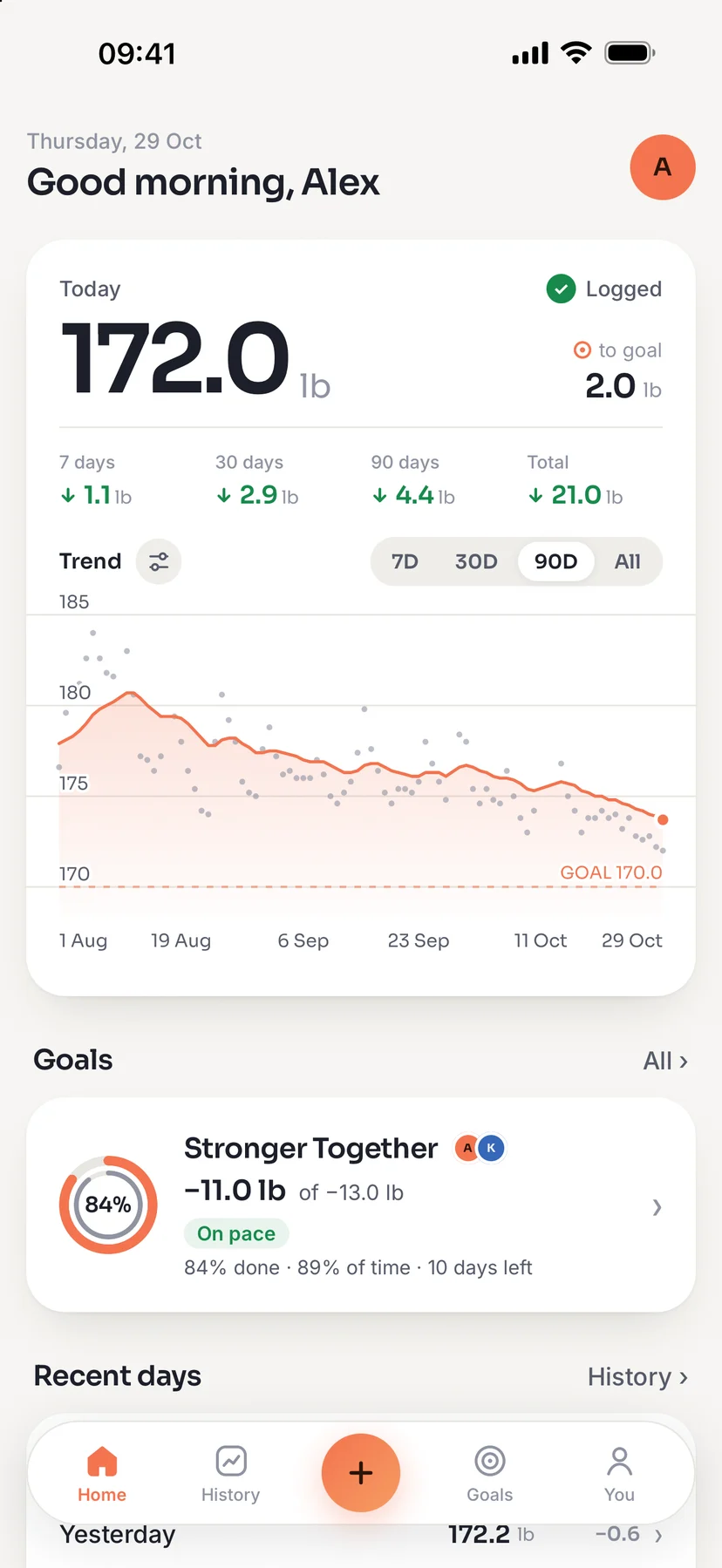
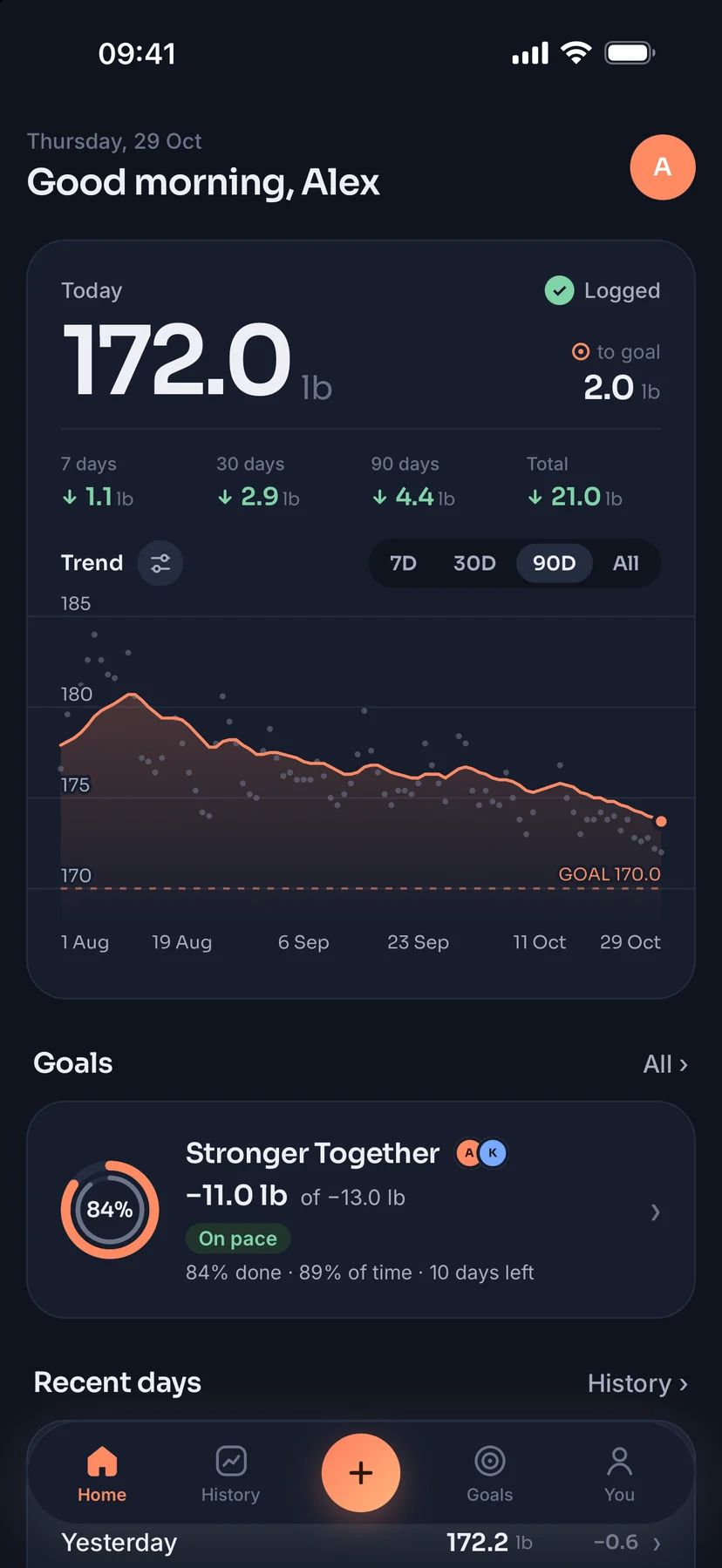
Weigh as usual through your period. Weight Tracker keeps every reading in History, so you can look back at the same days of last month’s cycle instead of the week before.
Weight Tracker also shows how your smoothed trend has changed over 7, 30, and 90 days and charts your daily values over any period, so a higher week sits next to the weeks around it. See weight history and trends.
Questions
Do you gain weight before your period?
Often, a little. In one study women felt fluid retention build through the second half of the cycle and peak on the first day of the period, and a separate study that weighed women found weight was higher during their periods. Most of it is water and goes within a few days.
How much weight do you gain on your period?
On average, not much. A study that weighed 42 women twice a week found weight was about 0.45 kg (1.0 lb) higher during their periods than in the first week of the menstrual cycle, as the study defined it, almost all of it water. Some people see more, some see none.
When does period weight go away?
Usually within a few days of your period starting. Fluid retention peaks on the first day of flow and falls after that, and the US Office on Women’s Health says PMS symptoms usually go away within a few days after a period starts.
Do you gain weight during ovulation?
Some people feel it. In a year-long study of 62 women, self-reported fluid retention increased gradually over the 11 days around ovulation, though it stayed lower than on the first day of a period. The study recorded how women felt, not their weight.
Is period weight gain fat?
Mostly not. In the study above, the extra weight during periods matched an increase in water held outside the cells. Fat changes slowly and shows up as a trend that keeps going over several weeks.
Does the pill change period weight gain?
It may not show much either way. A study of 30 women on a combined pill and 17 with a natural cycle found no significant changes in body weight across either cycle. Everyone is different, so your own weigh-ins are the best guide.
Should I weigh myself on my period?
You can. Weigh the same way as always and expect a slightly higher reading. If it bothers you, skip those days. To compare fairly, look at the same point in your cycle from one month to the next.
Sources
Show all 9 sourcesHide sources
- Kanellakis S, Skoufas E, Simitsopoulou E, et al. Changes in body weight and body composition during the menstrual cycle. Am J Hum Biol 2023;35(11):e23951. PMID 37395124.
- White CP, Hitchcock CL, Vigna YM, Prior JC. Fluid retention over the menstrual cycle: 1-year data from the Prospective Ovulation Cohort. Obstet Gynecol Int 2011;2011:138451. PMC3154522.
- Thompson BM, Hillebrandt HL, Sculley DV, Barba-Moreno L, Janse de Jonge XAK. The acute effect of the menstrual cycle and oral contraceptive cycle on measures of body composition. Eur J Appl Physiol 2021;121(11):3051–3059. PMID 34296342.
- Tucker JAL, McCarthy SF, Bornath DPD, Khoja JS, Hazell TJ. The effect of the menstrual cycle on energy intake: a systematic review and meta-analysis. Nutr Rev 2025;83(3):e866–e876. PMC11819481.
- Office on Women’s Health. Premenstrual syndrome (PMS). Updated 26 September 2025.
- Fuller N. How often should you really weigh yourself? The Conversation, 1 July 2024.
- NHS. Periods.
- NHS. PMS (premenstrual syndrome). Reviewed 18 June 2024.
- NHS. Bloating. Reviewed 21 January 2026.
This guide is general information, not medical advice.