What a weight loss plateau is
A plateau is a stretch of weeks when your weight stops going down even though you are doing what worked before. Cleveland Clinic calls it perfectly normal, something that happens to pretty much everyone, at different points for different people.
Research shows the same shape again and again. In a review of weight loss studies, Hall and Kahan describe early, faster weight loss that stalls after several months, usually within the first year, and is then followed by slow regain for many people.
If you have only just started and the scale has not moved, the reasons may be different. See why am I not losing weight?
How long does a plateau last?
There is no standard length. An endocrinologist interviewed by Cleveland Clinic puts it simply: people plateau at different points, and it depends on your body. She also notes that it can take three to five years for the body to settle at a new weight after weight loss. That is the body as a whole, not one plateau, but it shows why weight loss is a long process.
Hall and Kahan’s explanation helps here. A plateau is the point where rising appetite and a lower energy need catch up with your current habits. Nothing about that point has a timer. In the studies they reviewed, many people slowly regained after it, so holding steady is worth something in itself. Moving on from it means something has to change: your habits, your routine, or your goal, if you decide to hold the weight you have reached.
Our rule of thumb, not a medical definition: call it a plateau once your weekly average has not moved for three to four weeks while you weigh the same way. Before that, it is more likely normal day-to-day noise.
Is it a real plateau, or just noise?
Weight can move by 2 to 3 lb either way from day to day with water and food, according to Cleveland Clinic, so a flat week on its own tells you very little. A plateau shows up in your weekly averages, not in single mornings.
In this sample, losses get smaller from week 2 to week 4, then the weekly average stays within 0.1 kg for three weeks. That is a plateau. A single high Monday would not be.
Before you call it, rule out the usual noise. See how much weight fluctuates in a day, water weight, and the best time to weigh yourself. If the scale then drops suddenly after a stall, see the whoosh effect.
Why weight loss stalls
| Reason | What happens |
|---|---|
| Appetite rises | An estimate cited by Hall and Kahan puts it this way: for each kilogram lost, appetite rises by about 100 calories a day above where it started. Over time that pulls eating back up, often without anyone noticing. |
| A smaller body uses less | A lighter body needs less energy, by about 20 to 30 calories a day per kilogram lost in the same estimate, so the same habits take off less each week. |
| Some muscle goes too | Mayo Clinic notes that as you lose weight you lose some muscle along with fat, and lower muscle mass slows your metabolism. |
| Habits drift | Effort is hard to keep at the level of the first weeks. Portions, snacks, drinks, and activity change a little at a time. |
| Sleep and stress | The NIDDK links not getting enough sleep with weight gain, and lists long-term stress among the health problems that may lead to weight gain. |
| Water hides fat loss | Salt, a period, a hard workout, or a few days of different food can hold water and mask a real change for a while. |
The numbers are lopsided. After losing 10 kg, Hall and Kahan’s estimate puts the drop in energy use at about 200 to 300 calories a day, but the rise in appetite at about 1,000. They suggest that appetite, more than a slowing metabolism, is likely the main reason weight loss levels off. Cleveland Clinic describes the same pushback: the body treats weight loss as a threat and raises hunger.
The weight loss planner reflects that slowdown with a simple curve by default, rather than a straight line. In a sample plan from 100 kg to 80 kg that starts at 0.5 kg a week, the eased plan ends at about 0.40 kg a week and takes about 45 weeks instead of 40. The plan already expects a slower last stretch, so reaching one does not mean you are failing.
Free toolWeight loss calculator by dateSee a plan that eases off as you lose, so a slower stretch near the end is already in your dates.Plan with an eased paceWhat can help
- Check that it is real. Weigh at the same time each day and compare weekly averages over three to four weeks before deciding. The printable weight loss tracker has a row for each week’s average and a 12-week chart, so a flat stretch is easy to see.
- Look honestly at the small things. Since appetite rises quietly, portions, snacks, and drinks tend to creep up. A week of writing things down often shows where.
- Keep moving, and keep it steady. Cleveland Clinic suggests more exercise as the best way past a plateau, and consistency with eating habits rather than big changes. For a sense of scale, the CDC says adults need 150 minutes of moderate-intensity physical activity a week, plus at least 2 days of muscle-strengthening activity.
- Expect strength training to show on the scale. Cleveland Clinic notes that exercise, particularly strength training, can lead to short-term weight gain from added muscle. Give it a few weeks before reading too much into it. The weight gain after exercise guide explains what adds the weight and how long it lasts.
- Look after sleep and stress. They are easy to overlook, and the NIDDK links both to weight gain.
- Reset the timeline, not the goal. A slower pace near the end is expected. Moving a target date is easier to live with than a plan you cannot keep.
- Ask whether the goal still fits. Mayo Clinic suggests appreciating the weight you have lost and asking whether the number you are aiming for is realistic for you. Holding a lower weight is a result worth keeping.
- Count holding steady as progress. Keeping weight off is hard; a stable weight after a loss is an achievement in itself. A maintenance range can make that visible.
When to talk to a professional
Talk to a doctor if your weight stalls or rises with no change in your habits, if you have other new symptoms, or if you take a medicine that can affect weight. A doctor or registered dietitian can also help you decide whether to keep losing or to hold where you are. The guide on why you might not be losing weight covers medicines and health conditions in more detail.
Checking a plateau on the 90-day change
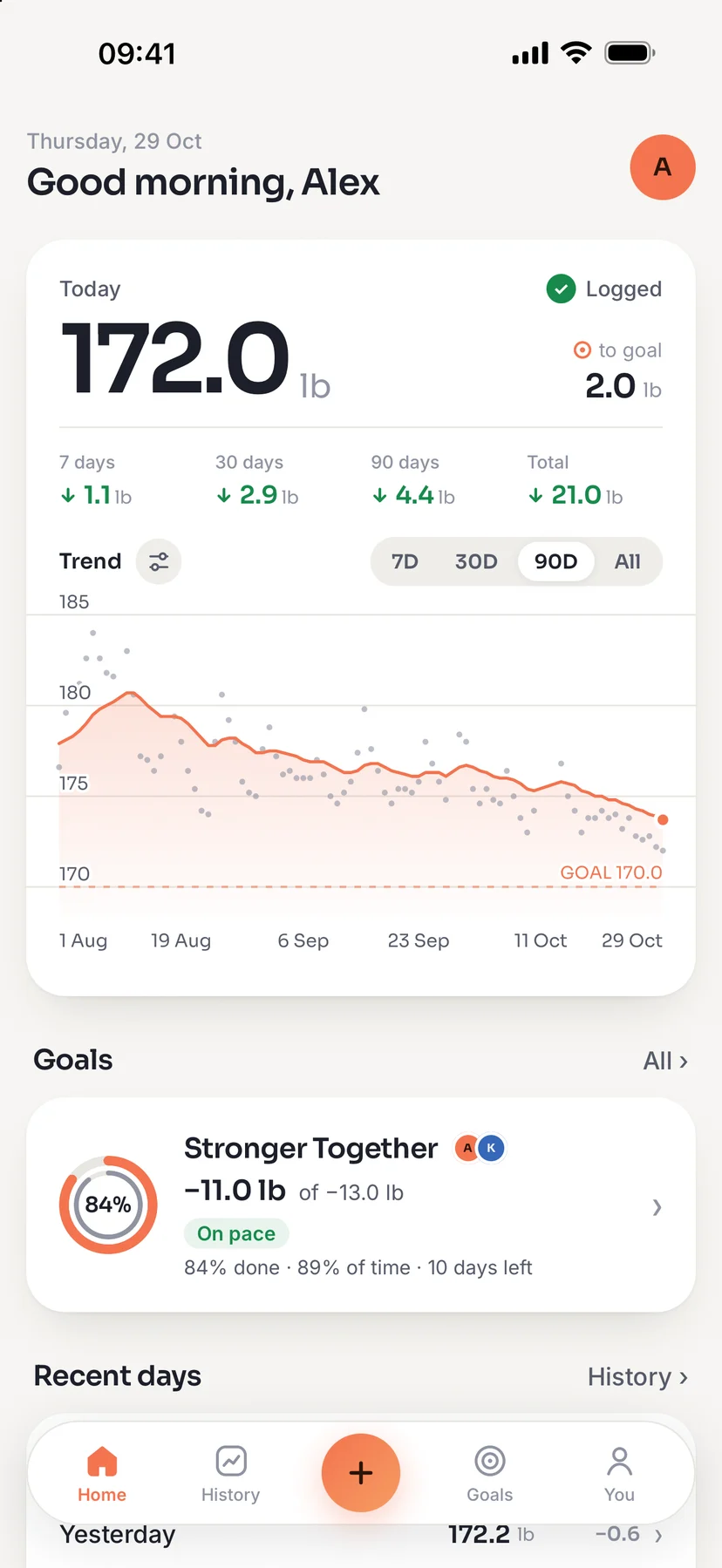
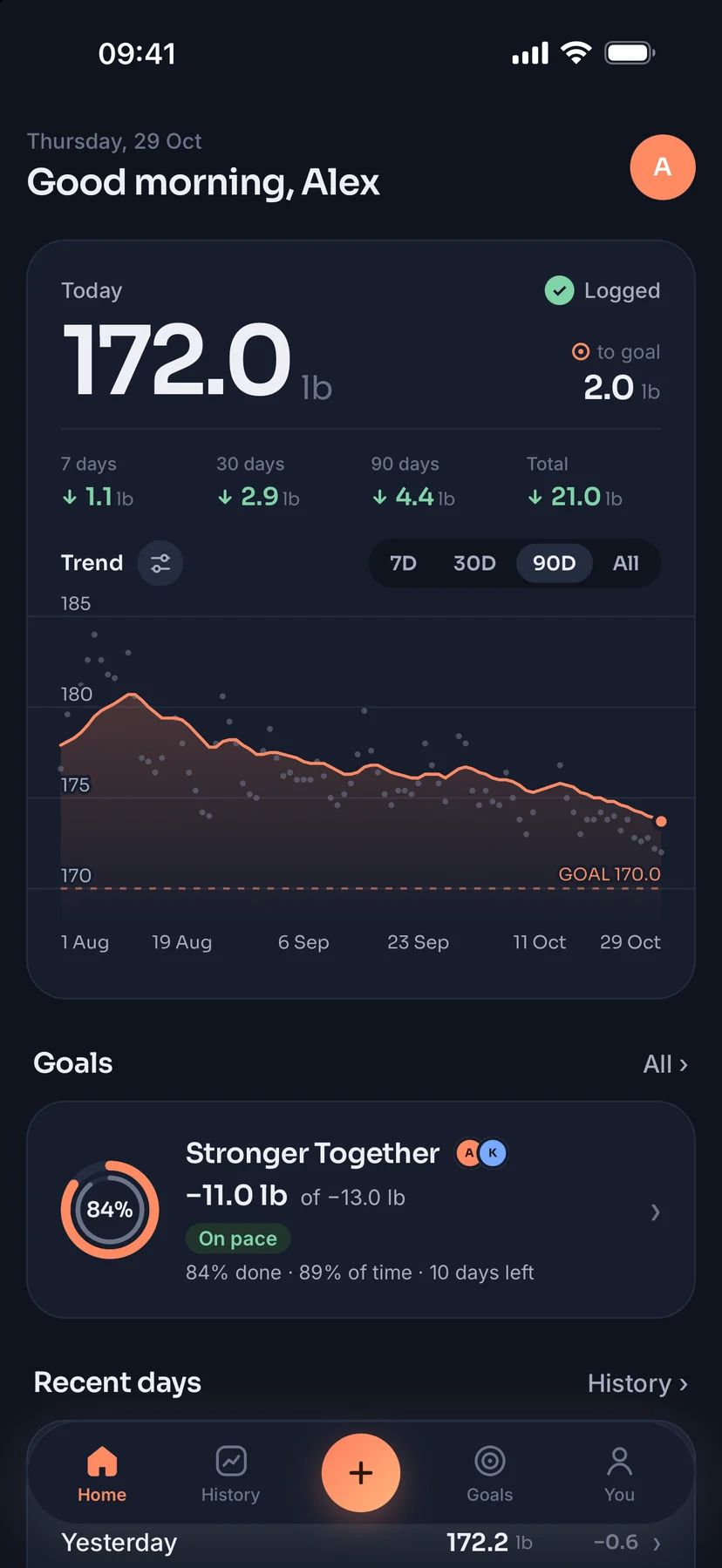
Weight Tracker shows how your smoothed trend has changed over 7, 30, and 90 days, so you can see whether a stall is real before you change anything. If it is, you can pause your goal while you work out what to change, or switch to a maintenance range and count holding steady as progress. See weight history and trends and personal goals.
Questions
How long does a weight loss plateau last?
There is no set length. Cleveland Clinic notes that people plateau at different points. Separately, it says the body can take three to five years to settle at a new weight after weight loss, which is not the same as how long a plateau lasts. To tell a plateau from normal swings, a practical rule is to wait until your weekly average has been flat for three to four weeks.
Is a weight loss plateau normal?
Yes. Cleveland Clinic calls it perfectly normal, and in weight loss studies the same pattern shows up again and again: faster loss early on that stalls after several months, usually within the first year.
Has my metabolism slowed down?
A little. A smaller body uses less energy, about 20 to 30 calories a day per kilogram lost in an estimate Hall and Kahan cite. The same estimate has appetite rising by about 100 calories a day per kilogram, so after 10 kg the rise in appetite is several times bigger than the drop in energy use.
How do you break a weight loss plateau?
Check that it is real first, using weekly averages over three to four weeks. Cleveland Clinic suggests more exercise and steady eating habits rather than big changes, and a week of writing down what you eat and drink often shows where small things have crept up.
Why did my weight go up when I started exercising more?
Cleveland Clinic says exercise, particularly strength training, can lead to short-term weight gain from added muscle. Give it a few weeks and judge by your weekly average rather than single mornings.
Sources
Show all 6 sourcesHide sources
- Hall KD, Kahan S. Maintenance of lost weight and long-term management of obesity. Med Clin North Am 2018;102(1):183–197. PMC5764193.
- Cleveland Clinic. How to break that frustrating weight-loss plateau. 2 February 2022.
- Cleveland Clinic. 7 possible reasons why your weight fluctuates. 26 July 2024.
- CDC. Adult activity: an overview. 20 December 2023.
- Mayo Clinic. Getting past a weight-loss plateau.
- NIDDK. Factors affecting weight and health. Reviewed May 2023.
This guide is general information, not medical advice.