The short answer
Divide 50 by the pounds you expect to lose each week. The CDC says people who lose weight at a gradual, steady pace of about 1 to 2 pounds a week are more likely to keep it off. At 2 pounds a week, 50 pounds takes 25 weeks (5.8 months); at 1 pound a week, 50 weeks (11.5 months). In kilograms, 50 pounds is about 22.7 kg, and the NHS’s 0.5 to 1 kg a week gives about 23 to 45 weeks.
Over most of a year, a straight line is the wrong shape. The weekly loss gets smaller as your weight falls, and life adds holidays, illness, and busy months. The rest of this guide plans for that. For other amounts, see how long it takes to lose 10 to 100 pounds and the shorter 30-pound timeline.
How your starting weight changes the answer
Fifty pounds is about a fifth of a 250-pound body and about a seventh of a 350-pound one. If you set your pace as a share of your weight, as the planner’s presets do, the starting weight changes the timeline a lot:
| Start | 50 lb is | At 0.5% a week | At 1% a week |
|---|---|---|---|
| 220 to 170 lb | 22.7% | 52 weeks11.9 months | 26 weeks5.9 months |
| 250 to 200 lb | 20.0% | 45 weeks10.3 months | 22 weeks5.1 months |
| 280 to 230 lb | 17.9% | 39 weeks9.1 months | 20 weeks4.5 months |
| 300 to 250 lb | 16.7% | 36 weeks8.4 months | 18 weeks4.2 months |
| 350 to 300 lb | 14.3% | 31 weeks7.1 months | 15 weeks3.6 months |
Both columns use the planner’s eased path, which keeps the same share of your weight each week. At 0.5% a week, the steady preset, 50 pounds takes about 52 weeks from 220 pounds and 31 from 350. At 1% a week, the faster preset, it is about 26 and 15 weeks: from a higher start, 1% a week is already more than 2 pounds, so treat it as an upper bound rather than a target.
Free toolWeight loss calculator by dateEnter your own start and goal, choose a pace, and see the date and the shape of the curve.Plan your 50 poundsHalfway is not half the time
Here is the planner’s eased path from 260 to 210 pounds, starting at 1.5 pounds a week. It reaches the goal in about 37 weeks, around 8.5 months, and by the end the weekly loss is down to about 1.2 pounds.
The first 25 pounds take about 18 weeks. The second 25 take about 19. That is the body adapting: a smaller body uses a little less energy, so the same routine takes off less each week. Hall and colleagues described this in their model of energy balance, and it is why the old 3,500-calories-per-pound rule predicts more loss than people see (Hall and Chow).
Knowing this in advance matters. Halfway at week 18 can feel like the finish is near, and a slower second half can feel like failure. It is neither: it is what the plan predicted. Open this plan in the calculator and change the numbers to yours.
Three goals instead of one
A goal that takes most of a year is easier as a few shorter ones, each with its own date and its own finish. The NIDDK gives losing 5% of your body weight over six months as an example of a good first goal, and the CDC says a loss of 5 to 10% may improve blood pressure, blood cholesterol, and blood sugar for people with overweight or obesity. That makes 5% and 10% natural stops. On the same eased path:
| Stage | From → to | Takes about | Done by week |
|---|---|---|---|
| Goal 1: the first 5% | 260.0 → 247.0 lb | 9 weeks | 9 |
| Goal 2: on to 10% | 247.0 → 234.0 lb | 9 weeks | 18 |
| Goal 3: the rest | 234.0 → 210.0 lb | 19 weeks | 37 |
The first two goals together are about 26 pounds and take about 18 weeks. Reaching them is a real result on its own, and a good point to look back at what is working before setting the last goal.
50 pounds by a deadline: the pace each one needs
| 50 lb in | Pace a week | Compared with the CDC range |
|---|---|---|
| 3 months | 3.8 lb | Faster than 2 lb a week |
| 4 months | 2.9 lb | Faster than 2 lb a week |
| 5 months | 2.3 lb | Faster than 2 lb a week |
| 6 months | 1.9 lb | Within 1 to 2 lb a week |
| 9 months | 1.3 lb | Within 1 to 2 lb a week |
| 12 months | 1.0 lb | Gentler than 1 lb a week |
Six months sits right at the top of the steady range, every week for half a year. Nine to twelve months leaves room for the slower second half and for ordinary life. Anything shorter than about six months asks for more than 2 pounds a week; the CDC warns that unrealistic goals can leave you feeling defeated, and the NIDDK says losing weight very quickly may raise the chance of gallstones.
When to involve a doctor
For a goal of 50 pounds, a doctor is worth seeing at the start. Many people with this goal have a BMI in the obesity range: for someone 5 feet 10 inches tall, going from 260 to 210 pounds takes BMI from about 37.3 to 30.1. The BMI calculator shows yours and the healthy range for your height.
- Medicines and conditions. The NIDDK names some medicines for depression and epilepsy, corticosteroids, and insulin, and conditions such as hypothyroidism and PCOS, among things that affect weight.
- Weight loss medicines. The NHS lists semaglutide, tirzepatide, and liraglutide, which reduce appetite, and orlistat among treatments, depending on your BMI and health. The timelines on this page assume lifestyle changes alone, so ask your prescriber what pace to expect.
- Surgery. The NHS describes weight loss surgery as an option for some people with a BMI of 40 or more, or between 35 and 40 with an obesity-related condition.
A year of tracking
- Weigh the same way, and compare weekly averages. Day to day the scale can swing by 2 to 3 pounds either way (Cleveland Clinic). Over a year that is a lot of noise; the weekly average is the signal. See weight fluctuation.
- Look back once a month. Compare this month’s average with last month’s. The free weight loss calendar puts a month on one page with a summary, and the weight loss tracker spreadsheet holds a year of weigh-ins and draws the trend.
- Expect stalls. Over a year, a few weeks without change are likely. Three or four flat weeks are the time to look closer; the plateau guide covers what helps.
- Plan for after. The CDC lists recording your weight once a week among its tips for keeping weight off. Keep weighing once you reach the goal.
Fifty pounds in Weight Tracker
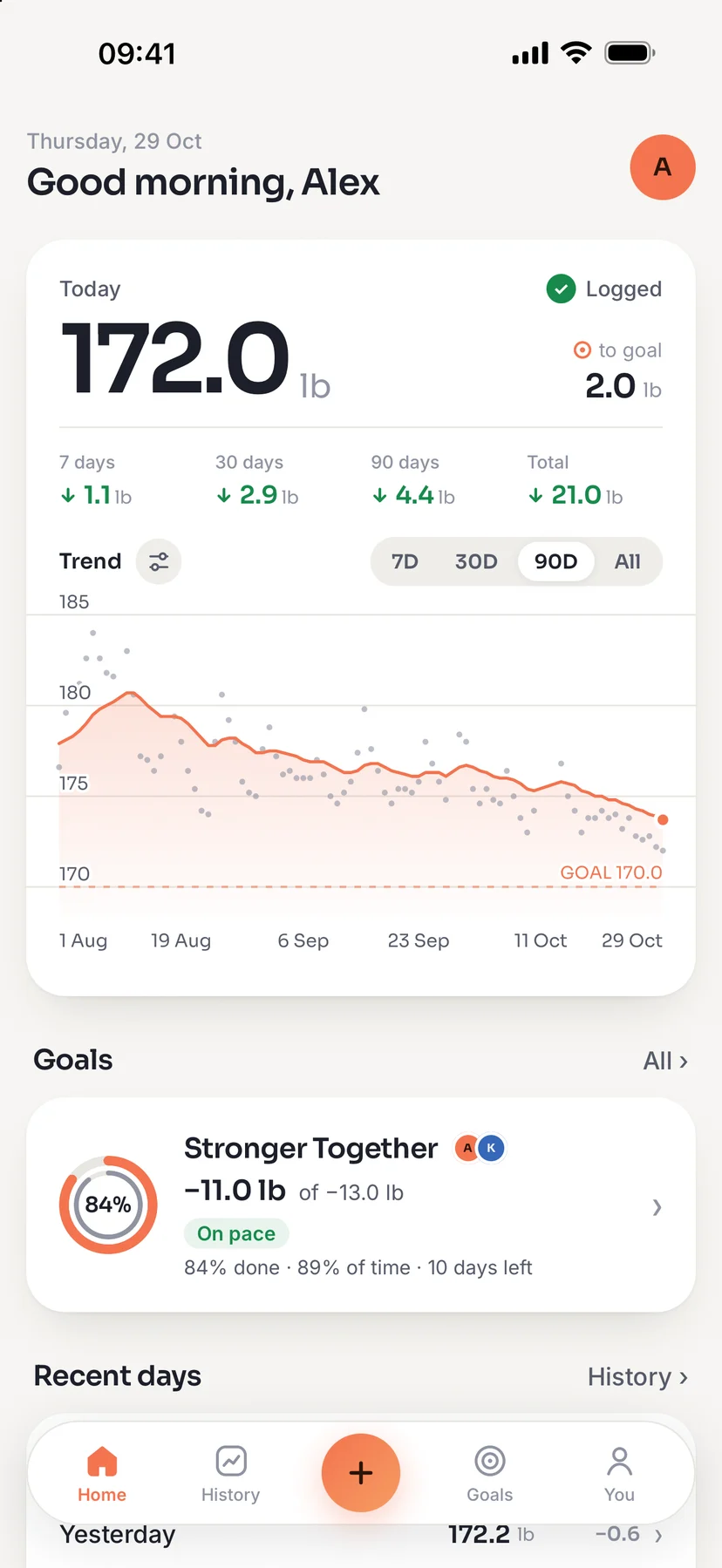
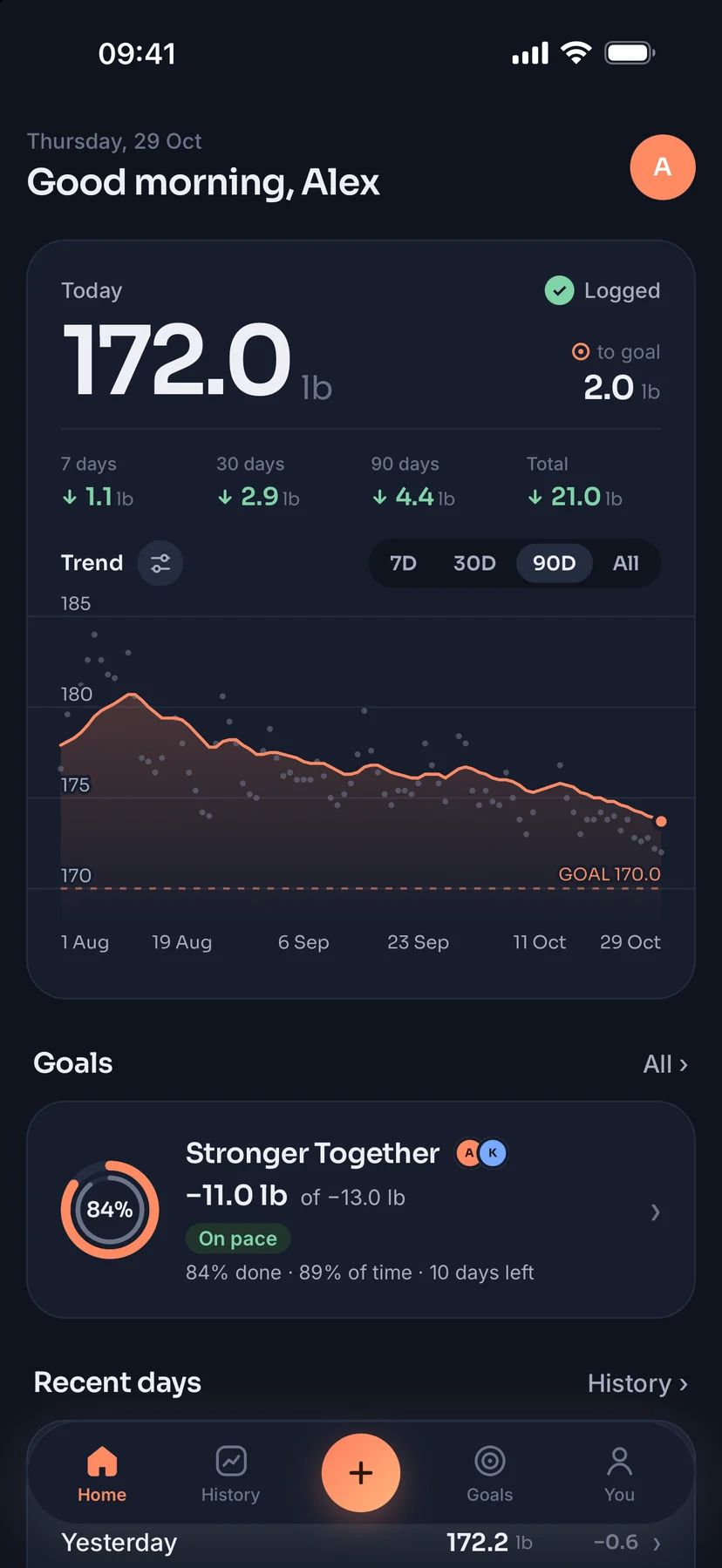
Set each stage as its own goal with a start and end date, and Pace shows each day whether you are ahead, on pace, or behind. See personal weight goals. If you already weigh on a smart scale, Weight Tracker can read your past weights from Apple Health, so the plan starts from your real trend. Once you are there, maintenance keeps you inside a range you choose.
85% of the goal reached
Questions
How long does it take to lose 50 pounds?
About 25 to 50 weeks, or 5.8 to 11.5 months, at the CDC’s steady 1 to 2 pounds a week. Because the weekly loss shrinks as you go, a realistic plan usually runs most of a year.
Can I lose 50 pounds in 6 months?
It needs about 1.9 pounds a week for 26 weeks, the very top of the CDC’s 1 to 2 pounds a week, held for half a year. It can happen, especially from a higher starting weight, but nine to twelve months is a pace most people can keep.
Is losing 50 pounds in 3 months possible?
It would take about 3.8 pounds a week, roughly twice the top of a steady pace. The NIDDK says losing weight very quickly may raise the chance of gallstones; a goal like this belongs in a plan made with a doctor.
How much is 50 pounds in kilograms, and how long does that take?
50 pounds is about 22.7 kg. At the NHS’s suggested 0.5 to 1 kg a week, that is about 23 to 45 weeks.
Why does the second half take longer than the first?
A smaller body uses a little less energy, so the same habits take off less each week. In the example on this page the first 25 pounds take about 18 weeks and the second 25 about 19.
Should I see a doctor before trying to lose 50 pounds?
It is a good idea. A doctor can check what is safe for you, look at medicines or conditions that affect your weight, and talk about treatments beyond lifestyle changes. The NHS lists weight loss medicines and, for higher BMIs, surgery among the options.
Sources
Show all 9 sourcesHide sources
- CDC. Steps for losing weight. 17 January 2025.
- CDC. Tips for keeping weight off. 15 November 2023.
- NHS. Overweight and obesity in adults. Reviewed 29 April 2026.
- NIDDK. Treatment for overweight and obesity. Reviewed May 2023.
- NIDDK. Factors affecting weight and health.
- NIDDK. Dieting and gallstones. Reviewed November 2017.
- Cleveland Clinic. 7 possible reasons why your weight fluctuates. 26 July 2024.
- Hall KD, Sacks G, Chandramohan D, et al. Quantification of the effect of energy imbalance on bodyweight. Lancet 2011;378(9793):826–837. PMID 21872751.
- Hall KD, Chow CC. Why is the 3500 kcal per pound weight loss rule wrong? Int J Obes 2013;37(12):1614. PMC3859816.
This guide is general information, not medical advice.